
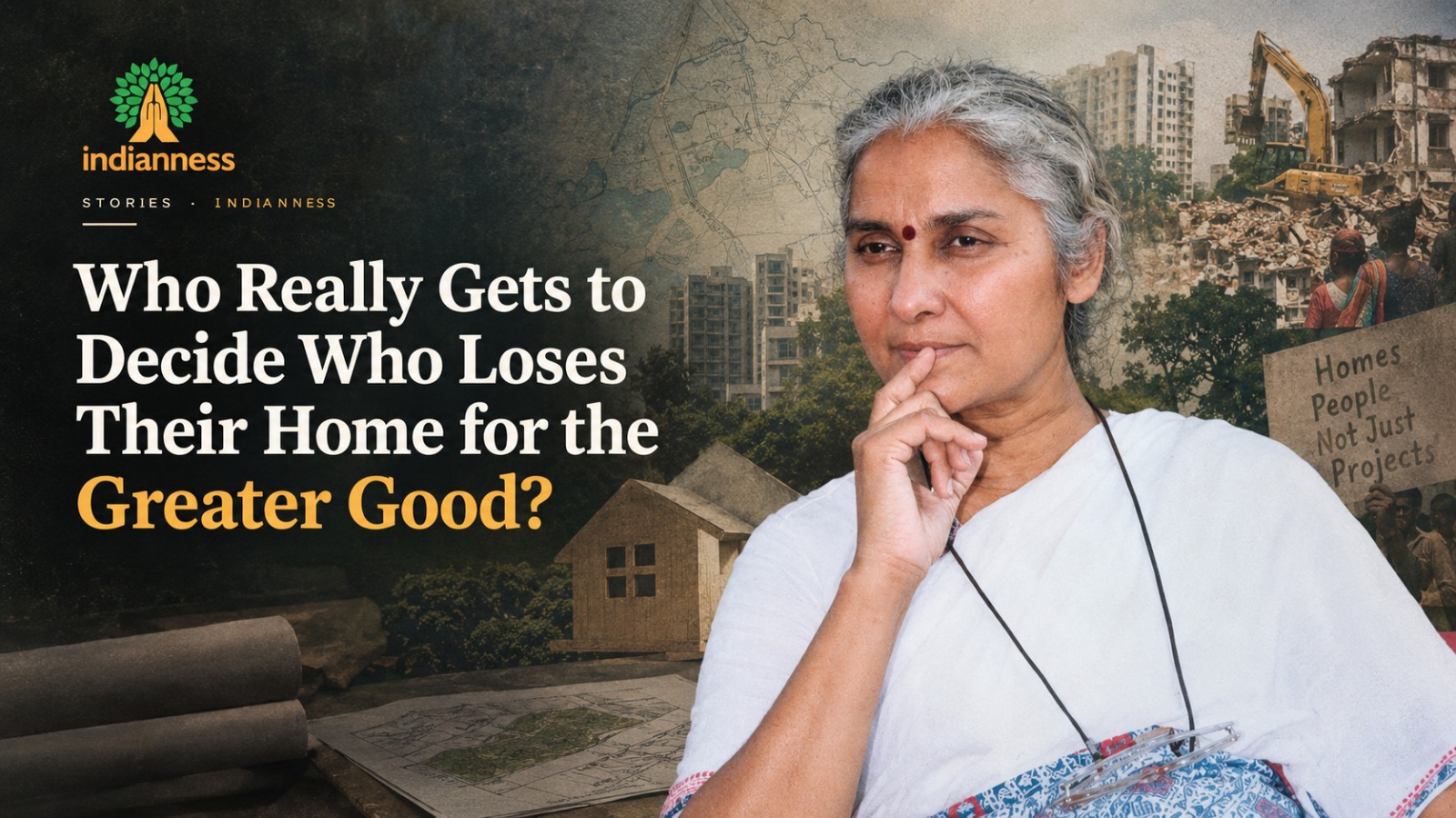
There’s a question buried inside almost every large infrastructure project that gets built anywhere in the world, and it’s rarely asked directly, let alone answered honestly: who actually gets to decide that a project’s overall benefits outweigh its costs, when the people who will bear those costs most directly — losing their homes, their farmland, their entire communities, sometimes with little or no meaningful say in the decision at all — are frequently not the same people who stand to receive the project’s benefits, and are often the very people with the least institutional power to influence the decision in the first place? Medha Patkar spent decades building a sustained, organised movement around exactly that question, in specific and direct opposition to a massive dam-building project on India’s Narmada River — and in doing so, she helped permanently reshape how large infrastructure projects, in India and increasingly in many other countries, are required to at least consider the people they physically and economically displace.
Patkar trained in social work before turning to full-time grassroots activism, and in 1985 she helped found the Narmada Bachao Andolan, generally translated as the “Save the Narmada Movement,” in direct response to the Sardar Sarovar Dam, one component within a genuinely massive, multi-decade planned network of large dams intended to be built along the Narmada River across the Indian states of Gujarat, Madhya Pradesh, and Maharashtra. The dam project’s stated benefits were substantial and, on their own terms, entirely genuine: significantly expanded irrigation capacity for agricultural land across multiple states, meaningful new hydroelectric power generation capacity, and improved, more reliable drinking water access for numerous towns and cities in the broader region.
The People Who Would Lose Everything Were Never Seriously Asked
What the dam’s official project planning had substantially failed to adequately address, in Patkar’s sustained and increasingly well-documented analysis, was the fate of the hundreds of thousands of people — a very large proportion of them from indigenous tribal communities and other already economically marginalised rural populations — who would be permanently displaced from their ancestral land and traditional livelihoods by the dam’s resulting reservoir. Many of these communities had lived in the specific river valleys slated for flooding for many generations, holding deep, direct cultural and economic ties to that particular land that no amount of financial compensation, however generous on paper, could genuinely or fully replace. The official resettlement and rehabilitation plans that governments had put forward were, by Patkar’s sustained and increasingly well-substantiated documentation, frequently inadequate in practice — offering displaced families land of demonstrably poorer agricultural quality than what they had originally lost, or in a substantial number of documented cases, providing genuinely insufficient compensation, or none at all.
The Narmada Bachao Andolan’s core organising strategy involved directly and sustainedly mobilising the affected communities themselves to demand meaningful participation in decisions that would permanently and irreversibly reshape their entire lives, rather than accepting the more typical top-down development model in which government planners and engineers determined a project’s overall costs and benefits in the abstract, and affected communities were then simply informed, after the fact, of a decision that had already been finalised without their meaningful input. Patkar and the movement organised sustained protests, engaged in extended and repeated hunger strikes, and pursued a genuinely determined, years-long legal campaign challenging the dam’s construction and specifically demanding substantially more comprehensive and fair resettlement provisions for the communities the project would inevitably displace.
A Legal and Political Battle That Stretched Across Decades
The movement’s efforts led to genuinely significant, if ultimately partial and contested, outcomes. The World Bank, which had originally committed substantial funding to the broader Narmada dam project, withdrew its financial support in 1993 following an independent review that substantiated many of the movement’s core concerns regarding inadequate resettlement planning and unaddressed environmental impact. India’s Supreme Court became directly involved in extended, multi-year litigation over the dam’s construction, at various points ordering construction halts pending further, more adequate resettlement measures, though the court ultimately allowed the dam’s construction to proceed to completion, with revised but still, in Patkar’s ongoing assessment, imperfect and incomplete resettlement provisions attached.
The Sardar Sarovar Dam was, in the end, built and completed, despite the movement’s sustained, decades-long opposition — a genuinely difficult, complicated, and by no means unambiguously triumphant outcome for a movement that had fought so hard and for so long. But the broader legacy of the Narmada Bachao Andolan extends meaningfully beyond the specific, final fate of that one particular dam. It significantly strengthened both legal requirements and broader public and institutional expectations, in India and internationally, around environmental impact assessment and resettlement planning for large infrastructure projects generally — establishing considerably more forcefully than before that the people directly displaced by a major development project have a genuine, legitimate stake in shaping the decision-making process itself, and are not merely a logistical or budgetary problem to be managed and resolved after the fundamental decision to build has already been made elsewhere.
Refusing to Accept That “the Greater Good” Settles Everything
What makes Patkar’s decades of sustained work genuinely significant, well beyond the specific and ultimately incomplete outcome of the Narmada campaign itself, is the broader and more difficult underlying question it forced into sustained, serious public and institutional attention: large infrastructure projects are very often genuinely justified in aggregate economic and social terms, providing electricity, water, and irrigation to very large numbers of people who benefit substantially and legitimately from them. But that broader aggregate justification does not, on its own, automatically or adequately account for the specific, concentrated, and often devastating costs borne by a much smaller number of people, frequently among the very poorest and most politically marginalised populations in the entire country, whose homes, land, and traditional livelihoods are permanently destroyed to make those broader collective benefits possible for everyone else. Patkar’s sustained work insisted, consistently and often at real personal cost, that this specific trade-off must be actively confronted, seriously debated, and genuinely, substantively negotiated with the affected communities themselves — rather than simply assumed, dismissed, or waved away as an acceptable, unavoidable cost of broader national development.
A Question Development Planning Still Hasn’t Answered
This underlying and genuinely difficult question — precisely how large infrastructure projects should account for, meaningfully negotiate with, and fairly compensate the specific communities they displace, rather than simply asserting that aggregate net benefits sufficiently justify the resulting individual and community-level harm — remains a live, unresolved, and increasingly urgent issue in large-scale infrastructure and development planning around the world today, from dam projects in Africa and Southeast Asia to major urban redevelopment and infrastructure projects in wealthy countries. Patkar’s sustained decades of organising work on the Narmada River didn’t produce a fully satisfying resolution to that question — the underlying tension is, in its essential nature, genuinely difficult and may not admit any single, fully satisfying resolution at all — but it did succeed in making the question itself considerably harder for governments and large development institutions to simply avoid asking altogether, which is, in its own right, a form of genuine and lasting change.
Sources: Narmada Bachao Andolan institutional history and public campaign records; World Bank Independent Review of the Sardar Sarovar Projects (Morse Commission, 1992); Supreme Court of India rulings on the Narmada Bachao Andolan litigation.