
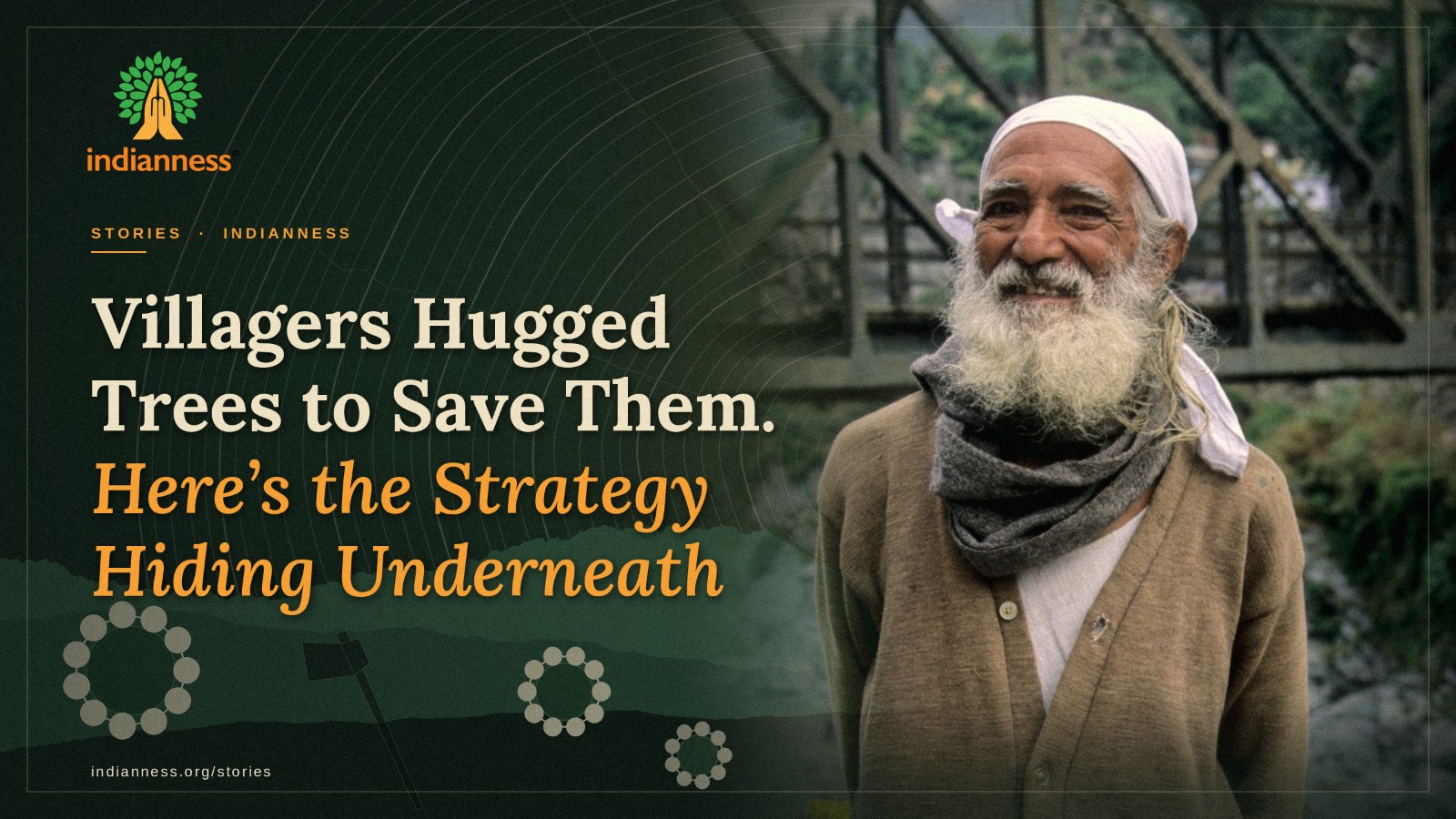
The image most people carry of the Chipko movement, if they know it at all, is a simple and genuinely moving one: villagers, many of them women, physically embracing trees to prevent loggers from cutting them down, willing to place their own bodies directly between the axe and the trunk. That image is accurate as far as it goes, and it captures something genuinely powerful about the movement’s underlying spirit and courage. But treating it as simply a spontaneous act of protest, arising purely from emotional attachment to trees, misses the more careful, more strategically considered ecological and economic argument that Sundarlal Bahuguna and other movement leaders built underneath that vivid, widely photographed image — an argument about water, soil, flooding, and who actually bears the concentrated, long-term costs when forests in a fragile mountain ecosystem are cleared primarily for the economic benefit of distant commercial interests.
Bahuguna, a Gandhian activist working in the Garhwal Himalayas region of what is now the Indian state of Uttarakhand, became one of the most prominent and consistently articulate voices of the Chipko movement, which emerged in the early 1970s in direct response to commercial logging operations that were rapidly, and with little regard for local consequence, clearing forests across the ecologically fragile Himalayan foothills. The movement’s name, “Chipko,” derives from a Hindi word meaning “to stick” or “to cling” — a direct, literal reference to the specific tactic of villagers physically embracing individual trees to prevent them from being felled by logging crews.
The Hard Science Hiding Beneath One Unforgettable Image
Bahuguna’s particular and lasting contribution to the broader Chipko movement was to develop and consistently, patiently articulate the underlying scientific and ecological reasoning connecting Himalayan deforestation directly to a specific, concrete cascade of very real downstream consequences: soil erosion in a naturally steep and geologically fragile mountain terrain, more frequent and considerably more severe landslides once the stabilising root systems of mature forest cover had been substantially removed, and significantly increased and more destructive flooding in river valleys and plains areas located well downstream of the actual logging sites — regions that would bear a very large share of these compounding, cascading consequences despite having received essentially none of the direct economic benefit that the original commercial logging operations generated.
This was a genuinely important and, at the time, still relatively novel argument for the specific ecological and geological context of the Himalayan region, and Bahuguna worked to ensure it reached well beyond the specific villages directly involved in individual tree-protection protests. He coined and consistently used the phrase “ecology is permanent economy” — a deliberately compact, memorable way of directly asserting that a forest’s genuine, lasting economic value, properly and fully understood, lay substantially in its ongoing ecological function of stabilising soil, regulating water flow, and preventing catastrophic and repeated downstream flooding and erosion damage, rather than merely in the immediate, one-time commercial value of its timber once it had been cut down and permanently removed. Cutting the forest down for short-term timber revenue, in this more complete accounting, wasn’t a neutral economic trade-off between competing legitimate interests at all — it was closer to a form of borrowing dramatically and irreversibly against a region’s genuinely permanent, long-term economic and physical safety in exchange for a comparatively small, one-time financial gain that accrued substantially to distant commercial interests rather than to the local communities left to bear the resulting long-term costs.
Walking Across an Entire Mountain Range to Make His Case in Person
Bahuguna undertook a genuinely long and physically demanding series of extended padyatras — long-distance foot marches undertaken specifically to build direct, sustained public awareness and organise local community support — walking across enormous stretches of the Himalayan region over multiple extended campaigns spanning literally thousands of kilometres in total distance covered, to speak directly and repeatedly with individual local villagers about the specific, concrete ecological argument underlying the broader movement, and to help build and sustain the kind of genuinely broad, geographically dispersed local support that ultimately allowed Chipko’s core tactics and underlying arguments to spread successfully well beyond the movement’s original starting villages.
This sustained, patient, direct organising work — walking from village to remote village, year after year, having the same essential, patient conversation repeatedly with local communities across an enormous and difficult mountainous terrain — represented a genuinely different, more painstaking and far less immediately dramatic kind of activism than the singular, visually powerful image of villagers embracing trees that later became the movement’s most widely recognised and internationally reproduced symbol. It was the less visible but arguably more foundational and more essential work of actually building the broad-based, geographically extensive local understanding and sustained local commitment that made the movement’s more visible, dramatic direct actions genuinely effective and durable over time, rather than a series of isolated, disconnected local incidents that outside commercial and political interests could simply wait out or work quietly around.
Winning a Fifteen-Year Ban That Reshaped a Nation’s Forest Policy
The Chipko movement’s sustained efforts achieved genuinely significant concrete policy results. In 1980, the Indian government imposed a fifteen-year ban on commercial tree-felling across large areas of the Himalayan forests in Uttar Pradesh, a very substantial and directly attributable victory for the movement’s sustained years of organising and advocacy, and one that Bahuguna’s direct advocacy work with national government officials, including extended personal appeals delivered directly to Prime Minister Indira Gandhi, played a significant and well-documented role in ultimately securing. The movement’s underlying core arguments and organising strategies also went on to directly influence broader Indian forest conservation policy in the years and decades that followed, and it became, over time, a widely cited and internationally studied example within global environmental movements — helping to popularise and legitimise the broader concept that indigenous and local communities, who typically hold the most direct, sustained, and consequential knowledge of and stake in their immediate local ecosystems, deserve genuinely serious, direct standing and voice in resource management and development decisions that will directly and lastingly affect them, rather than having those decisions made exclusively by distant government or commercial actors with comparatively little direct, lasting stake in the specific local consequences.
An Idea That Outgrew the Forests It Began In
Bahuguna’s specific, patient framing — that a fragile ecosystem’s genuine long-term value has to be measured honestly against the real, cascading, downstream costs of its degradation, rather than assessed solely by the immediate, one-time commercial value of directly extracting and selling its most obviously marketable natural resources — has become an increasingly foundational and increasingly urgent idea across environmental economics and conservation policy more broadly, well beyond the specific Himalayan forests where he first patiently, persistently developed and refined the argument. As climate change and large-scale ecosystem degradation have made the genuine, cascading long-term costs of exactly this kind of short-term extraction increasingly visible and increasingly costly on a truly global scale, Bahuguna’s decades-old, patiently walked-out and repeatedly explained argument feels considerably less like a specific, localised regional environmental protest from a particular place and time, and considerably more like an early, prescient, and increasingly vindicated articulation of a lesson the wider world is still, in many places, only beginning to fully and seriously learn.
Sources: Contemporaneous and retrospective accounts of the Chipko movement and Sundarlal Bahuguna’s role within it; Government of India forest policy records on the 1980 Himalayan tree-felling ban; Bahuguna’s own published writing and public statements on ecology and Himalayan conservation.