
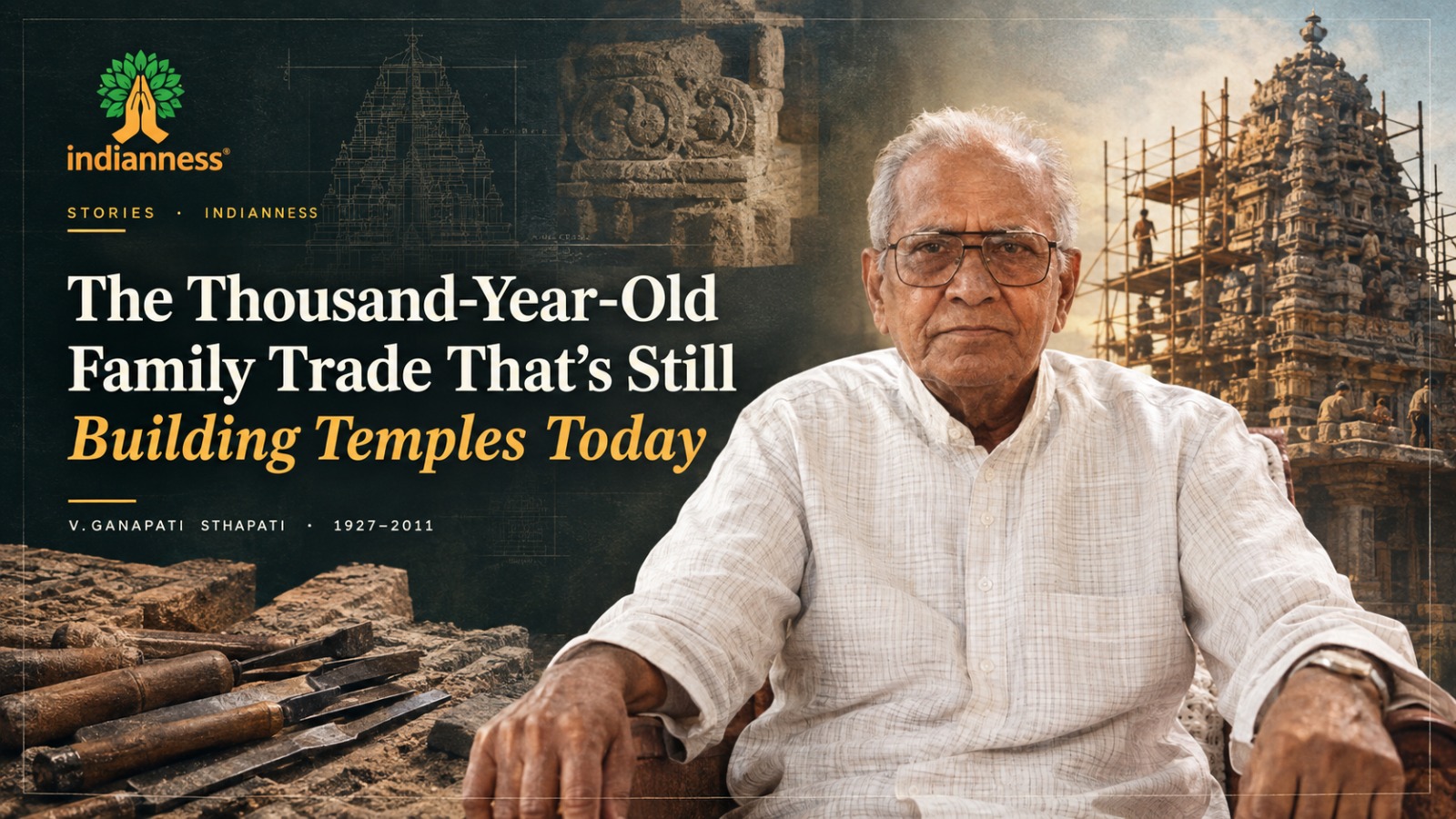
Note on sourcing: the name “Lakshmipathy Naidu” could not be independently verified against available historical or biographical records. Rather than risk presenting unverified or invented details as fact, this article profiles the best-documented and most internationally recognised figure from the same living tradition of hereditary temple architects — the sthapatis of Tamil Nadu — whose career illustrates the same story: an ancient craft discipline still actively shaping buildings today, carried forward not through books but through direct, generations-long apprenticeship.
There’s a particular kind of continuity that most modern professions have entirely lost: the experience of being trained not primarily in a classroom, but by your own father, who was trained by his father, in a chain of direct apprenticeship stretching back not decades but centuries. V. Ganapati Sthapati, one of the most celebrated Hindu temple architects of twentieth-century India, belonged to exactly that kind of lineage — a family of stone carvers and temple builders tracing its craft back, by his own family’s account, some thirty generations, connected to the very builders who constructed the Brihadisvara Temple in Thanjavur, one of the largest and most architecturally significant temples in India, completed in the year 1010.
Sthapati was born in 1927 in Pillayarpatti, a village near Karaikudi in what was then the Madras Presidency, trained from childhood in the intricate craft of temple design and stone sculpture by his own father, a respected sculptor in his own right. And yet, in a detail that captures something genuinely universal about how young people sometimes try to escape the weight of inherited family tradition, Sthapati didn’t initially set out to become a temple architect at all. He first pursued a career teaching mathematics — a very different, more conventionally modern path than the one his family’s centuries-old craft tradition had laid out for him.
He Tried to Escape the Family Trade. It Pulled Him Back Anyway.
That path didn’t hold. In 1957, at the age of thirty, Sthapati joined the Tamil Nadu government’s temple board to oversee temple design and construction — a return to the family craft he had once set aside, and the beginning of what would become an extraordinarily prolific career. What makes this detail worth pausing on is how familiar the underlying pattern feels, even across such a specific and unusual craft tradition: a young person raised inside a demanding inherited discipline tries a different, more conventional path first, only to find themselves eventually drawn back to the thing they were always, in some sense, being prepared for.
Once he returned to temple architecture, Sthapati built a career of remarkable range and output. He designed the Valluvar Kottam in Chennai, an architectural monument in the form of a stone temple car, built to honour the great Tamil poet-saint Thiruvalluvar. He designed the Iraivan Temple in Hawaii — one of only two entirely stone-constructed Hindu temples built anywhere in the world in the past century, an extraordinary technical undertaking given that traditional stone temple construction, using interlocking carved stone blocks assembled largely without modern binding materials, is a painstaking and highly specialised discipline that very few builders anywhere still practice at that level of authenticity. He also designed a companion stone temple in Delhi, along with the Tamil University campus in Thanjavur and numerous other secular and religious buildings across India and internationally.
Carrying Forward a Design System Modern Architecture Left Behind
What distinguishes the sthapati tradition Sthapati represented from conventional modern architectural training is its grounding in Vastu Shastra — an ancient Indian design and construction discipline governing everything from a temple’s precise measurements and proportions to its orientation, materials, and the sequence in which construction must proceed, all understood within the tradition as carrying spiritual and functional significance simultaneously, rather than treating those as separate concerns the way most contemporary architecture does. From the 1980s onward, Sthapati worked to formalise and elevate the standing of this traditional knowledge within modern Indian academic and professional life, affiliating dedicated courses with the University of Madras and helping establish a genuine, degree-granting educational pathway for a craft that had otherwise been transmitted almost entirely through informal family apprenticeship, at real risk of gradually disappearing as fewer young people entered the profession through the traditional route.
He also made a genuinely striking, if still debated, claim based on his own direct architectural observation: visiting the Incan ruins of Machu Picchu in Peru, he measured existing structures there and found what he described as remarkably close correspondences to Vastu Shastra’s prescribed floor plans, proportions, door and window placements, and structural conventions — a similarity he found so precise that he came to believe it pointed toward some deeper, still unexplained historical connection between ancient Indian and ancient South American building traditions. This remains a claim outside mainstream archaeological consensus, worth noting honestly rather than presenting as settled fact — but it illustrates the kind of genuinely wide-ranging intellectual curiosity that Sthapati brought to a craft that most outsiders assume operates purely within fixed, unchanging religious convention.
A Living Tradition, Not a Museum Piece
Sthapati passed away in 2011, having received India’s Padma Bhushan award in recognition of his contributions to architecture and sculpture. But the broader tradition he represented has not stopped with him. Contemporary sthapatis, many trained within the same family lineages and educational institutions Sthapati himself helped establish and formalise, continue actively designing and building Hindu temples today — not only across India, but increasingly across the diaspora, constructing temples in the United States, the United Kingdom, and numerous other countries with significant Hindu communities that want temples built according to genuinely traditional principles and craftsmanship, rather than modern architectural approximations of traditional style.
This is worth genuinely appreciating on its own terms: a design and construction tradition, rooted in principles and craft techniques that are, in some cases, well over a thousand years old, is not simply being studied, preserved, or exhibited as historical curiosity. It is still actively, functionally building — new temples, new stone carving, new applications of ancient proportional systems to entirely new sites and communities around the world — carried forward, generation after generation, by families and craftspeople who never stopped practising it, even through periods of colonial disruption and rapid modernisation that eliminated most other comparably old architectural traditions anywhere in the world.
Sources: Hinduism Today obituary and biographical profile of V. Ganapati Sthapati; Vastu Vedic Trust institutional records of Sthapati’s architectural projects; Wikipedia biographical entries on V. Ganapati Sthapati and related contemporary Tamil Nadu temple architects.