
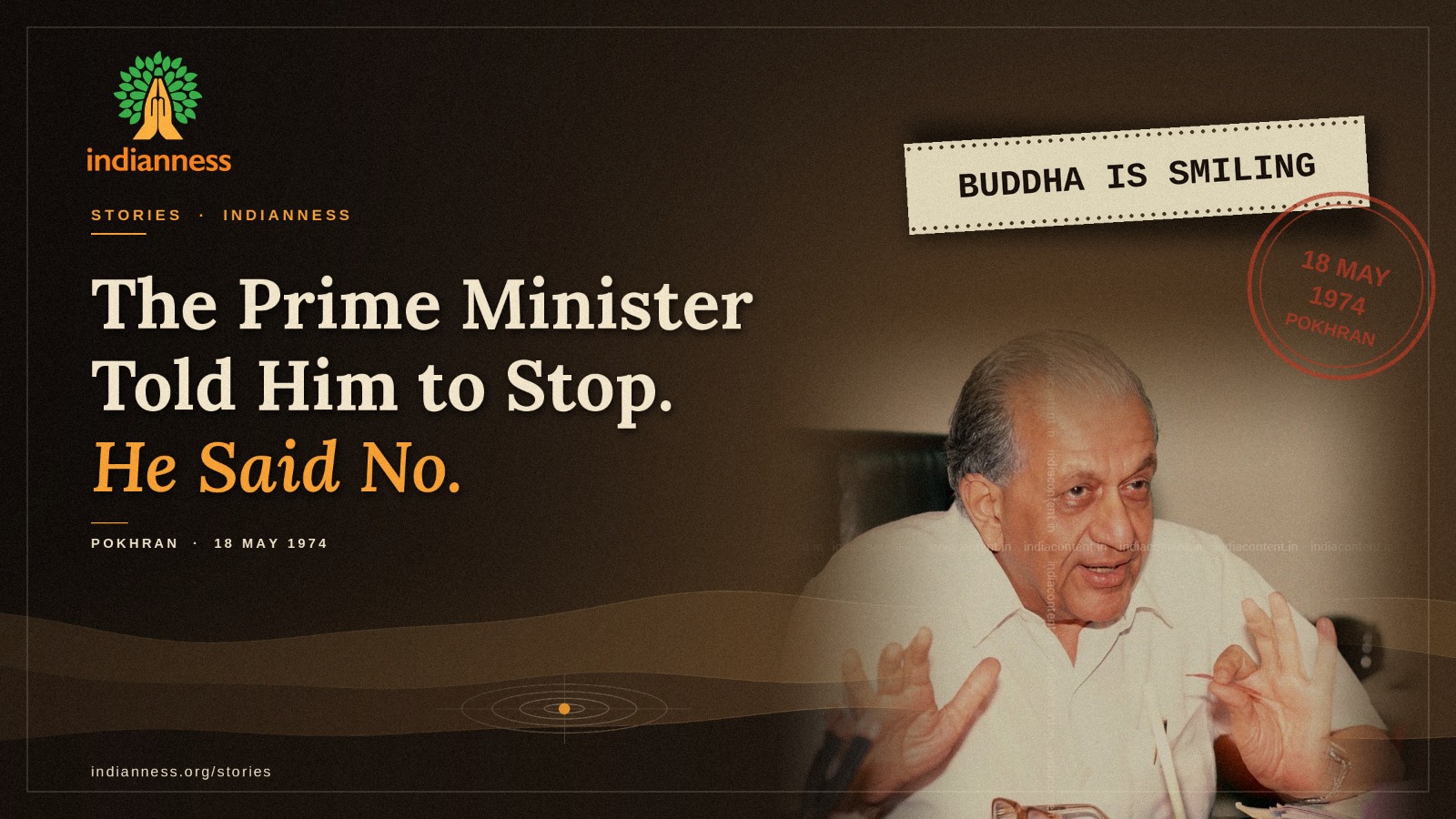
There’s a particular kind of pressure that comes from being told, at the highest level of your government, to stop — and choosing, on your own professional judgment, to keep going anyway. In May 1974, as India’s scientists and engineers prepared to conduct the country’s first nuclear test at Pokhran in the Rajasthan desert, Prime Minister Indira Gandhi reportedly suggested postponing the test. Homi Sethna, then chairman of India’s Atomic Energy Commission, responded with the kind of blunt conviction that doesn’t often survive contact with political power: he pushed forward. Hours later, Operation Smiling Buddha became India’s first successful nuclear test, and the country joined a small and exclusive group of nations capable of building nuclear weapons — a milestone that rested, at its technical core, on decades of unglamorous engineering work that Sethna had personally been doing since long before anyone was talking about a test at all.
Sethna was a chemical engineer by training, educated at the University Department of Chemical Technology in Bombay and at the University of Michigan in the United States — a specialisation that, unlike the theoretical physics most associated with the atomic age in popular imagination, is fundamentally about the grinding, exacting work of actually processing materials at industrial scale. That distinction matters enormously to understanding what he actually contributed. Building a nuclear weapon requires far more than understanding nuclear physics in the abstract; it requires the capacity to extract, purify, and process specific radioactive materials to an exacting standard, reliably, at a scale that a laboratory experiment never has to manage. That is precisely the kind of engineering problem Sethna spent his entire career solving.
Building the Plants No One Else Had Ever Built
Long before Pokhran, Sethna’s career reads almost like a checklist of foundational industrial capabilities that India’s nuclear programme needed and simply didn’t yet possess. He was first engaged in extracting rare-earth monazite-rich beach sands in Kerala, an early and unglamorous foray into the raw material end of the nuclear fuel chain. In 1958, he took charge of producing pure thorium extracts at Trombay, followed by uranium metal production there in the years that followed. He was the project manager overseeing the construction of the CIRUS research reactor, a joint Canadian-Indian collaboration completed in the late 1950s, and he later guided the establishment of a uranium ore processing plant at Jaduguda in Bihar, and India’s plutonium reprocessing capability — the specific technology needed to extract weapons-usable plutonium from spent nuclear fuel, a technically demanding and closely guarded process that only a handful of countries in the world had managed to develop independently at the time.
Each of these was, on its own, a multi-year engineering undertaking requiring the design and construction of entirely new industrial plants for processes that had never before been attempted in India, often with limited outside technical assistance because of the sensitive, dual-use nature of nuclear materials and technology. By the time Sethna was appointed director of the Bhabha Atomic Research Centre in 1966, and then chairman of the Atomic Energy Commission in 1972, he had spent roughly two decades quietly building, piece by piece, essentially every major industrial capability that a nuclear weapons programme would eventually need — years before any government decision had been made about whether to actually build one.
Quietly Providing the Plutonium a More Famous Scientist Would Need
When Prime Minister Indira Gandhi authorised Indian scientists in 1972 to develop and test an indigenous nuclear device, the resulting effort drew on contributions from a range of scientists and engineers, each responsible for a distinct piece of an enormously complex technical puzzle. Raja Ramanna, director of the Bhabha Atomic Research Centre at the time, led the design of the nuclear device itself. But the weapons-grade plutonium that device actually required — extracted from spent fuel out of the CIRUS reactor, using reprocessing technology that Sethna had personally spearheaded developing since the late 1950s — existed specifically because of the plants and processes Sethna had spent years building well before anyone had formally decided a test would even happen. Without that plutonium, and without the industrial infrastructure capable of producing it reliably and safely, there would have been no device for Ramanna’s team to design in the first place.
This is, in miniature, a genuinely important and often overlooked truth about how technologically ambitious national projects actually get accomplished: the dramatic, headline-making moment — a detonation in a desert, a satellite launch, a first flight — is nearly always the visible tip of a much longer, much less visible foundation of patient industrial and engineering capability-building, carried out by people whose names rarely make it into the history books that later celebrate the dramatic moment itself.
The Day That Changed How the World Saw India
As chairman of the Atomic Energy Commission on the day of the Pokhran test itself, Sethna held direct responsibility for coordinating the final stages of preparation and ensuring the project had the resources, materials, and organisational support it needed to succeed. The successful test on 18 May 1974 was celebrated within India as a genuine milestone of indigenous scientific and engineering achievement, even as it triggered serious international concern and led several Western countries, including the United States, to impose sanctions and tighten restrictions on nuclear-related technology transfers to India — consequences that shaped India’s international standing and technology access for years afterward, in ways the scientists and engineers who built the programme could see coming even as they proceeded.
Sethna went on to serve as Atomic Energy Commission chairman until 1983, later chairing Tata Power and serving on the boards of several major Indian companies. He remained, throughout his later life, a genuinely outspoken figure on nuclear policy, publicly criticising aspects of India’s later 1998 nuclear tests and offering blunt, sometimes controversial assessments of other officials involved in the country’s nuclear establishment — a directness that had apparently served him well decades earlier, when a prime minister suggested he stop, and he decided, on his own professional judgment, that the moment called for proceeding instead.
The Unglamorous Infrastructure Behind One Dramatic Headline
Sethna’s career is a reminder that the technologies a country becomes internationally known for are almost never the product of a single dramatic breakthrough. They’re the product of years of patient, difficult, often anonymous industrial engineering — building the plants, refining the processes, and solving the unglamorous material-science problems that make a later, more visible achievement even possible in the first place. Sethna spent decades doing exactly that kind of work, and history has, somewhat fittingly given the nature of the work itself, remembered him mostly for the single dramatic day it eventually made possible.
Sources: Contemporaneous accounts of Homi Sethna’s career published by the Geological Society of India and Deccan Herald; historical records on Operation Smiling Buddha and India’s 1974 nuclear test; Homi Sethna’s own published writing on India’s atomic energy programme.