
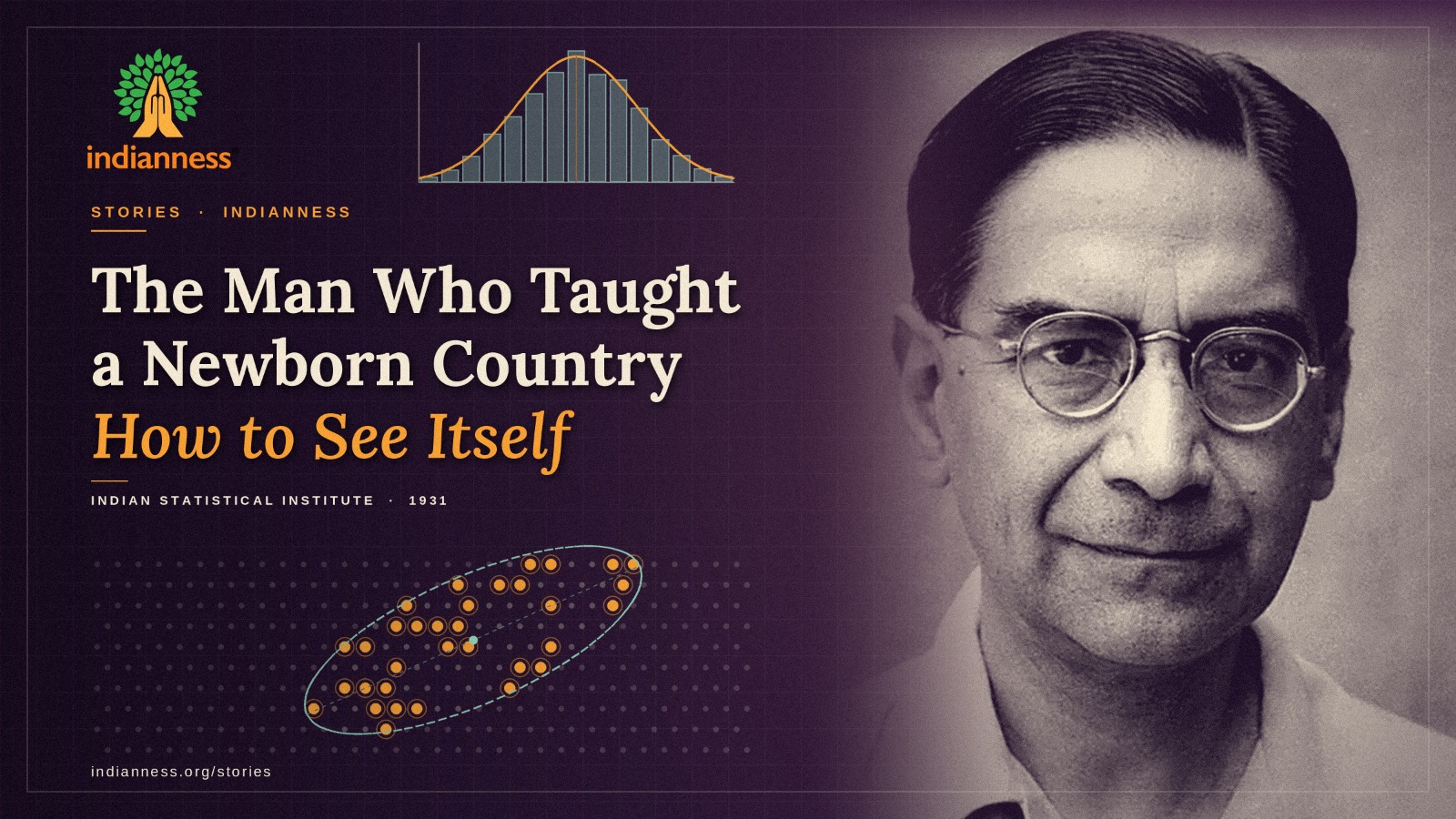
Imagine being handed a country the moment it becomes free — not a metaphor, but an actual administrative reality — and being told to figure out, with almost no reliable information about who lives where, what they grow, what they earn, or what they need, how to build an entire economy from the ground up. That was, in effect, the challenge facing India’s first government after 1947. Prasanta Chandra Mahalanobis’s answer to it wasn’t a policy or a five-year plan in the first instance. It was something far less glamorous and far more foundational: he decided the country first needed to learn how to measure itself accurately, because no government, however well-intentioned, can plan what it cannot see clearly.
Mahalanobis trained originally as a physicist, studying in Kolkata and then at Cambridge University in England, immersed in a discipline built around precise measurement of the physical world. It’s a small but telling detail that the man who would go on to shape how India understood its own population and economy began his intellectual life trying to understand the behaviour of light and matter. Somewhere along the way, his attention shifted from measuring the physical universe to measuring human lives — and he never really looked back.
Before You Can Plan a Country, You Have to Learn to See It
In 1931, more than a decade before Indian independence, Mahalanobis founded the Indian Statistical Institute in Kolkata — a research body dedicated to a discipline that, at the time, barely existed as an organised profession in India. This wasn’t an obvious or fashionable thing to do. Statistics, as a field, carried none of the prestige of physics or the visible drama of engineering. It was patient, unglamorous work: designing methods to estimate things accurately from partial information, building the quiet machinery that other, more celebrated decisions would eventually rest on.
His core insight, though, was almost uncomfortably simple once you sit with it: a government cannot make good decisions about crop yields, industrial output, poverty, or employment if it doesn’t actually know, with any reliability, what any of those things look like across a country of hundreds of millions of people spread over an enormous and varied landscape. In the India of the 1930s and 40s, that kind of nationwide data barely existed. Estimates were patchy, inconsistent, sometimes simply invented to fill gaps in colonial administrative records. You cannot plan for people you cannot see.
How Do You Understand a Billion People Without Asking Them All?
Mahalanobis’s specific technical contribution was pioneering large-scale sample surveys — a method for estimating conditions across an entire population by rigorously surveying a carefully chosen, statistically representative slice of it, rather than attempting the impossible task of surveying everyone. There’s something almost poetic in the idea: you cannot knock on every door in a country of hundreds of millions, but if you knock on the right doors, chosen with enough mathematical care, you can still hear the country speaking honestly about itself.
In 1950, he established the National Sample Survey, an ongoing nationwide data-collection effort that — remarkably — is still running today, still one of the primary sources of information on income, consumption, employment, and poverty in India, more than seventy years after it began. Generations of Indian policymakers have made decisions based on data that traces its lineage directly back to a survey methodology Mahalanobis worked out in the years right after independence. Versions of his sampling techniques are now taught as standard practice in statistical agencies around the world — a quiet, largely uncredited Indian export to global statistical science.
The Bet That Made Ordinary Families Wait Years for a Bicycle
Mahalanobis’s other major legacy moved from measurement into something far more consequential and far more contested: he became the principal architect of the economic strategy behind India’s Second Five-Year Plan, launched in 1956, the government’s central mechanism for setting national development priorities in the newly independent country.
His argument, distilled to its core, was this: a poor, largely agrarian country newly free from colonial rule needed to prioritise building heavy industry — steel mills, machine tool factories, capital goods production — even ahead of consumer goods that people wanted and needed immediately. The reasoning was long-term and, in its way, almost stubbornly patient: a country that could manufacture its own machines and industrial inputs would eventually be able to build everything else — textiles, food processing, consumer products — on its own terms, rather than remaining permanently dependent on imports controlled by wealthier nations.
This became known as the Mahalanobis model, and it directly shaped where India built its major public-sector steel plants, its machine-tool factories, and its heavy engineering complexes over the following decades. It’s the kind of decision that takes real conviction to make, because the costs land immediately and visibly on ordinary households — years of shortages in consumer goods, queues for basic items, a standard of living that lagged what a more consumer-oriented strategy might have delivered faster — while the benefits, if they materialise at all, arrive slowly and are hard to attribute to any single policy decision a decade or two later.
The strategy remains genuinely, seriously contested among economists and historians. Critics argue it under-invested in agriculture and left ordinary Indians facing goods shortages for years longer than necessary. Supporters argue it gave India an industrial and engineering foundation — skilled labour, heavy manufacturing capacity, technical institutions — that later economic liberalisation and private enterprise were able to build directly on top of. Both things can be true at once, and the honest answer is that historians still argue about the balance. What’s not in dispute is the scale of what one man’s economic model was allowed to shape: the material backbone of an entire national economy.
The Institute That Quietly Outlived Everything Else He Built
The Indian Statistical Institute Mahalanobis founded became, and remains, one of the most respected centres for statistics and quantitative economics anywhere in Asia, producing generations of statisticians, economists, and mathematicians who went on to influence policy far beyond India’s own borders. Mahalanobis himself worked internationally as well, serving on United Nations statistical commissions and helping shape statistical practice on a genuinely global stage, at a time when few Indian scientists had that kind of international institutional standing.
He’s remembered today, if he’s remembered at all outside specialist circles, through something almost invisible: India marks National Statistics Day on his birthday, 29 June, each year. It’s a modest, easily overlooked tribute, and that’s oddly fitting. Measuring a country accurately enough to plan its future is one of the least visible forms of nation-building there is — no ribbon-cutting, no monument, no headline. It just quietly makes every other decision that follows a little more honest, a little less like guessing. Mahalanobis spent a lifetime building exactly that kind of infrastructure, and most of the people whose lives it eventually touched never learned his name.
Sources: Indian Statistical Institute institutional history; Planning Commission of India archival records on the Second Five-Year Plan; Government of India National Statistics Day materials.