
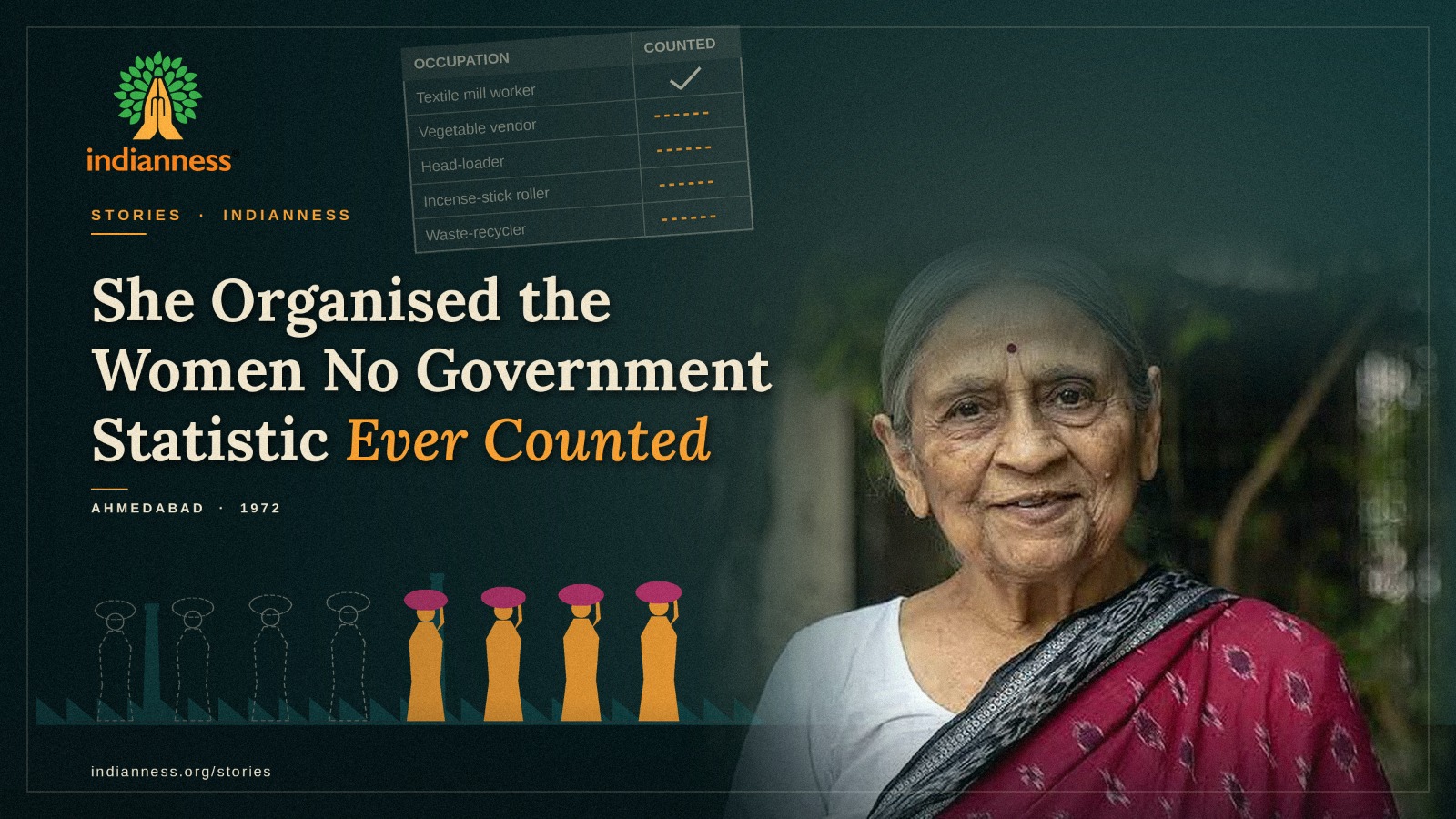
Millions of women across India have always worked — selling vegetables from a cart, stitching garments at home for a contractor who pays by the piece, rolling incense sticks, collecting and sorting recyclable waste, headloading goods through crowded markets. For most of India’s economic history, virtually none of this labour was formally recognised as “employment” at all. These women had no employer to negotiate with, no formal contract, no legal minimum wage protection, no access to credit from any bank, and, crucially, no official economic existence in any government record that a policymaker might actually look at when deciding how to design labour law or social welfare programmes. Ela Bhatt spent her life arguing, and then organising to prove, that this invisibility wasn’t some natural, unavoidable feature of how informal economies simply work. It was a specific, correctable failure of imagination and institutional will — and she built an organisation that eventually gave hundreds of thousands of these women both a collective voice and access to the basic economic tools, like credit and insurance, that formally employed workers had long taken for granted.
Bhatt trained as a lawyer and began her career working with the Textile Labour Association in Ahmedabad, one of India’s oldest and most established trade unions, itself founded under Mahatma Gandhi’s influence. It was through this work that she came into direct, sustained contact with a group of workers the union’s existing structure had essentially no framework for representing at all: self-employed women working in the informal economy — home-based workers, small vendors, and manual labourers who had no single employer to organise against, no fixed workplace to picket, and no formal employment contract that existing labour law and existing union organising strategies were actually built to address.
Building a Union for Workers Who Technically Had No Boss
In 1972, Bhatt founded the Self Employed Women’s Association, known as SEWA — a trade union built specifically for women who worked, but who fell entirely outside the conventional definition of formal, waged employment that virtually all existing labour organising and labour law had been designed around. This required a genuinely significant conceptual leap that most labour organisations at the time simply hadn’t made: recognising that a woman selling vegetables from her own cart, or stitching garments at home for a middleman contractor who might pay her erratically and refuse to explain why, was nonetheless a genuine worker, facing genuine, serious economic exploitation and precarity, and deserving of exactly the same kind of collective organisation, solidarity, and bargaining power that formally employed factory or office workers had spent generations fighting to secure for themselves.
SEWA’s specific organising strategies had to be built essentially from scratch, because virtually none of the existing labour organising playbook — designed around a single identifiable employer, a shared physical workplace, and a formal employment contract — actually applied to its target membership at all. Instead, SEWA organised women around their shared occupation and their genuinely shared economic vulnerabilities: vendors organised together to negotiate collectively for legal rights to sell in specific public spaces without constant harassment or bribe demands from local officials; home-based workers organised together to negotiate for fairer, more transparent, and more consistently paid piece rates from the contractors who employed their labour without formally employing them; waste-pickers organised together to negotiate for recognition and fair compensation for genuinely valuable recycling work that municipal authorities and private companies had, until then, largely ignored or actively suppressed as a nuisance.
Discovering a Bank Account Could Change a Life as Much as Any Law
One of SEWA’s most significant and directly practical innovations was the founding of SEWA Bank in 1974 — a bank created specifically to serve self-employed women who, as a group, had virtually no access whatsoever to conventional banking or credit. Mainstream Indian banks at the time routinely refused to extend loans to poor, self-employed women, who typically lacked any formal collateral, any verifiable and consistent income documentation, or any established credit history that a conventional bank’s underwriting process could recognise or work with at all — leaving these women almost entirely dependent on informal moneylenders who frequently charged genuinely exploitative, sometimes ruinous interest rates on emergency loans.
SEWA Bank was built specifically around serving exactly this excluded population, and it demonstrated something that mainstream conventional banking had, up to that point, largely refused to seriously believe: that poor, self-employed women were, in practice, entirely reliable borrowers and savers, given fair and genuinely accessible terms rather than the predatory terms informal moneylenders had long imposed on them. This work became an important, early precursor to the broader microfinance movement that later gained significant international attention and influence through institutions like Grameen Bank in Bangladesh — demonstrating, well before “microfinance” became a widely recognised global development term, that formal financial inclusion for the poorest and most economically marginalised women could be a genuinely sound, sustainable, and transformative business proposition, not merely a charitable gesture.
Making an Invisible Workforce Impossible to Keep Ignoring
Beyond the direct, tangible economic services SEWA provided, Bhatt’s broader and arguably more far-reaching contribution was pushing, consistently and often successfully, for the informal economy itself to be formally recognised, counted, and protected within Indian and eventually international labour law and economic policy. She played a genuinely significant role in the development of international labour standards specifically addressing home-based work and the broader informal economy, helping influence policy discussions at the International Labour Organization and other global institutions that, until sustained advocacy like hers, had largely continued to treat “informal work” as a marginal, temporary problem destined to simply disappear as economies modernised and developed, rather than recognising it as a permanent, genuinely major, and chronically under-protected component of the global economy that required its own dedicated, purpose-built policy attention.
This matters because policy, at every level of government, tends overwhelmingly to address and protect what gets formally counted and measured, and to systematically neglect what doesn’t. If informal women workers don’t appear as a meaningful category in official government labour statistics, they are considerably less likely to be seriously considered when new labour laws, social security systems, or targeted economic support programmes are eventually designed. Bhatt’s decades of sustained work helped change that basic pattern of neglect, both directly through SEWA’s own on-the-ground organising in India and indirectly through her broader, sustained international policy advocacy on behalf of informal workers everywhere.
A Model Now Studied Well Beyond the Country It Started In
SEWA grew, over the decades since its 1972 founding, into one of the largest unions of informal-sector workers anywhere in the world, with a membership numbering well into the millions, and its specific organising model has since been studied and adapted by labour organisers and policymakers working with informal economies in numerous other countries, from South Asia to Africa to Latin America, all grappling with strikingly similar underlying versions of the same fundamental problem Bhatt first confronted in Ahmedabad in the early 1970s: how do you build collective power, secure fair economic terms, and win formal recognition for workers who have always laboured hard, but whom the existing formal economic system was never actually designed to see or protect at all.
Sources: Self Employed Women’s Association (SEWA) institutional history; SEWA Bank founding records; International Labour Organization records on informal economy and home-based work policy development.