
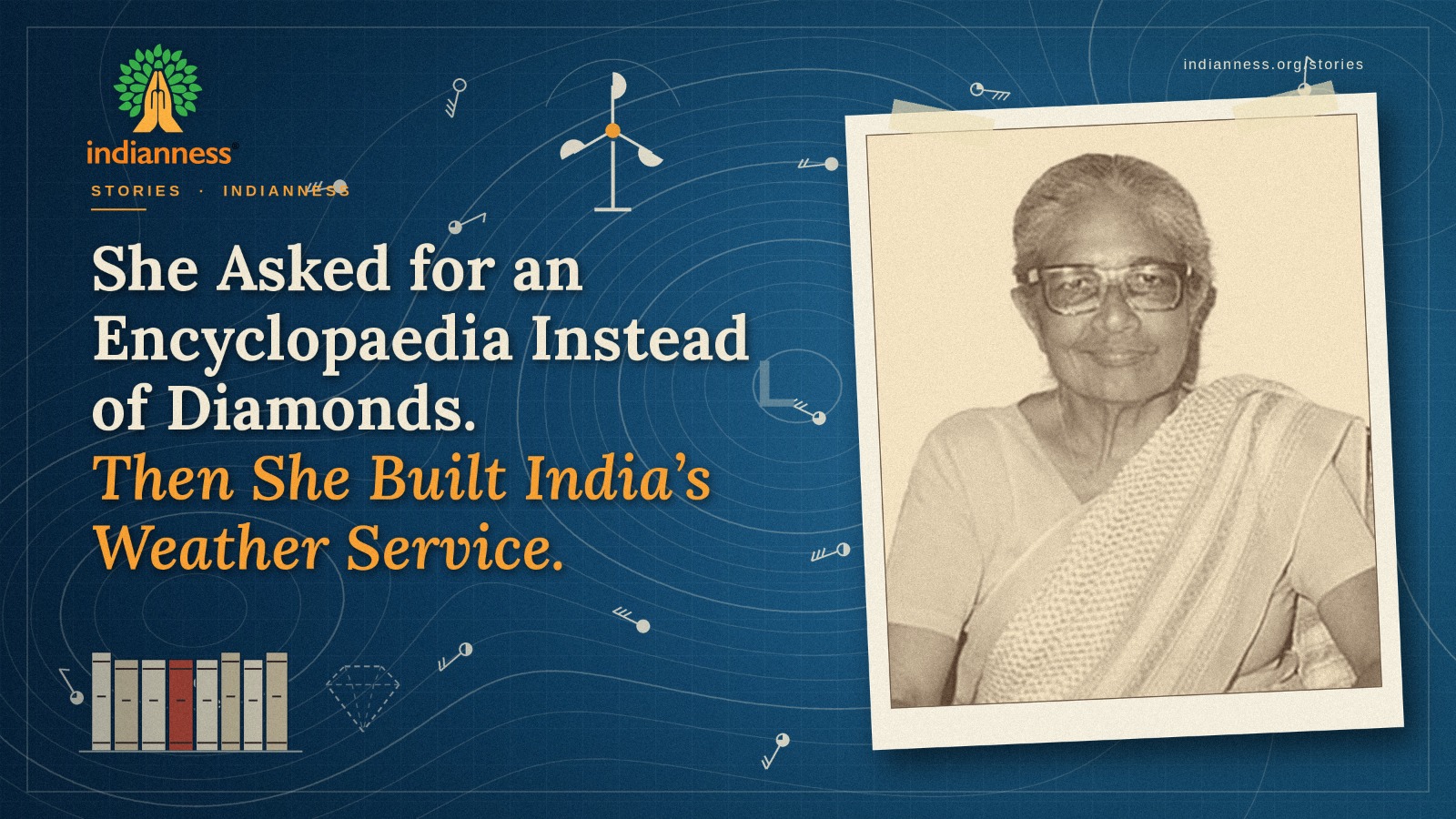
On her eighth birthday, she was offered a pair of diamond earrings — the kind of gift a family gives a daughter when they want her to grow up looking a certain way, prepared for a certain kind of future. She asked for a set of the Encyclopaedia Britannica instead. It’s a small moment, almost a footnote in most accounts of her life, but it tells you almost everything you need to know about Anna Mani: even as a child, she seemed to understand that the future she wanted for herself would have to be built out of knowledge, not ornament, and that no one was going to hand it to her without her insisting on it first.
Born in 1918 in Peermade, a hill town in what was then the princely state of Travancore in southern India, Mani grew up in a household that, in almost every practical sense, was not built with her ambitions in mind. It was a large family, and like many of its era, the sons were groomed for professional careers while the daughters were prepared for marriage. There was no particular hostility in this — it was simply how things were arranged, an assumption so deeply embedded that it rarely needed to be stated out loud. Mani, by every account, refused to accept the assumption anyway. She read constantly. She gravitated toward the local library rather than toward whatever was expected of a young woman of her background. Eventually, she set her sights on medicine, before a fascination with physics pulled her in a different direction, and she enrolled to study it at Presidency College in Madras — one of relatively few women doing so at the time, in a country where, in the early twentieth century, female literacy and college enrolment were both strikingly low.
She Worked Beside a Nobel Laureate — Then Walked Away From the Glamour
Mani’s early scientific career put her in company that most physicists, of any gender, could only dream of: she worked at the Indian Institute of Science in Bengaluru under the direct supervision of C.V. Raman, the Indian physicist who had already won the Nobel Prize for his groundbreaking work on how light scatters through matter. Under Raman, she researched the optical properties of diamonds and rubies — precise, painstaking, and by scientific standards, genuinely prestigious work.
And then she left it. In 1945, she travelled to Imperial College London on a government scholarship, intending to continue in physics — and instead found herself pulled toward something far less glamorous: meteorological instrumentation, the unglamorous, hands-on discipline of designing the physical devices that measure rainfall, wind speed, atmospheric pressure, and sunlight accurately enough that a government or a farmer could actually trust the numbers. It’s the kind of career pivot that, on paper, looks almost like a step backward — trading the intellectual glamour of studying gemstones under a Nobel laureate for the practical grind of calibrating rain gauges. But it was exactly the kind of unglamorous, foundational work that a newly independent country, about to be born in just a couple of years, was going to desperately need someone to do.
Building, Almost by Hand, the Instruments Her Country Didn’t Have Yet
Mani returned to India in 1948, shortly after independence, and joined the India Meteorological Department in Pune. What awaited her there was an enormous, almost thankless task: India, at the time, depended heavily on imported weather instruments, and had no reliable domestic capacity to design, manufacture, and calibrate the equipment that any serious national weather service requires. There was no existing playbook for what she was being asked to build. She had to write it herself, instrument by instrument.
Over the following decades, that’s essentially what she did. She personally standardised the designs of roughly a hundred different types of weather-related instruments — rain gauges, wind anemometers, solar radiation sensors, ozone-measuring devices — so that India could manufacture this equipment domestically rather than remain dependent on imports from wealthier countries. It’s difficult to overstate how unglamorous and how essential this kind of work is. No one remembers the name of the person who calibrated the rain gauge that told a farmer when to plant. But someone has to do that work with total rigour, or every weather forecast built on top of it is unreliable from the ground up. Mani rose, over time, to become Deputy Director General of the department — one of the most senior scientific positions available there — in a field that was, at every level, overwhelmingly dominated by men.
She Saw the Sun as an Energy Source Decades Before Anyone Else Looked
Perhaps Mani’s most quietly remarkable contribution is also one of the least widely known: she recognised, decades before climate change made renewable energy a global policy priority, that reliable, systematic data on solar radiation and wind speed across India would eventually be essential to actually harnessing solar and wind power at scale. This wasn’t an obvious thing to prioritise in the 1950s and 60s, when fossil fuels were cheap, abundant, and largely unquestioned as the foundation of industrial development. Mani built a national network of monitoring stations to measure solar radiation starting in the late 1950s anyway, and her work produced some of the first comprehensive published data on solar radiation levels across the Indian subcontinent — data that, decades later, would directly inform India’s early solar-energy planning, long after she had done the original, patient groundwork of simply measuring it.
She also designed an ozonesonde — an instrument carried aloft by weather balloons to measure atmospheric ozone — and helped set up a meteorological observatory at India’s first rocket-launching facility at Thumba, quietly linking her instrument-design expertise to the country’s earliest space research.
A Career You’ll Never See Credited Anywhere — That’s the Whole Point
Anna Mani retired from the India Meteorological Department in 1976, but didn’t really stop working. She went on to establish a research unit focused on assessing India’s solar and wind energy potential for the national Department of Science and Technology, and she held senior roles in international meteorological organisations, carrying India’s hard-won instrument-design expertise into global forums where it could be shared and compared against other countries’ work.
She isn’t a household name, even within India — and there’s something almost fitting, if not entirely fair, about that. The instruments a country trusts to tell it whether it will rain tomorrow, whether a drought is coming, or whether a particular region gets enough sun to justify solar panels are rarely credited to any one person. They just quietly work, day after day, and everyone assumes they always have. Anna Mani spent thirty years making sure those instruments existed at all, built by Indian hands to Indian standards, so that an entire country’s weather forecasts — and eventually its renewable energy ambitions — could stand on something solid. She never got the diamond earrings. She built something that outlasted them by a very long way.
Sources: World Meteorological Organization historical profile of Anna Mani; Indian National Science Academy biographical records; contemporaneous accounts of her work at the India Meteorological Department.