
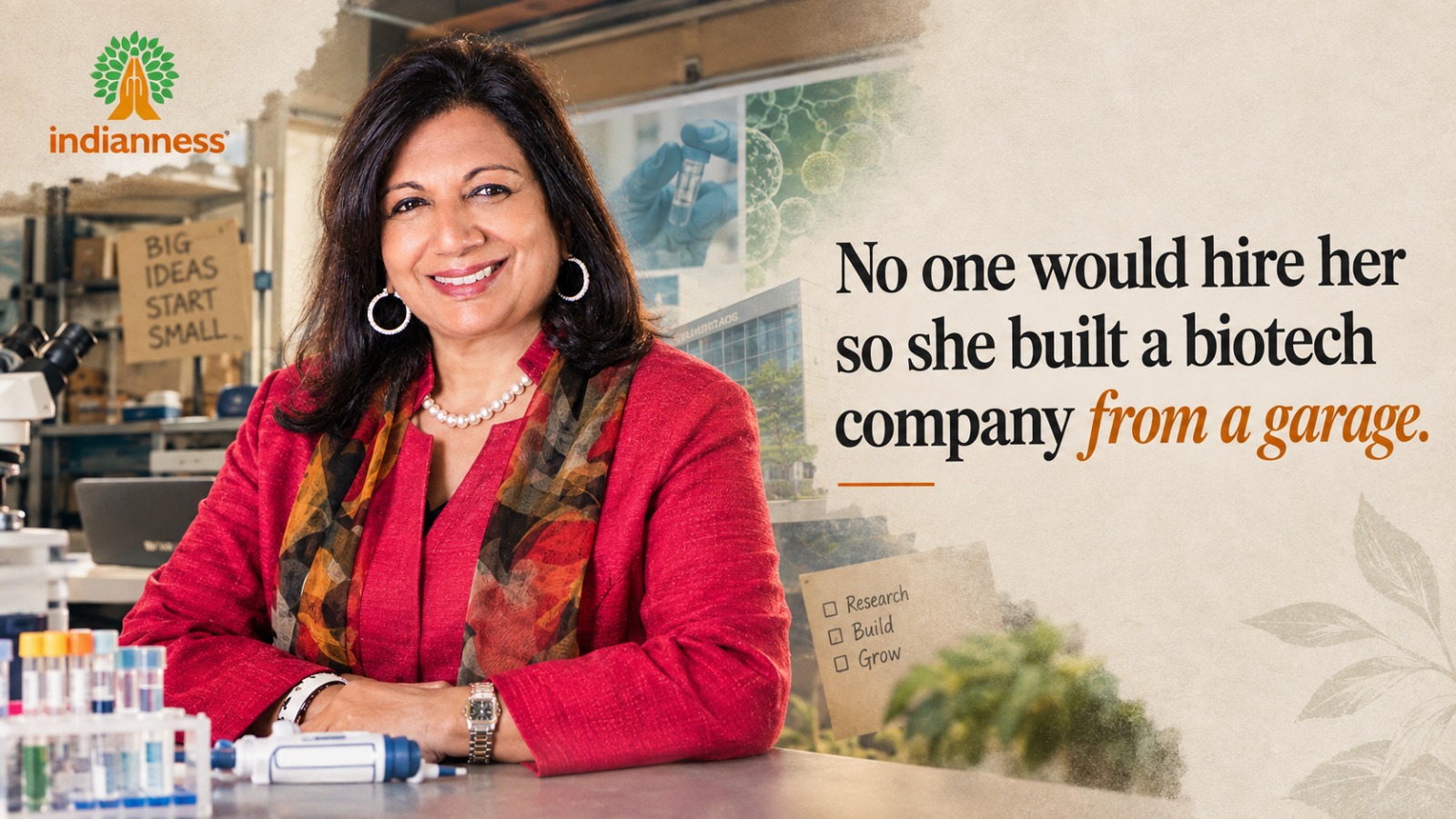
In 1978, Kiran Mazumdar-Shaw started a biotechnology company in the garage of a rented house in Bangalore, with a starting capital of about 10,000 rupees — at the time, a modest sum, nowhere close to what a genuine biotechnology venture would normally require. She was twenty-five years old. She had trained as a brewer, of all things, at Ballarat College in Australia, one of the few women in the world at the time working in that specific, heavily male-dominated field, and she had returned to India to find that no company would hire a woman brewer, regardless of her qualifications, simply because the industry didn’t consider it a job for women. So she built something else entirely — a company that would eventually make her one of India’s most successful entrepreneurs, in an industry, biotechnology, that barely existed in the country when she started.
It’s worth sitting with how genuinely improbable this beginning was. Not a well-funded research lab. Not a university spinout with institutional backing. A garage, a small amount of capital, one employee to start, and a founder who had just spent months discovering that her hard-won professional training was apparently worthless to Indian employers because of her gender. Most people, faced with that particular combination of obstacles, would have looked for a different, more accommodating career. Mazumdar-Shaw built a company instead.
Finding the One Niche That Happened to Need Exactly Her Training
Mazumdar-Shaw founded Biocon India as a joint venture with an Irish biotechnology company, initially focused on extracting enzymes — a natural extension of her brewing and fermentation training, since industrial enzyme production relies on many of the same biological processes as brewing does. It wasn’t an obvious first move for someone hoping to eventually build a major pharmaceutical company, but it gave her a functioning, revenue-generating business while she built the scientific and manufacturing capability that would let Biocon grow into something considerably larger.
The company’s real transformation began as it gradually shifted toward biopharmaceuticals — producing insulin, cancer drugs, and other complex biologic medicines using genetically engineered organisms rather than simpler chemical synthesis. This is a genuinely difficult manufacturing and regulatory challenge even for well-funded, established pharmaceutical companies. Doing it as a scrappy startup from India, a country with essentially no existing biotechnology manufacturing base or regulatory precedent for this kind of work at the time, required Mazumdar-Shaw and her small team to build up scientific and manufacturing expertise almost entirely from first principles, with limited access to the capital, mentorship, and established supply chains that biotech startups in the United States or Europe could generally take for granted.
Trying to Raise Money as a Woman No Bank Had a Category For
There is a particular, specific difficulty in raising capital for a genuinely novel venture, and it becomes considerably harder when you’re a young woman pitching an industry that most banks and investors have never before been asked to evaluate at all. Mazumdar-Shaw has spoken candidly about the scepticism she faced in the early years — banks reluctant to lend to a biotechnology venture they didn’t understand, led by a woman in a field where they had essentially no other reference point to compare her against. She persisted anyway, building the company gradually, reinvesting revenue, and slowly proving out both the business model and her own credibility in an industry that had given her no obvious reason to expect success.
That persistence eventually paid off in a way that reshaped the broader Indian pharmaceutical landscape. Biocon grew into one of India’s largest biopharmaceutical companies, producing affordable insulin and other biologic drugs that dramatically expanded access to treatment for diabetes and other chronic conditions, not just within India but across other developing countries where the cost of biologic medicines from Western pharmaceutical companies had put them out of reach for enormous numbers of patients. In 2004, Biocon’s public stock offering made Mazumdar-Shaw one of India’s wealthiest self-made women entrepreneurs — a milestone that mattered less for the personal wealth it represented than for what it demonstrated to a generation of Indian women watching: that a woman could build a serious, technically demanding company from nothing, in an industry the country had essentially no existing tradition of doing business in at all.
The Unglamorous Work of Making Medicine People Could Actually Afford
What makes Mazumdar-Shaw’s work genuinely significant beyond her personal success story is the specific problem her company chose to focus on: the price of biologic medicines, a category of drugs that includes some of the most effective treatments for cancer, diabetes, and autoimmune conditions, but that has historically been priced far beyond what most patients in developing countries — and even many in wealthier countries — can actually afford. Biocon has worked specifically on producing biosimilars, which are highly similar versions of already-approved biologic drugs, at costs dramatically lower than the original branded versions, expanding access to treatments that would otherwise remain entirely out of reach for the vast majority of patients who need them.
Think about what that actually means in practical terms for someone facing a cancer diagnosis in a country without the kind of comprehensive health insurance systems common in wealthier nations: the difference between a treatment costing an amount that could bankrupt a family for generations, and one that a family might realistically be able to afford, can be the entire difference between receiving treatment at all and going without it. That’s not an abstract public health statistic. It’s the specific, concrete difference Biocon’s work has aimed to make in individual patients’ lives, at a scale of millions of people across multiple countries.
Building an Entire Industry’s Credibility From Absolutely Nothing
Mazumdar-Shaw’s career also mattered for a reason that’s easy to overlook if you only look at Biocon’s balance sheet: she helped establish that biotechnology could be a serious, investable, scientifically rigorous industry in India at all, at a time when the country had essentially no track record in the field and most global biotech investment assumed India simply wasn’t a place where this kind of work happened. Her success helped open the door for a broader Indian biotechnology and pharmaceutical manufacturing sector that has since grown to become one of the largest suppliers of generic medicines and vaccines in the world — India is sometimes described, with real justification, as the “pharmacy of the world,” a role that depended substantially on entrepreneurs like Mazumdar-Shaw proving, against real scepticism, that the underlying scientific and manufacturing capability could actually be built there.
She started in a garage because no one would give a woman brewer a job. She ended up building one of the reasons millions of people around the world can now afford medicine that would otherwise have been out of reach. It’s not the career she originally trained for. It turned out to matter considerably more.
Sources: Biocon Limited institutional history and public filings; contemporaneous interviews and profiles of Kiran Mazumdar-Shaw’s founding of Biocon; industry accounts of India’s biosimilar and generic pharmaceutical manufacturing sector.