
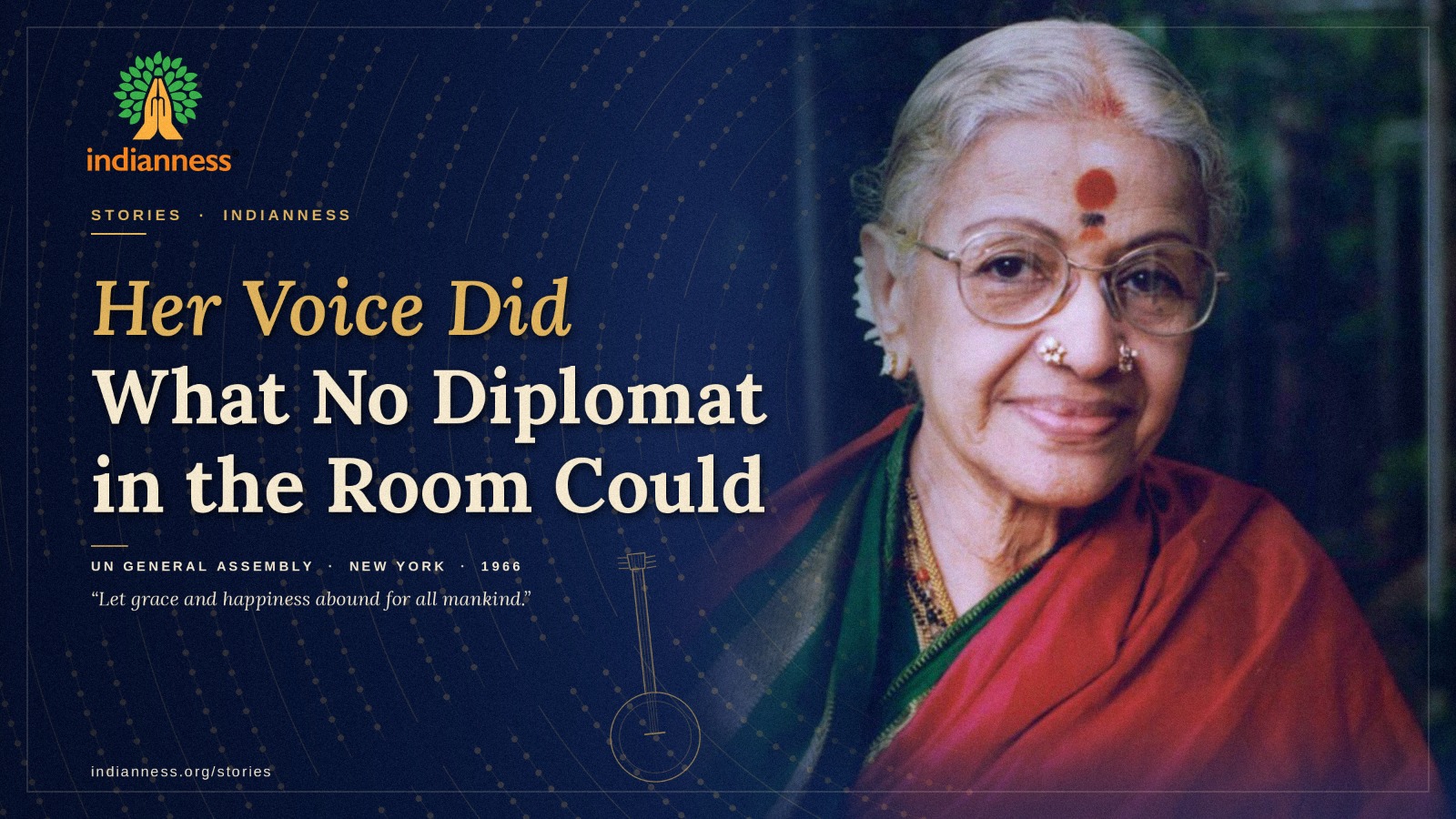
Some artists get invited to perform at the United Nations because they’re famous. M.S. Subbulakshmi was invited because her voice had already been doing a form of quiet diplomatic work for decades — carrying a classical musical tradition into rooms, causes, and countries that formal diplomacy alone had never quite managed to reach. To understand why that invitation mattered so much, you have to understand what she had to overcome just to be allowed to sing on the terms she eventually sang on.
Madurai Shanmukhavadivu Subbulakshmi was born in 1916 in Madurai, in southern India, into a family of musicians — her mother was a respected performer on the veena, a classical Indian string instrument whose sound is often described as closer to the human voice than almost any other instrument. Subbulakshmi trained in Carnatic music, the classical musical tradition of southern India, and gave her first public performance at the age of just eleven. It’s worth pausing on that number: eleven years old, already carrying an audience’s attention on the strength of her voice alone. By her teenage years, she was being recognised as an exceptional talent — but recognition, for someone from her particular background, was never going to be automatic or uncomplicated.
Singing Against Everything People Had Already Decided About Her
Hereditary female musicians in southern India at the time carried the weight of significant social prejudice, rooted in colonial-era judgments about traditional performance communities historically associated with courtly and devadasi traditions — a lineage that mainstream society, shaped by decades of moralising colonial attitudes, often treated with suspicion or outright stigma rather than respect. A young woman from that background, however extraordinary her talent, could not simply assume that talent alone would be enough to earn her acceptance as a mainstream classical artist rather than being quietly marginalised by the circumstances of her birth.
Subbulakshmi’s rise mattered, and still matters, precisely because of what she had to overcome to achieve it. Her extraordinary technical command of Carnatic music — the kind of control and depth that takes a lifetime of relentless discipline to build — combined with a public persona of extreme personal reserve and evident religious devotion, gradually shifted public perception in a way that few individual careers manage to do. She didn’t just become accepted. She became revered, to the point where she came to be regarded as arguably the most respected classical vocalist in India during her lifetime — a status that almost no musician from her particular social background had achieved before her, and one that quietly reshaped what audiences assumed was possible for the generation of women who came after.
She was also unusual in her range in a way that’s easy to overlook now: alongside her demanding classical concert career, she acted in a small number of Tamil-language films in the 1930s and 40s, most memorably playing the eighth-century philosopher-poet Meera in the 1945 film “Meera” — a role whose devotional songs became enormously and independently popular across India, reaching listeners who had never set foot inside a classical concert hall.
When a Single Concert Becomes a Country’s Introduction to the World
What sets Subbulakshmi apart from other celebrated classical musicians of her era is how consistently her performances came to be treated as acts of national representation rather than purely artistic events. In 1966, she performed at the United Nations General Assembly, becoming the first Indian musician ever to do so. Think about what that invitation actually meant: on an occasion of genuine international significance, when India wanted to present something of itself to the world, the thing it chose to send was not a diplomat’s speech but a single woman’s voice.
She went on to perform for numerous visiting heads of state and international dignitaries over the following decades, effectively serving, informally but repeatedly, as a cultural ambassador at moments when formal diplomatic channels needed a register that a trade agreement or a state dinner simply couldn’t provide. There’s something worth noticing here about the limits of formal diplomacy itself — the way a treaty can establish a relationship between governments but cannot make two peoples feel anything about each other. A voice, apparently, sometimes can.
The Songs That Outgrew the Concerts They Came From
Certain performances of hers moved entirely beyond the concert hall and became part of India’s shared cultural memory in a way that transcends music criticism altogether. Her rendition of “Vaishnava Jana To,” a devotional hymn closely associated with Mahatma Gandhi, and her performance of the national song “Vande Mataram,” became so deeply identified with her voice specifically that, decades later, many Indians find it genuinely difficult to hear either song performed any other way — as though her particular phrasing had become, for an entire generation, the only correct way the song could sound. Her recordings were reportedly played at Gandhi’s own request during his lifetime, and continue to be played at significant national commemorations today, carrying her voice into moments of collective memory for a country she is no longer alive to witness.
The Recognition Took Decades to Finally Catch Up
Subbulakshmi received virtually every major cultural honour India had to offer, culminating in the Bharat Ratna in 1998 — India’s highest civilian award — becoming the first musician of any kind ever to receive it. She was also honoured with the Ramon Magsaysay Award in the Philippines, often described as Asia’s equivalent of the Nobel Prize, specifically recognising her contribution to bridging Indian classical music with audiences well beyond India’s borders. It took decades for formal recognition to fully catch up to what audiences had already sensed about her for most of her career — that she wasn’t simply an exceptional singer, but something closer to a living embodiment of a tradition that a country wanted the rest of the world to hear and understand.
A Quieter Kind of Power No One Had a Name For Yet
What makes Subbulakshmi’s career worth understanding outside specialist musical circles is how clearly it illustrates a form of influence that formal international relations analysis rarely knows how to categorise: a single performer’s voice, cultivated over decades of unrelenting artistic discipline, becoming trusted enough — by governments, by the general public, and eventually by a wary and hierarchical music tradition that had once been reluctant to fully embrace her — to represent an entire country’s cultural identity on the world stage. Long before “soft power” became a familiar term in international relations, Subbulakshmi’s concerts were already quietly doing exactly that work, one performance at a time, carried by nothing more than a voice that a young girl in Madurai had begun training before she was even old enough to fully understand what she was being asked to overcome.
Sources: Sangeet Natak Akademi and Government of India records on national cultural honours; contemporaneous accounts of Subbulakshmi’s 1966 United Nations performance; Ramon Magsaysay Award Foundation citation.