
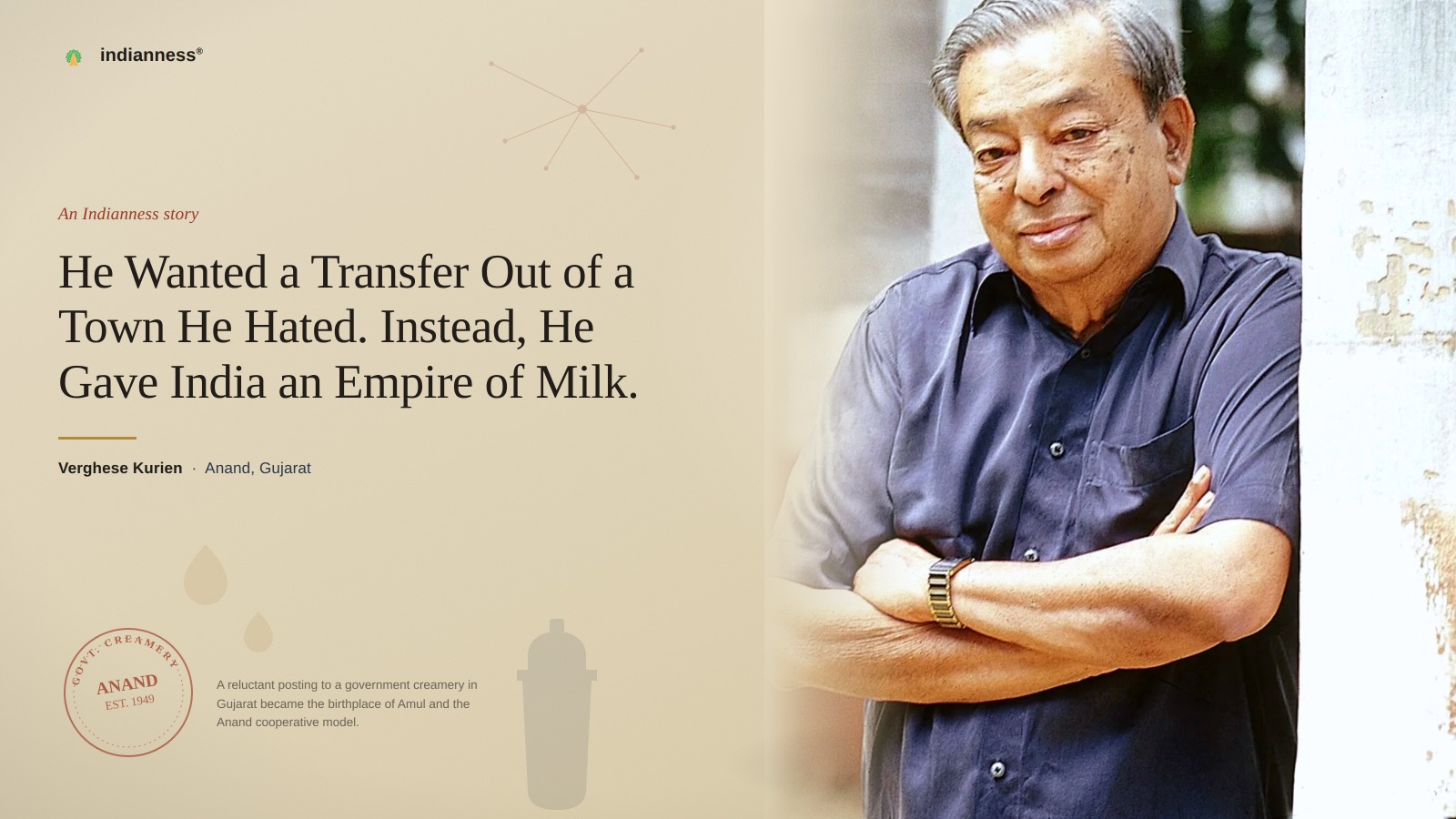
He didn’t want the job. He didn’t even want to be in the town. Verghese Kurien had trained as an engineer in the United States, had a taste for good food and good company, and had every intention of building a life somewhere more interesting than a dusty, mosquito-ridden creamery town in western India. Instead, a bureaucratic accident stranded him there — and the fight he stumbled into ended up building the largest dairy cooperative network on Earth, and teaching an entire country that the people who did the hardest, least-visible work in a supply chain could still end up owning it.
It’s worth sitting with how unlikely this is. Most of us, dropped somewhere we don’t want to be, doing work we find beneath us, spend our energy trying to leave. Kurien spent years trying exactly that. What kept him instead wasn’t ambition or a grand plan. It was a stubborn, almost accidental sense of obligation to people who had nothing to do with his original career and everything to do with the fight already happening next door.
The Job He Never Wanted, In a Town He Was Desperate to Leave
In 1949, Kurien arrived in Anand, a small town in Gujarat, to work off a government scholarship bond at a struggling government-run creamery. He hated it almost immediately. The work felt like a demotion from what he’d trained for. He applied, repeatedly, for a transfer somewhere — anywhere — else. Imagine that frustration: years of study, a specific vision of the engineer you were going to become, and then a posting that felt like punishment for no reason you could name.
While Kurien was busy trying to leave, a farmer-organiser named Tribhuvandas Patel was busy trying to build something. Patel had spent years watching local dairy farmers get squeezed by Polson, a private company that held an effective monopoly on collecting and processing the region’s milk for sale in the distant city of Mumbai. The farmers had no leverage. They took whatever price they were offered, on whatever day the buyer decided to show up, because there was no alternative buyer to turn to. Patel had already begun organising these farmers into a cooperative society — an idea with real moral force but no technical muscle behind it. He needed someone who understood machines, processing, and engineering. He found Kurien, still stuck in Anand, still wanting to leave.
Something in that appeal must have landed differently than the job itself had. Kurien stayed — not because the town had grown on him, but because the fight had.
No Textbook Had the Answer, So His Team Had to Write One
The technical problem the cooperative faced was almost comically specific, and also genuinely hard: nearly all existing dairy-processing technology in the world had been engineered around cow’s milk, the dominant dairy animal in Europe and North America. India’s dairy economy, though, ran heavily on buffalo milk, which behaves differently under industrial processing — different fat content, different protein structure, different reaction to the machinery designed for something else entirely. No one, anywhere, had cracked how to convert buffalo milk into milk powder at commercial scale.
There’s a particular kind of loneliness in that kind of problem. You can’t look up the answer. You can’t call an expert who’s solved it before, because no one has. Kurien’s small team spent months in a kind of technical wilderness, adapting machines never designed for their raw material, failing, adjusting, failing again. When they finally succeeded, it wasn’t just a clever engineering fix — it was the thing that let the cooperative stand on its own feet, competing directly against the monopoly it had been built specifically to challenge. The cooperative took the name Amul. Within a few years, it was outcompeting Polson on its own turf.
Betting an Entire Nation on the Farmers Everyone Else Had Ignored
Kurien could have treated this as a local success story and moved on. Instead, in 1965 — sixteen years after he’d first tried to leave Anand — he was asked to lead a new national body built to replicate what had happened there across the whole of India. He said yes to something enormous: taking a model that had worked in one district and asking whether it could work for hundreds of millions of people.
What followed came to be called the White Revolution, and the scale of it is easy to state in numbers and hard to actually feel. India went from a country that could not reliably produce enough milk to feed itself to the largest milk-producing nation on the planet. But behind that statistic sit millions of individual, human decisions — a farmer in a village somewhere deciding, for the first time in her life, that she had a stake in a business rather than a buyer she had to accept on his terms. Many of these farmers were women, for whom a share in a village dairy cooperative was often the first independent economic foothold they had ever held — a modest but real form of financial agency in households and villages where that had rarely existed before.
This is the part of Kurien’s story that resonates far beyond dairy, and far beyond India. It’s a story about what happens when the people who do the actual, physical, unglamorous labour of production — milking animals at dawn, carrying pails, tending livestock through illness and drought — are allowed to also own the processing plants and the brand built on their work, instead of watching someone else capture all the value further up the chain. That’s not a uniquely Indian tension. It’s the same tension that runs through coffee farming in East Africa, cocoa farming in West Africa, and small-scale fisheries almost everywhere. Kurien’s answer to it — organise, build technical capacity, and refuse to let intermediaries keep all the leverage — has been studied and partially replicated in agricultural cooperatives on multiple continents since.
The Fight He Kept Fighting for Forty More Years
Kurien spent more than four decades at the institutions he built, and he spent a good portion of that time fighting — not the original monopoly, which had long since been defeated, but a recurring pressure from within his own government to hand dairy processing and marketing back to large private companies or centralised bureaucratic control. He argued, repeatedly and without much diplomatic softening, that the people who bore all the risk of production — the farmers, exposed to disease, drought, and price volatility — deserved to keep the profits from processing and selling their milk too. It’s a strikingly simple argument, and also one that a great many industries, in a great many countries, still haven’t been organised around.
He never planned any of this. He planned to leave a town he found unbearable. What he left behind instead, decades later, is one of the most studied examples in the world of farmers successfully owning the industry built on their own labour — proof, still cited by economists and cooperative organisers well outside India, that the people at the bottom of a supply chain don’t have to stay there.
Sources: National Dairy Development Board historical accounts; Verghese Kurien’s memoir “I Too Had a Dream”; Amul/GCMMF institutional history.