
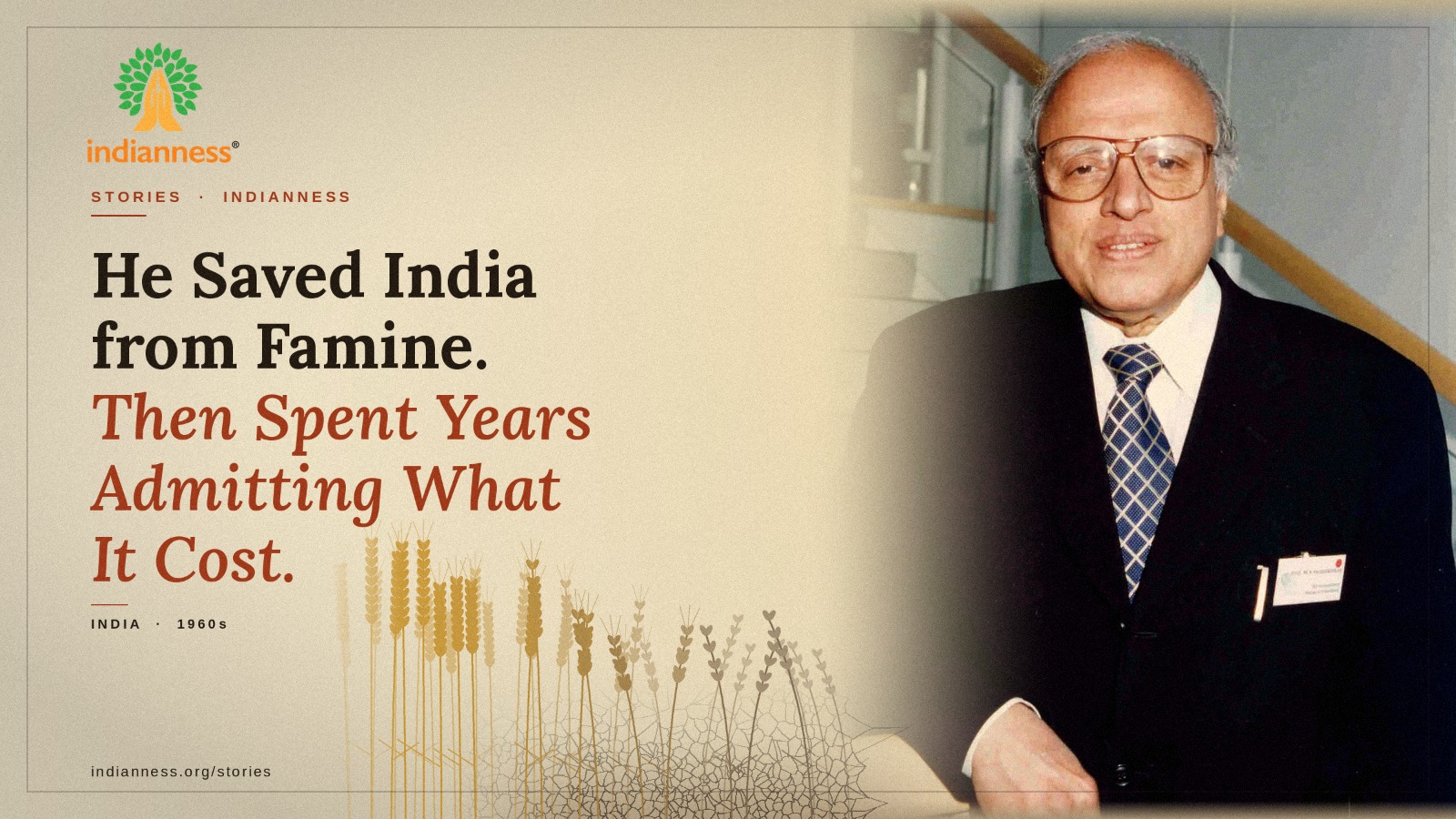
In the mid-1960s, India was a country repeatedly on the edge of famine, dependent on emergency food shipments from the United States just to keep its population fed through periods of severe drought and crop failure. Within roughly a decade, it had transformed into a country capable of feeding itself, producing enough grain not just to meet domestic demand but eventually to build a food reserve. That transformation is usually told as an unambiguous triumph, and much of it genuinely was one. M.S. Swaminathan, the agricultural scientist most responsible for bringing high-yield farming techniques to India, deserves that credit. But the fuller, more honest version of his story — the one worth actually sitting with rather than simplifying — includes real, lasting trade-offs that Swaminathan himself, to his considerable credit, spent much of his later career trying to openly reckon with.
Swaminathan trained as a geneticist and plant breeder, and in the early 1960s he became convinced that a new generation of high-yield wheat and rice varieties, developed largely through international agricultural research led by figures like Norman Borlaug, could be adapted to Indian growing conditions and could dramatically increase the country’s food output. This was, at the time, a genuinely urgent proposition rather than an academic exercise: India in the mid-1960s faced severe famine risk, a rapidly growing population, and agricultural yields that had remained largely stagnant for generations, dependent on farming methods that had changed little over centuries.
Convincing Farmers to Abandon What Had Always Kept Them Alive
Introducing high-yield seed varieties at the scale India needed required far more than simply distributing new seeds to farmers and waiting for results. These new varieties required specific, carefully managed inputs to actually deliver on their yield potential — controlled irrigation rather than dependence on unpredictable rainfall, substantial quantities of chemical fertiliser, and pesticides to protect crops that, being bred intensively for yield, were often more vulnerable to pest damage than the traditional varieties farmers had grown for generations. Swaminathan worked directly with Indian farmers, agricultural extension services, and government policymakers to build the infrastructure and knowledge systems this transition genuinely required — expanding irrigation networks, ensuring fertiliser was actually available and affordable at the necessary scale, and convincing farmers to abandon centuries-old farming practices and switch to methods that were, at least initially, unfamiliar and genuinely risky for people whose entire livelihood depended on getting the harvest right.
Picture the actual, human scale of what that persuasion required: a farmer whose family had grown a particular traditional variety of wheat for generations, using irrigation and cultivation methods passed down largely unchanged, being asked to switch to an unfamiliar seed variety requiring different water management, different fertiliser inputs, and different pest control — with his family’s entire year of food and income riding on the outcome. Multiply that individual leap of faith across millions of farmers, and you begin to grasp the sheer scale of behavioural and infrastructural change that what came to be called India’s Green Revolution actually required, well beyond the scientific breakthrough of the seeds themselves.
The Harvest Was Real. So Was Who Got Left Behind.
The results, in terms of sheer food output, were genuinely transformative. Indian wheat production roughly tripled within a matter of years following the introduction of high-yield varieties in the mid-to-late 1960s, and the country moved from chronic dependence on food imports and the constant threat of famine to consistent, and eventually surplus, grain production. Millions of people who would otherwise have faced severe food insecurity, and in some cases outright starvation during drought years, were protected by this dramatic increase in domestic food production. That achievement is real, and it deserves to be stated plainly rather than buried under caveats.
But the trade-offs embedded in how the Green Revolution actually unfolded on the ground are equally real, and Swaminathan himself became one of the most prominent voices publicly acknowledging them in his later career, rather than defending the transformation uncritically as an unqualified success. The intensive irrigation the new seed varieties required contributed to serious groundwater depletion in several regions of India, some of which face acute water scarcity today as a direct, traceable legacy of irrigation patterns established decades earlier. Heavy reliance on chemical fertilisers and pesticides degraded soil health in various regions over time and introduced new environmental and public health concerns tied to agricultural chemical use. And the benefits of the Green Revolution were distributed genuinely unevenly: farmers with larger landholdings, better access to credit for the necessary inputs, and land in regions with reliable irrigation infrastructure benefited disproportionately, while smaller farmers and those in more marginal, less well-irrigated agricultural regions were frequently left behind, sometimes falling further into relative disadvantage even as national food production rose dramatically around them.
Spending His Own Legacy Correcting His Own Mistakes
What distinguishes Swaminathan’s story from a simpler narrative of scientific triumph is what he chose to do once these consequences became clear. Rather than simply defending his earlier work against criticism, he spent much of his later career actively advocating for what he termed an “evergreen revolution” — a deliberate push toward more environmentally sustainable agricultural practices that could maintain the food security gains of the original Green Revolution while addressing the ecological damage and social inequities that had accompanied it. He became a genuinely prominent voice for sustainable farming practices, for more equitable land and water use policy, and for renewed attention to India’s traditional crop varieties and farming knowledge — precisely the kind of localised, ecologically adapted agricultural wisdom that the original rush toward standardised high-yield varieties had, in many regions, displaced and devalued.
This willingness to publicly reckon with the unintended consequences of one’s own most celebrated achievement is, in its own way, a genuinely rare form of scientific integrity — considerably rarer, certainly, than either uncritical celebration or defensive denial. Swaminathan didn’t disown the Green Revolution, because the famine it prevented was entirely real. But he also refused to let that achievement be told as an uncomplicated success story, when he knew, from having lived through its actual on-the-ground consequences, that the truth was considerably more complicated than that.
A Question Every Country Facing Famine Still Has to Answer
Swaminathan’s full story — both the dramatic increase in food production and the genuine environmental and social costs that came with how it was implemented — has become a foundational case study for agricultural policy debates that continue today, in India and in many other countries: how does a country dramatically increase food production quickly enough to prevent famine, without simultaneously creating serious, long-term environmental and social problems that undermine the very food security the intervention was meant to secure in the first place? There isn’t a clean, satisfying answer to that question, and Swaminathan’s career, taken as a whole rather than reduced to its most celebrated chapter, is honest about exactly that difficulty in a way that fewer scientific legacies manage to be.
Sources: M.S. Swaminathan Research Foundation institutional accounts; historical records on India’s Green Revolution and wheat and rice yield data from the 1960s; Swaminathan’s own later published work advocating an “evergreen revolution.”