
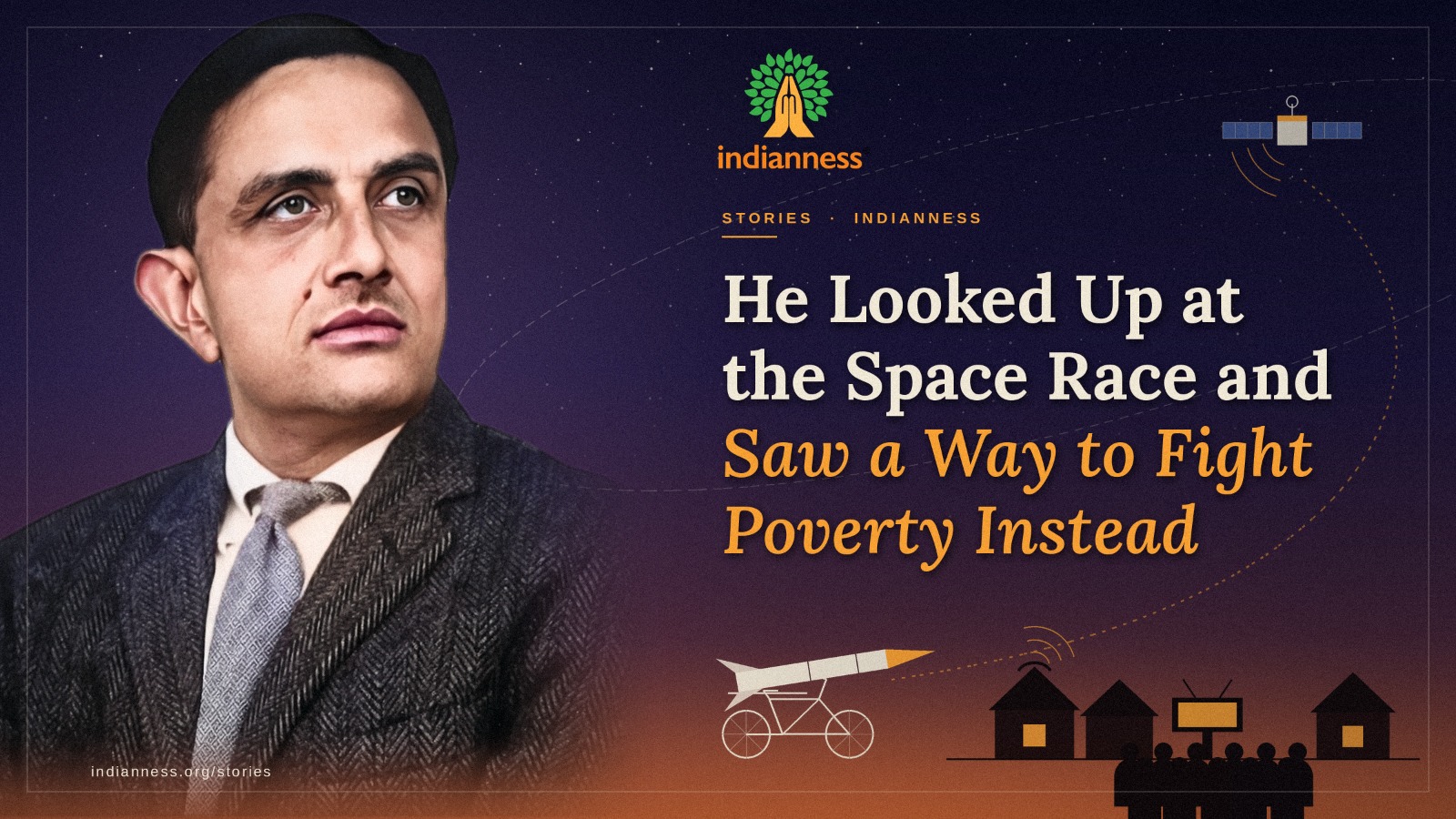
Picture the scepticism Vikram Sarabhai must have faced. This is a country that, in the early 1960s, hadn’t yet solved chronic food shortages. A country with almost no industrial manufacturing base to speak of, where a large share of the population lived in villages with no electricity, no telephone lines, and often no school within walking distance. And into that reality, Sarabhai proposed that India should build a space programme — a field so associated, in the global imagination of the era, with Cold War superpower rivalry and staggering budgets that the very idea must have seemed, to a great many reasonable people, like a spectacular misallocation of a poor country’s scarce resources. Why would a nation that couldn’t yet feed all of its own people need to be in space?
Sarabhai’s answer to that question didn’t try to win the argument on the terms it was being asked. Instead, it quietly redefined what a space programme was even for — and that redefinition is the reason India’s space agency still operates on his founding logic today, more than fifty years after he first made the case.
A Life That Could Have Gone Anywhere — and Chose to Build Instead
Vikram Sarabhai was born into a wealthy, progressive industrialist family in Ahmedabad and trained as a physicist at Cambridge University, working in cosmic ray research alongside some of the leading scientific minds of his generation. Like Homi Bhabha, whom he knew and collaborated with closely, Sarabhai had every option available to build a comfortable, prestigious research career pretty much anywhere in the world. Instead, he spent his entire working life founding institutions — by some counts, more than a dozen of them, spanning physics, management education, textile research, and eventually, space. There’s a particular kind of restlessness in that pattern, a refusal to settle into any single completed achievement, as though he kept noticing gaps that needed filling and couldn’t quite make himself walk past them.
He Refused to Race the Superpowers to the Moon
The framing Sarabhai offered, when he began pushing for an Indian space programme in the early 1960s, was deliberately, almost stubbornly unglamorous. India, he insisted, had no interest in competing with wealthier nations in a prestige race to put human beings on the Moon. That wasn’t false modesty — it was a genuine rejection of what space exploration meant to most of the world at the time. What India needed space technology for, in his framing, was something far more immediate and far less photogenic: satellites that could dramatically improve weather forecasting for a country whose agriculture, and by extension the livelihoods of hundreds of millions of people, depended on unpredictable monsoon rains arriving roughly on schedule. Satellites that could carry television and radio broadcasts to remote villages that had no other realistic way of receiving education or information. Satellites that could improve communication and resource-mapping across a vast, geographically difficult country where laying physical infrastructure — roads, telephone wires, rail lines — to every remote corner would take generations and resources the country didn’t have.
In other words, Sarabhai looked up at the same sky everyone else was racing toward and saw an application almost no other space-faring nation was building for: technology aimed squarely at rural development and mass communication in a poor, largely agrarian country, rather than at military dominance or geopolitical bragging rights.
Bicycles, Bullock Carts, and a Church That Became a Space Centre
In 1962, Sarabhai established the Indian National Committee for Space Research, the body that would eventually become the Indian Space Research Organisation, ISRO. One of his first practical decisions was choosing where to build India’s rocket-launching facility, and he picked Thumba — a small fishing village near Thiruvananthapuram in the southern state of Kerala — specifically because its location close to the Earth’s magnetic equator made it scientifically ideal for the kind of upper-atmosphere research the fledgling programme wanted to conduct.
What happened next has become part of ISRO’s origin folklore, and it’s worth sitting with the details, because they’re genuinely almost hard to believe: the local Catholic bishop’s residence and a nearby church were among the first buildings requisitioned to house what would become India’s space research facility. In the earliest days, scientific equipment was reportedly transported to the site on bicycles and in bullock carts, because the area had none of the roads, cranes, or industrial infrastructure that a space programme would normally require anywhere else in the world. Try to picture that scene: components for rocket research, jostling along a dirt path on the back of a bullock cart, headed toward a converted church that was about to become the birthplace of a national space agency. India launched its first sounding rocket from Thumba in November 1963 — a modest scientific rocket, built on heavily improvised infrastructure, that nonetheless marked the genuine beginning of India’s presence in space.
Proving It Worked, One Village TV Set at a Time
Perhaps the clearest, most human demonstration of Sarabhai’s entire philosophy came after his death, from a project he had personally initiated while he was alive: the Satellite Instructional Television Experiment, known as SITE, conducted in 1975–76 in partnership with NASA. It used an American satellite to beam educational television programming — covering agriculture, health, and family planning — directly into roughly 2,400 villages across India that had no other access to television at all. Picture that: villagers gathering, in many cases for the first time in their lives, around a communal television set, watching programming that arrived not through wires or towers but from a machine orbiting the Earth, carrying practical information that could genuinely change how they farmed or cared for their families. It remains one of the largest experiments of its kind ever conducted anywhere, and it validated Sarabhai’s original argument in the most concrete way imaginable: that satellites could be tools of development for the rural poor, not merely instruments of national prestige for governments to point to.
He Died Before He Ever Saw Any of It Work
Sarabhai died suddenly in 1971, at the age of 52, before India had launched a single satellite of its own. Aryabhata, India’s first satellite, went up in 1975 — four years after his death. The country’s first satellite launched on an Indian-built rocket followed only in 1980, nearly a decade after he was gone. He never saw the headline achievements that his work made possible. There’s something quietly devastating in that timeline if you let yourself sit with it: a man who spent the last decade of his life patiently building an institution, a philosophy, and a physical launch site out of almost nothing, and who died before any of it produced the visible results he had spent his life arguing for.
What Outlived Him Was Bigger Than Anything He Saw Built
What he left behind, instead of the achievements themselves, was something arguably more durable: the institutional architecture and founding philosophy that ISRO still operates within today, decades later. An agency whose stated mission has always centred on affordable, application-driven space technology aimed at national development, rather than exploration or prestige for its own sake — a positioning that later helped ISRO become known around the world for running ambitious missions, including to the Moon and Mars, at a fraction of the cost of comparable programmes run by far wealthier countries. Every time that comparison gets made — India’s Mars mission costing less than a Hollywood space film’s production budget, a detail that circulated widely in global media — it is, in a quiet and mostly unacknowledged way, still Sarabhai’s original argument playing out: that a space programme built around a poor country’s real needs, rather than around imitating wealthier ones, could still reach genuinely extraordinary places.
Sources: Indian Space Research Organisation institutional history; Physical Research Laboratory founding archives; contemporaneous accounts of the Satellite Instructional Television Experiment (SITE).