
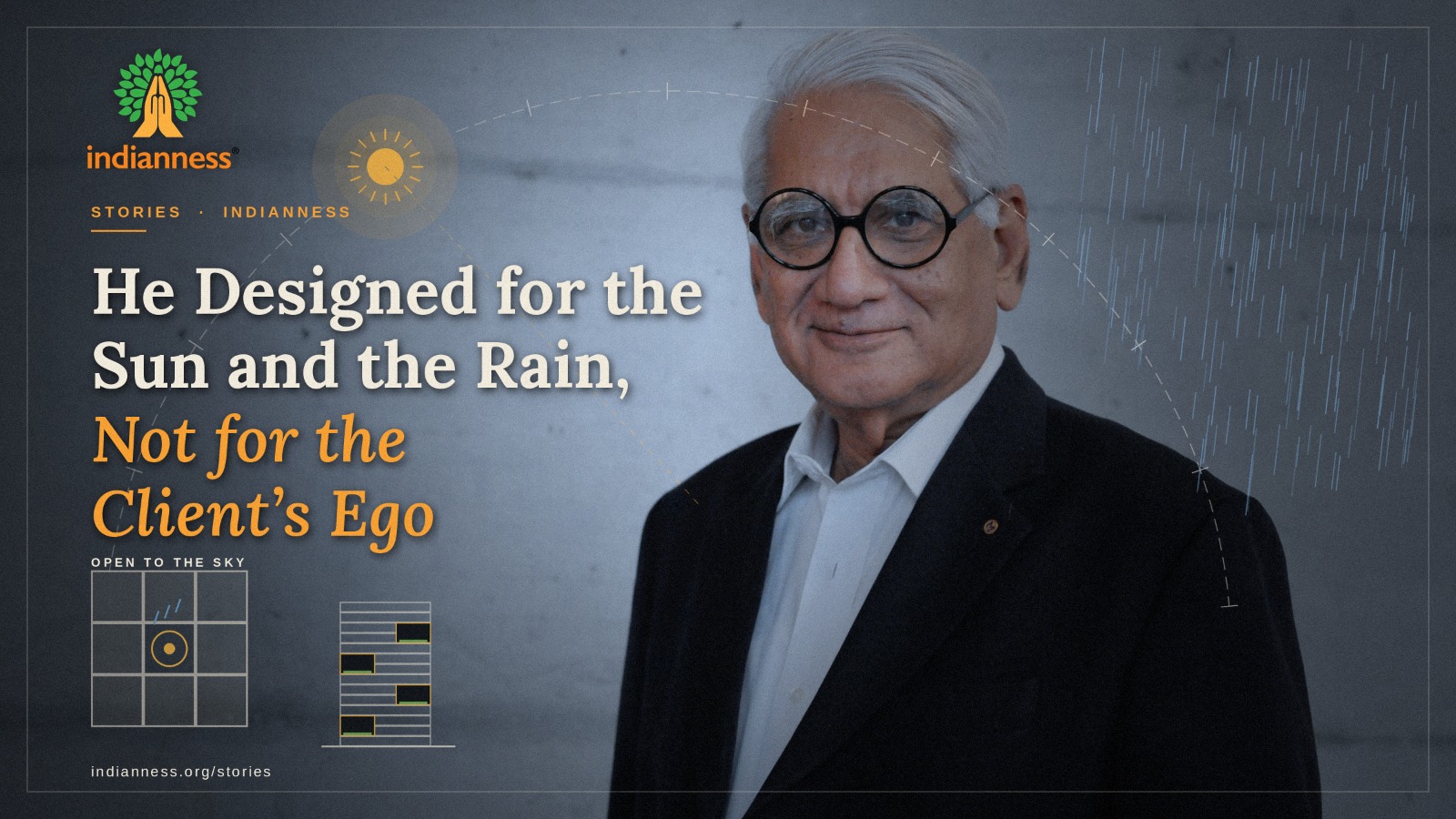
There’s a specific, easily overlooked kind of arrogance built into a great deal of modern architecture: the assumption that a building design proven successful in one climate, one culture, one set of daily habits, can simply be transplanted somewhere else with only minor cosmetic adjustments. Charles Correa spent his entire career arguing against that assumption, in the specific and demanding context of India’s climate and its particular patterns of daily life — insisting that a building’s fundamental design should emerge from the place it stands in, the sun and heat and rain it has to contend with, and the way people who live there actually move through their day, rather than from whatever architectural style happened to be internationally fashionable at the time.
Correa trained as an architect at the University of Michigan and the Massachusetts Institute of Technology in the United States, immersed for years in the modernist architectural movement then dominating global design thinking — a movement built substantially around the climate, materials, and lifestyle assumptions of temperate Europe and North America. He returned to India with formidable technical training, but also with a clear-eyed understanding of exactly how poorly much of that training actually applied to Indian conditions: a hot, often humid climate utterly different from anywhere his professors had designed for, a culture in which outdoor and semi-outdoor space plays an entirely different role in daily life than it typically does in colder countries, and a scale of urban poverty and housing need that most of the modernist architectural theory he’d studied had never seriously had to reckon with at all.
Building Around the Sun Instead of Fighting It With Air Conditioning
Correa’s design philosophy centred on what he called “form follows climate” — a deliberate variation on the modernist maxim “form follows function,” reoriented specifically around the reality that a building’s function, in a genuinely hot climate, is inseparable from how effectively it manages heat, light, ventilation, and shade. Rather than relying on mechanical air conditioning to compensate for buildings that were, at a fundamental design level, poorly suited to their climate — the default solution that a great deal of internationally influenced modern architecture in developing countries quietly adopted — Correa designed buildings that used passive architectural techniques to remain naturally comfortable: deep verandahs providing shade from direct sun, courtyards allowing air to circulate and creating shaded outdoor living space, thick walls and carefully oriented openings that minimised heat gain while still allowing natural light and ventilation, and building layouts that consciously drew on centuries-old vernacular Indian architectural techniques rather than dismissing them as pre-modern and irrelevant to contemporary design.
This wasn’t nostalgic traditionalism for its own sake, dressed up as environmental consciousness. It was a genuinely rigorous engineering and design response to a very specific climate problem, arrived at by taking traditional building wisdom — developed and refined over centuries by builders who had no other reliable way to manage heat besides getting the architecture itself right — as seriously as any imported modernist theory, rather than treating traditional approaches as something a “modern” architect should simply move past.
Housing Designed to Assume Poverty, Not Design It Away
Correa’s most socially significant work addressed a problem that most celebrated architects, in India and internationally, largely ignored or treated as beneath serious architectural attention: designing genuinely affordable, dignified housing for India’s urban poor, at the enormous scale that rapid urbanisation actually demanded. He developed and championed the concept of low-rise, high-density housing specifically calibrated to Indian conditions and Indian household patterns — recognising that many Indian families, across income levels, valued direct access to open ground-level or semi-outdoor space for cooking, socialising, and children’s play in a way that high-rise apartment towers, however space-efficient on paper, often failed to provide at all.
His approach to affordable housing consistently treated genuine architectural quality and dignity as compatible with low-cost construction, rather than accepting the common, often unstated assumption that housing for poor people could reasonably sacrifice design quality entirely in the name of cost savings. Correa argued, in his writing and through his built projects, that poor families deserved thoughtfully designed housing every bit as much as wealthy clients did — climate-appropriate, spatially generous within genuinely tight budget constraints, and organised around how people actually lived, rather than around whatever was cheapest and fastest for a contractor to simply repeat identically across a housing block.
Planning a Whole City Around One Radical Idea: Growth Shouldn’t Mean Crowding
Correa’s ambitions extended well beyond individual buildings into urban planning at a genuinely large scale. He served as chief architect for Navi Mumbai, a large planned new city developed specifically to relieve chronic overcrowding in Mumbai, one of the most densely populated cities in the world. His planning approach for Navi Mumbai emphasised decentralised, mixed-use development and a deliberate rejection of the assumption that a growing metropolitan region necessarily had to keep concentrating people and infrastructure ever more densely into its already overburdened original core.
He also chaired a National Commission on Urbanisation for the Indian government, translating his architectural design philosophy into broader national policy recommendations about how India’s rapidly growing cities should actually be planned and managed — a rare instance of a practising architect being asked to help shape policy at a genuinely national scale, rather than remaining confined to individual building commissions.
Global Recognition That Never Cost Him His Local Relevance
Correa’s work earned him substantial international recognition, including the Royal Gold Medal from the Royal Institute of British Architects and the Praemium Imperiale from the Japan Art Association, placing him firmly among the most celebrated architects of his generation on a genuinely global stage. What makes that international recognition notable, rather than simply a career accolade, is that it came for work that remained deeply, specifically rooted in Indian climate and Indian social conditions throughout his entire career, rather than for work that achieved international acclaim by abandoning that specificity in favour of a more placeless, internationally exportable architectural style — the kind of generically “global” design language that a great deal of internationally celebrated contemporary architecture has increasingly gravitated toward.
What “Designing for the Place” Actually Requires
Correa’s underlying argument — that genuinely good architecture has to emerge from a sustained, serious engagement with a specific climate, a specific culture, and a specific pattern of daily life, rather than from an imported style applied uniformly regardless of where it lands — has become an increasingly influential and increasingly urgent idea in global architectural thinking, particularly as climate change makes energy-intensive, climate-inappropriate buildings a genuinely serious environmental problem rather than merely an aesthetic one. Correa was making this argument, and building serious, technically rigorous buildings around it, decades before sustainability became a mainstream architectural priority — not because he was trying to be prescient about a coming trend, but because he had simply looked honestly and carefully at where he was actually building, and designed accordingly.
Sources: Royal Institute of British Architects Gold Medal citation for Charles Correa; Praemium Imperiale award records; Charles Correa’s published architectural writing on climate-responsive design and Indian urbanisation.