
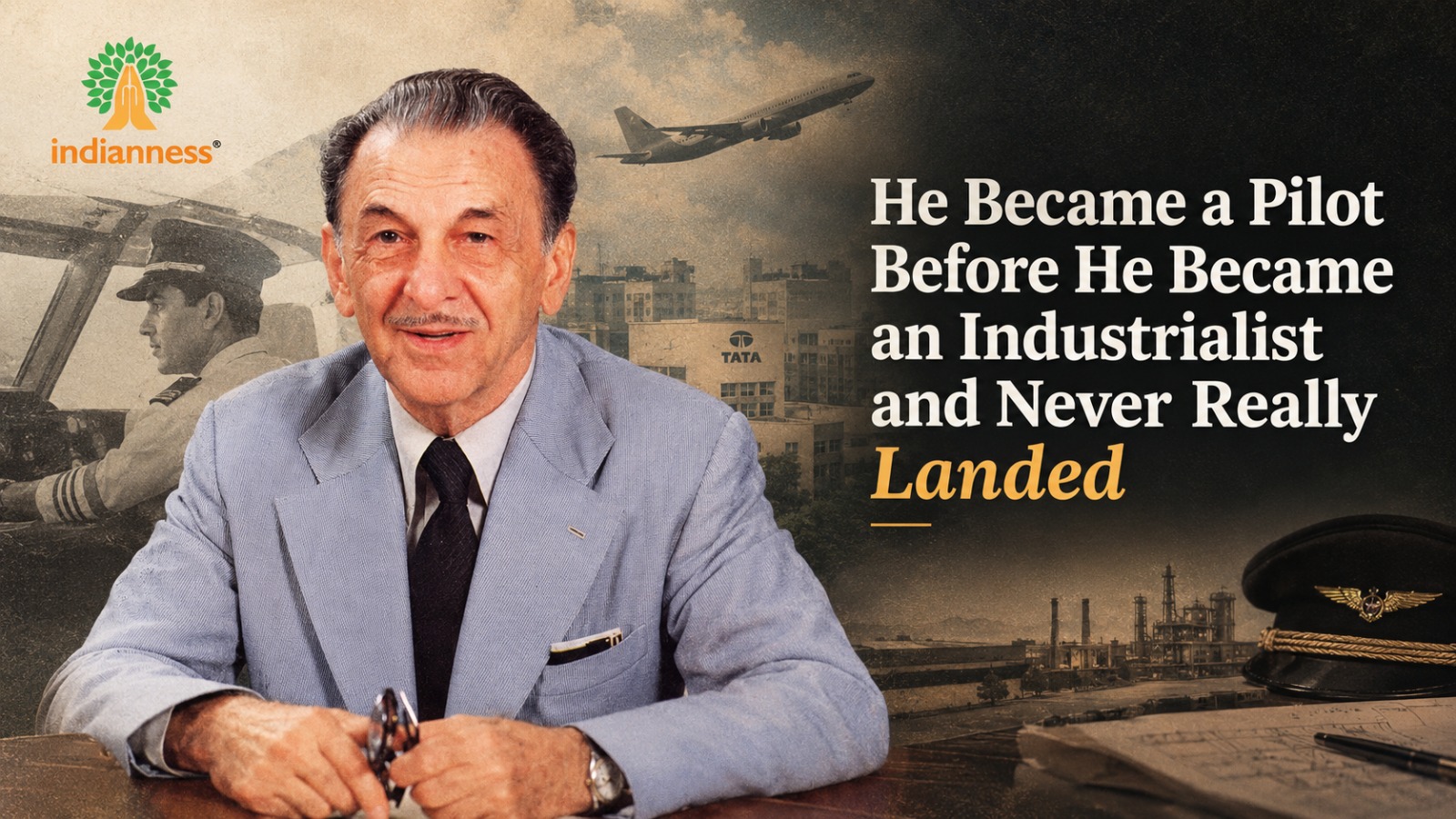
Before he ran one of the largest industrial conglomerates in Asia, before boardrooms and balance sheets and decades of steering one of the biggest employers on the subcontinent, JRD Tata did something almost no business leader of his era would have thought to do: he personally learned to fly, sat the exams, earned the licence, and got into the cockpit himself. That wasn’t a hobby he kept carefully separate from his business career, indulged on weekends and forgotten on Monday mornings. It was, in a very real sense, the reason India has a national airline industry at all.
Jehangir Ratanji Dadabhoy Tata was born in Paris in 1904, to an Indian father and a French mother, and spent his childhood moving between France and India — a genuinely unusual upbringing for the era, straddling two cultures and two languages before he’d even reached adulthood. As a young man, he became fascinated with flight, at a time when aviation was still a novel, faintly reckless technology — daredevil territory more than established industry, the kind of pursuit that worried families and made newspaper headlines when it went wrong. In 1929, Tata became the first Indian to receive a commercial pilot’s licence — not an honorary gesture or a ceremonial credential handed to a wealthy young man for the optics of it, but a genuine qualification, earned through the same rigorous training any working pilot of that era would have had to complete.
He Flew the First Flight Himself, Because Someone Had To
Tata didn’t stop at holding the licence and quietly filing it away as an achievement. In 1932, he personally piloted the inaugural flight of Tata Air Mail Services’ route between Karachi and Mumbai, carrying mail — genuinely new infrastructure for the region at the time, connecting cities in a fraction of the time that surface transport by rail or road required. Picture him actually in that cockpit: a young industrialist who could easily have delegated the entire venture to hired pilots and simply funded it from a comfortable distance, choosing instead to be the one at the controls on the day it mattered most, when the entire idea was still unproven and there was no guarantee it would work at all.
That airmail operation became the direct predecessor of Tata Airlines, which he founded and built into India’s first commercial airline. This was not an eccentric industrialist’s expensive hobby dressed up as a business. Tata Airlines operated as a genuinely serious commercial carrier through the 1930s and 40s, carrying real passengers and real cargo on a real schedule. After India’s independence, the government nationalised the international operations of Indian airlines in 1953, drawing heavily on the airline Tata had built from nothing over the preceding two decades. That nationalised entity became Air India — and in a genuinely unusual arrangement, Tata was retained as its chairman for decades afterward, continuing to shape the airline’s standards for service and safety even after the underlying business had passed out of his own family’s hands and into the state’s. Air India, later reprivatised and brought back under Tata Group ownership in 2022, traces its institutional lineage directly back to the airline that JRD Tata founded — and personally flew — nearly a century earlier.
Running an Industrial Empire Without Ever Letting Go of the Cockpit
Aviation was, in terms of sheer scale, actually the smaller part of Tata’s professional life — he simultaneously led the Tata Group, one of India’s largest industrial conglomerates, across steel, chemicals, hospitality, and eventually a wide range of other sectors, for over five decades starting in 1938. Under his chairmanship, the Tata Group expanded enormously and became closely associated with a distinctive style of Indian industrial leadership — one that combined genuinely aggressive commercial ambition with an unusually explicit, sustained commitment to employee welfare, philanthropy, and institution-building. It’s a combination that shaped what “responsible” big business was expected to look like in India for generations of executives who came after him, many of whom never met him but still operated inside standards he’d helped establish.
And yet aviation remained something more than a business line he’d delegated and moved on from. Colleagues and biographers consistently describe Tata continuing to fly personally well into his career, long after he could have handed every operational detail to professional pilots and administrators without anyone thinking twice about it. That’s not really a business decision at all. It reads more like an unresolved, lifelong fascination — an engineer’s and a pilot’s genuine love of the mechanics of flight itself, refusing to be fully absorbed into the more abstract, more distant work of running a sprawling industrial empire from behind a desk.
Turning Private Wealth Into a Public Obligation
Tata’s broader legacy reached well past both aviation and the Tata Group’s commercial businesses. He was closely involved in establishing major Indian institutions in science, medicine, and social welfare, including the Tata Institute of Fundamental Research and the Tata Memorial Hospital for cancer treatment and research. There’s a recurring pattern worth noticing among the figures whose stories echo his — industrialists and scientists of that particular generation of newly independent India who seemed to treat private wealth less as something to be simply accumulated and enjoyed, and more as a resource that came bundled with an obligation to build public institutions that would outlast them, for people who would never know their names.
He received the Bharat Ratna, India’s highest civilian honour, in 1992 — recognition that spanned both his decades of industrial leadership and his foundational role in Indian civil aviation, a rare instance of a single award trying to capture two entirely different kinds of legacy at once.
Why the Aviation Story Actually Tells You Who He Was
Tata is most often remembered, reasonably enough, as one of India’s most significant industrialists — a name attached to steel plants, hotels, and a vast corporate group that still shapes the Indian economy today. But the aviation story is arguably the more revealing one, precisely because of what it shows about how he actually approached a new and uncertain venture. It shows a man who didn’t just fund or authorise an emerging industry from the comfortable distance of a boardroom, issuing instructions and waiting for reports. He trained for it. He qualified for it, the same way any working pilot had to. And he personally flew the very first flight of the airline he was building, at a moment when the whole idea could easily have failed — treating a genuinely new technology not as a business opportunity to be managed from a distance, but as something worth learning to operate with his own hands, in his own body, at real personal risk, because he apparently couldn’t imagine building it any other way.
Sources: Air India and Tata Group institutional histories; contemporaneous records of Tata Air Mail Services’ inaugural 1932 flight; Government of India Bharat Ratna citation records.