
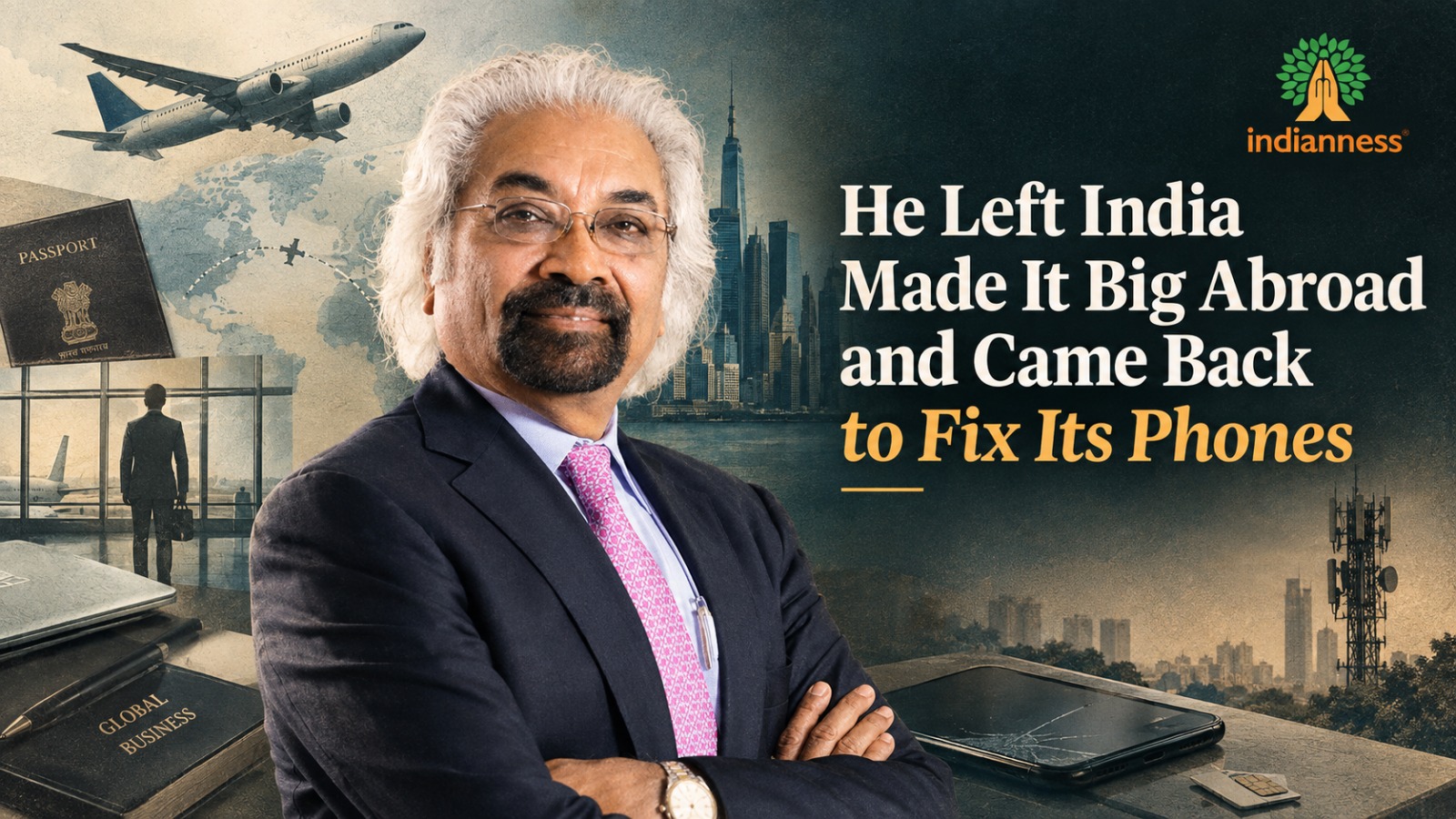
There’s a particular kind of frustration that comes from leaving a country, building a genuinely successful career somewhere else, and then coming home to find that something as basic as making a phone call is still nearly impossible. Sam Pitroda had already built and sold a telecommunications technology company in the United States — he was, by any conventional measure, a settled, wealthy Indian-American engineer with no obvious reason to return. But in the early 1980s, he went back to India anyway, driven by an idea that most people around him treated as somewhere between naive and delusional: that a country where most villages had never seen a working telephone could, within a matter of years, wire itself for direct-dial calling from nearly anywhere to anywhere.
To understand how radical that idea actually was, you have to understand what India’s telephone network looked like at the time. Getting a landline connection installed in an Indian city in the early 1980s could take years of waiting, bribery, or political connections — a running joke and a genuine source of national frustration. Rural India, home to the vast majority of the population, was almost entirely without telephone access at all. Making a long-distance call, even from a city, often meant booking it in advance through an operator and waiting, sometimes for hours, for the connection to actually go through. Pitroda had spent years in the United States, where any of this would have seemed like a description of technology from an earlier century. He came back to a country still living inside it.
Convincing a Government to Bet on Technology It Hadn’t Even Built Yet
Pitroda’s specific proposal was to develop Indian-designed digital telephone exchange technology, rather than continuing to rely on expensive imported switching equipment that most of the country couldn’t remotely afford to deploy at the scale needed. In 1984, he founded the Centre for Development of Telematics, known as C-DOT, with the explicit goal of designing rugged, low-cost digital exchanges specifically suited to Indian conditions — able to handle dust, heat, power fluctuations, and the kind of unreliable infrastructure that imported Western telecom equipment, designed for entirely different environments, simply wasn’t built to survive.
This required convincing India’s government, led at the time by Prime Minister Rajiv Gandhi, that a country still struggling with widespread poverty and food insecurity should invest seriously in domestic telecommunications research and development — a case that, on paper, must have sounded almost as improbable as Homi Bhabha’s earlier argument for nuclear physics research in a country that couldn’t yet feed itself. Pitroda’s argument was that communication infrastructure wasn’t a luxury to be deferred until the country grew richer — it was one of the preconditions for the country actually growing richer, because farmers, small businesses, and rural communities cut off from reliable communication were also cut off from markets, information, and opportunity in ways that compounded every single day the gap wasn’t closed.
The Yellow Booths That Put a Phone Within Reach of Nearly Everyone
What Pitroda and C-DOT actually built became one of the most visible and, in its own quiet way, socially transformative pieces of infrastructure in modern Indian history: the Public Call Office network, widely recognised by its bright yellow signage, which placed public telephone booths in villages and towns across the country, often for the very first time. These weren’t just conveniences for people who already had other options. For millions of Indians, a PCO booth in their village represented the first reliable way to call a relative working in a distant city, to check on a hospital patient without travelling there in person, to negotiate a price for crops with a buyer instead of waiting for someone to physically show up, or simply to be reachable by the outside world at all.
It’s worth sitting with what that actually changed in someone’s daily life. A migrant labourer working far from home no longer had to wait for a letter, which might take weeks, to know whether his family was safe after a flood or an illness. A small trader in a remote town could suddenly call ahead to confirm a shipment instead of travelling for days on the uncertain chance that the goods would actually be there. The yellow PCO booth became, for an entire generation of rural and small-town India, the physical object that first made the idea of instant, long-distance communication feel real rather than theoretical.
Quietly Wiring the Revolution Nobody Could See Coming Yet
The digital exchange technology C-DOT developed under Pitroda’s leadership dramatically expanded the capacity and reach of India’s telephone network through the late 1980s and 1990s, at a fraction of the cost that continuing to rely on imported systems would have required. This mattered enormously for what came next: when mobile telephony arrived in India in the 1990s and exploded into one of the largest and fastest-growing mobile markets in the world in the 2000s, it grew on top of a domestic telecommunications engineering base and policy environment that Pitroda’s earlier work had helped establish. It’s easy to look at India’s mobile phone boom — hundreds of millions of new subscribers added within a matter of years — and see only the dramatic, visible growth. It’s harder, but more accurate, to trace that boom back to unglamorous decisions made a decade earlier about domestic manufacturing capacity and rural infrastructure policy that most people never think about at all.
Pitroda went on to serve as an advisor to multiple Indian governments over the following decades on technology, telecommunications, and innovation policy, carrying the same basic instinct across each role: that a country’s technological infrastructure decisions made today determine, often invisibly, what kinds of economic opportunity are even possible for its citizens a decade or two later.
What It Means to Come Home With Something Left to Prove
Pitroda’s story resonates with a specific, recognisable experience for diaspora professionals in many countries: the particular mix of frustration, obligation, and stubborn optimism that comes from having left, succeeded somewhere else, and then looked back at what was left behind with the clear-eyed, slightly impatient perspective of someone who has seen it done differently and refuses to accept that it couldn’t be done better at home too. He didn’t return to India to build a comfortable second act to an already successful career. He returned because he’d apparently spent enough years abroad to see exactly how far behind his home country’s basic infrastructure had fallen — and because, unlike most people who notice that gap from a distance, he was willing to come back and spend years in unglamorous committee meetings and government offices trying to close it.
The yellow PCO booths that once dotted nearly every Indian village have largely disappeared now, replaced by the mobile phones that grew, in no small part, out of the domestic engineering capacity Pitroda helped build. That’s not really a loss. It’s closer to a quiet kind of success — the sign of an infrastructure project that did its job well enough to eventually make itself obsolete.
Sources: Centre for Development of Telematics (C-DOT) institutional history; Government of India telecommunications policy archives from the 1980s and 1990s; contemporaneous accounts of Sam Pitroda’s role in India’s telecom modernisation.