
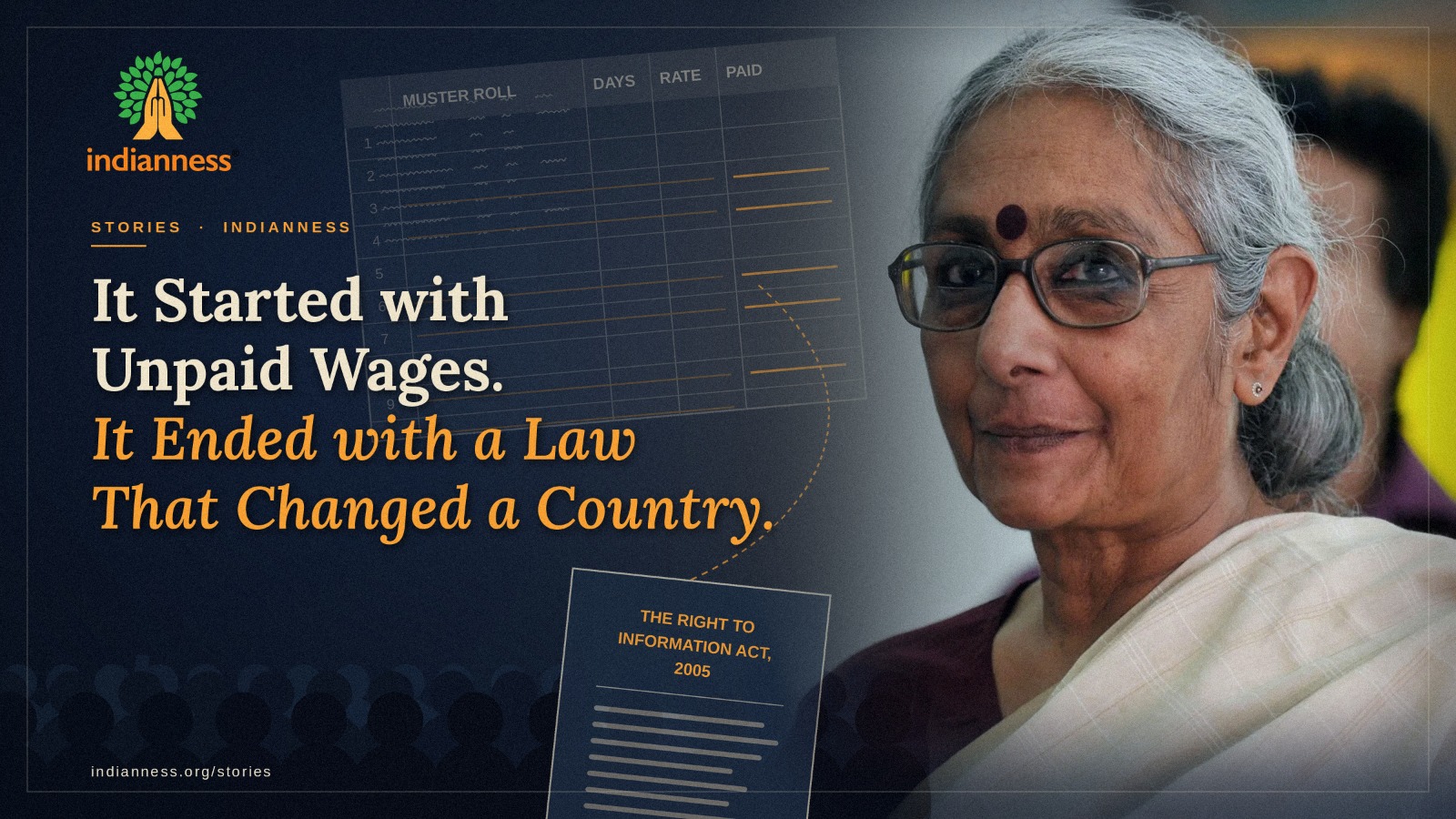
Imagine trying to find out why your family was never paid the wages you were legally owed for government construction work you had genuinely, verifiably completed — and discovering that you have absolutely no legal right whatsoever to see the government’s own official records that would tell you the answer. That was the specific, recurring situation facing rural workers across Rajasthan in the early 1990s, and it was the very concrete, unglamorous starting point for what eventually became one of the most significant pieces of transparency legislation passed anywhere in the world: India’s Right to Information Act.
Aruna Roy had already built a substantial career within the Indian civil service, a genuinely prestigious and secure professional path in Indian society, before resigning from it in 1975 to work directly in rural development. That specific decision — deliberately walking away from a stable, high-status government career to work directly, on the ground, alongside some of India’s poorest rural communities — set the pattern for the rest of her career: a consistent, sustained preference for building power and accountability directly from the ground up, among the people most directly affected by government decisions, rather than attempting to influence policy purely through more comfortable, top-down bureaucratic or elite advocacy channels.
Unpaid Wages and Government Secrecy Turned Out to Be the Same Problem
In the early 1990s, working with the Mazdoor Kisan Shakti Sangathan, a grassroots organisation representing rural labourers and small farmers, Roy encountered a specific, recurring, and genuinely infuriating pattern: workers employed on government-funded rural infrastructure and development projects frequently weren’t paid the full wages they were legally owed, and when they attempted to challenge this, they discovered they had no formal legal right to inspect the official government records — attendance registers, wage payment records, project expenditure accounts — that would actually let them verify whether they had, in fact, been paid correctly and in full. The government held every relevant record. The workers whose own labour and legal rights those records directly concerned had no legal right whatsoever to see them.
This specific, repeated injustice crystallised into a broader, more ambitious demand: the organisation began actively campaigning for a fundamental legal right to information, arguing that citizens could not meaningfully exercise their existing rights, hold their own government genuinely accountable, or expose corruption in any systematic way if the government was legally permitted to simply withhold the underlying official records that any of that oversight actually depended on being able to see. It’s a genuinely foundational point, easy to overlook until you actually encounter it in concrete practice the way these Rajasthan workers repeatedly did: nearly every other citizen right — freedom from corruption, freedom from unfair treatment, the basic ability to verify that public money has actually been spent as officially claimed — depends, in practice, on having access to the specific information needed to actually verify and enforce it.
Turning a Village-Level Demand Into a Piece of National Law
What began as localised, direct grassroots organising in rural Rajasthan — including public hearings where villagers directly and publicly confronted local officials with specific, itemised discrepancies between official government spending records and their own genuinely lived, verifiable experience — gradually grew, over more than a decade of sustained organising and advocacy, into a genuinely broad, cross-regional national campaign for a formal right to information law applying across the entire country. Roy became one of the most prominent and consistently visible national figures in this movement, helping translate what had originally been a specific, localised grievance about unpaid rural wages into a coherent, well-articulated, and ultimately successful demand for a fundamental change to how the Indian government operated with respect to its own citizens.
This sustained organising work eventually culminated in the passage of India’s Right to Information Act in 2005 — landmark legislation granting Indian citizens a broad, legally enforceable right to request and receive information held by government bodies at every level, from the smallest village panchayat to the national government itself, with clearly specified response timelines and meaningful, legally enforceable penalties for officials who improperly refused or unreasonably delayed a legitimate information request.
What Changes When Ordinary People Can Finally See the Paperwork
The practical, on-the-ground impact of this law has been genuinely substantial and has extended well beyond its original, more narrowly focused starting point in rural wage disputes. Indian citizens have used the Right to Information Act to expose significant corruption in government contracts, to verify that public infrastructure projects were actually completed to the specifications and standards officially claimed, to challenge and successfully overturn arbitrary or improperly justified bureaucratic decisions, and to hold public officials directly and specifically accountable in a way that had previously been functionally impossible under a system in which government information was, by legal default, treated as confidential unless a specific and often difficult-to-obtain exception applied.
Consider the specific, tangible practical difference this makes in daily life for an ordinary citizen. Before the law, a family whose application for an official document had somehow inexplicably stalled for months inside government offices had essentially no formal mechanism to find out why, or to compel any kind of timely response. After the law, that same family could file a simple, legally structured information request specifically asking exactly what stage their application had reached and precisely why it had been delayed — and government officials were now legally required to actually answer, within a clearly specified timeframe, or face real, specified legal consequences for failing to do so. That may sound, on its surface, like a small, almost bureaucratic procedural change. In the accumulated, lived experience of literally millions of individual citizens dealing with entrenched, opaque government processes, it represented a genuinely fundamental shift in where the underlying balance of power and accountability actually sat.
Refusing to Let a Landmark Win Become the End of the Fight
Roy has continued to advocate consistently for strengthening and actively protecting the Right to Information Act against subsequent attempts, from various governments over the years, to weaken or narrow its scope and practical reach, and she has remained deeply, actively involved in grassroots organising around related rural employment and social welfare policy issues well beyond information rights specifically. Her sustained, decades-long approach — building political and legal change from the accumulated weight of concrete, specific, individually experienced local grievances rather than starting from abstract policy theory and working downward — has become an influential, widely studied model for grassroots-driven policy reform movements in other countries, particularly other developing democracies grappling with genuinely similar underlying problems of entrenched government opacity and weak, hard-to-enforce citizen oversight mechanisms.
India’s Right to Information Act remains one of the most actively and heavily used transparency laws in the world by sheer volume of citizen requests filed, a direct and lasting legacy of rural workers in Rajasthan who first demanded, quite simply, the basic legal right to see whether they had actually been paid what they were genuinely owed — and who then had the sustained persistence, organisation, and eventual national reach to turn that specific, concrete local grievance into a fundamental, enforceable right for the entire country.
Sources: Mazdoor Kisan Shakti Sangathan institutional history; Government of India Right to Information Act, 2005, legislative records; contemporaneous accounts of the Rajasthan-based campaign for the right to information.