
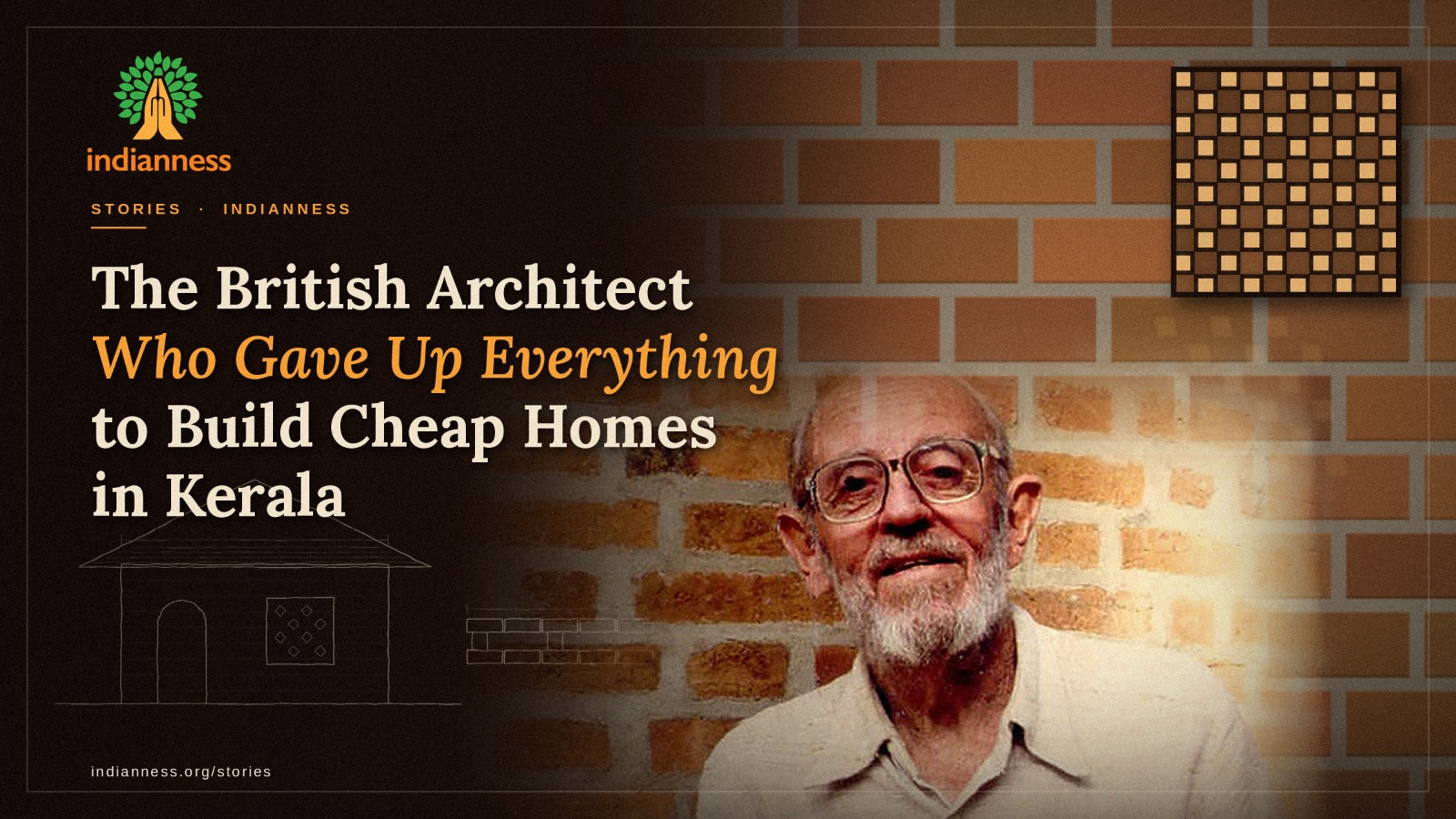
Laurie Baker was born in England, trained as an architect in Birmingham, and could very reasonably have built a comfortable, conventional career designing buildings for wealthy clients almost anywhere in the world. Instead, he spent most of his adult life in Kerala, in southern India, deliberately designing simple, radically affordable buildings for people who had almost nothing — refining, over decades, an entire building philosophy centred on a single, unglamorous, quietly radical question that most professional architects, focused on prestige commissions and striking visual design, rarely think to ask seriously at all: how do you build genuinely well, using the absolute minimum in cost and materials, without making the resulting building feel like a compromise, a lesser version of “real” architecture reserved for people too poor to afford anything better?
Baker’s path to India began, somewhat improbably, during the Second World War. As a committed pacifist, he served with the Friends Ambulance Unit, a Quaker-affiliated humanitarian organisation, and it was through that wartime humanitarian work that he first travelled to China and then India, and eventually met Mahatma Gandhi. That meeting appears to have shaped Baker’s entire subsequent worldview in a genuinely lasting way — Gandhi’s emphasis on simplicity, self-reliance, and design and technology appropriate to a community’s actual means and needs, rather than imported models designed for entirely different economic circumstances, became something close to Baker’s own guiding architectural philosophy for the rest of his career.
Learning to Build by Simply Watching How People Already Built
Baker settled permanently in India, eventually becoming an Indian citizen, and spent decades based in Kerala developing and refining an architectural approach built around local materials, local labour, and local climate conditions — a direct, lived rejection of the assumption, common among architects trained in Western institutions working in developing countries, that “proper” architecture necessarily meant imported materials, imported construction techniques, and imported aesthetic standards, regardless of whether they actually suited local conditions or local budgets at all.
Central to Baker’s approach was an almost obsessive commitment to using locally available, low-cost materials as effectively and beautifully as possible, rather than treating them as an unfortunate compromise necessitated by limited budgets. He became particularly known for his distinctive brickwork, using techniques like the “rat-trap bond” — a specific method of laying bricks on their edge rather than flat, which uses noticeably less material than conventional brick-laying while simultaneously creating an air cavity within the wall that provides genuinely useful natural insulation against heat, a real practical benefit in Kerala’s consistently warm and humid tropical climate. He favoured curved walls over straight ones in many of his designs, partly because curves generally require fewer bricks to enclose a given amount of interior floor space than straight walls with sharp corners do — a small, easily overlooked detail that, multiplied across dozens or hundreds of buildings, represents a genuinely significant cumulative saving in both material cost and the finite resource itself.
He deliberately incorporated recycled and reclaimed materials wherever they were available and structurally sound — old doors, salvaged window frames, broken tiles and pottery arranged decoratively — rather than treating scavenged materials as inherently inferior, unworthy inputs to serious architectural design. And critically, he consistently designed buildings around and in careful accommodation of existing site conditions — mature trees, natural land contours, existing rock formations — rather than the far more common and far more expensive standard construction practice of simply flattening and clearing a site entirely before building on it from scratch.
Refusing to Let “Affordable” Mean “Ugly” or “Cramped”
What set Baker apart from other architects and builders who have also worked seriously on low-cost housing was his consistent, deeply held insistence that genuinely affordable buildings could and absolutely should still be beautiful, comfortable, and thoughtfully designed — never treating cost reduction as a reasonable justification for producing buildings that felt cramped, poorly ventilated, visually unappealing, or lacking in basic human dignity. His buildings characteristically incorporated ample natural light and cross-ventilation, visually striking and genuinely functional perforated brick screens called jaalis that allowed air to circulate freely while still providing privacy and attractive dappled patterns of light and shadow, and carefully proportioned, human-scaled spaces that, by numerous independent accounts from people who actually lived and worked in them, felt genuinely warm and welcoming rather than institutional or bare, despite costing, in many documented cases, a small fraction of what conventional contemporary construction would have required for a comparable amount of usable space.
Baker’s approach reportedly could reduce construction costs by somewhere between a third and a half compared to conventional building methods, while still producing structurally sound, genuinely pleasant, and durable buildings — a combination that directly challenged, through built and lived example rather than theoretical argument, the common and rarely examined assumption that lower cost in construction must inevitably mean lower quality of life for the people who end up living or working inside the result.
Buildings Designed by Walking the Site, Not Sitting at a Desk
Baker was also known for an unusually intimate, hands-on, site-specific design process. Rather than producing complete, fixed architectural drawings in an office and then handing them off to be executed by a construction crew exactly as specified, he frequently visited construction sites in person, adjusting his designs in direct response to actual site conditions and to conversations with the specific families or communities who would eventually live or work in the finished building. This produced architecture that felt genuinely responsive to a particular place and particular people’s real, specific needs, rather than a standardised template design simply repeated identically regardless of the site or the family it was ultimately meant to serve.
Built Almost Entirely for People Architecture Usually Forgets
Over more than five decades of sustained work in India, Baker designed thousands of buildings — private homes for families with genuinely limited budgets, schools, churches, and other community institutions, largely for low-income communities across Kerala and beyond who could never have otherwise afforded architect-designed buildings at all. He received significant recognition within India for this body of work, including the Padma Shri, one of the country’s highest civilian honours, and he became known within India, with real affection, as something like the conscience of Indian architecture — a persistent, living reminder that thoughtful, genuinely dignified design shouldn’t be a luxury good reserved exclusively for wealthy clients who can afford to commission it.
Baker’s underlying philosophy — that architecture’s deepest obligation is to actual human need and genuine resource constraint, rather than to visual spectacle or professional prestige — has become an increasingly influential reference point in global conversations about sustainable and affordable building design, particularly as growing environmental and economic pressures make his decades-old emphasis on minimal material use and genuinely local, climate-appropriate construction feel considerably less like an eccentric personal choice and considerably more like an urgent, forward-looking necessity that the rest of the architecture world is only now beginning to fully catch up to.
Sources: Contemporaneous profiles and interviews with Laurie Baker on his architectural philosophy and construction techniques; Government of India Padma Shri citation records; institutional accounts of Baker’s built work in Kerala.