
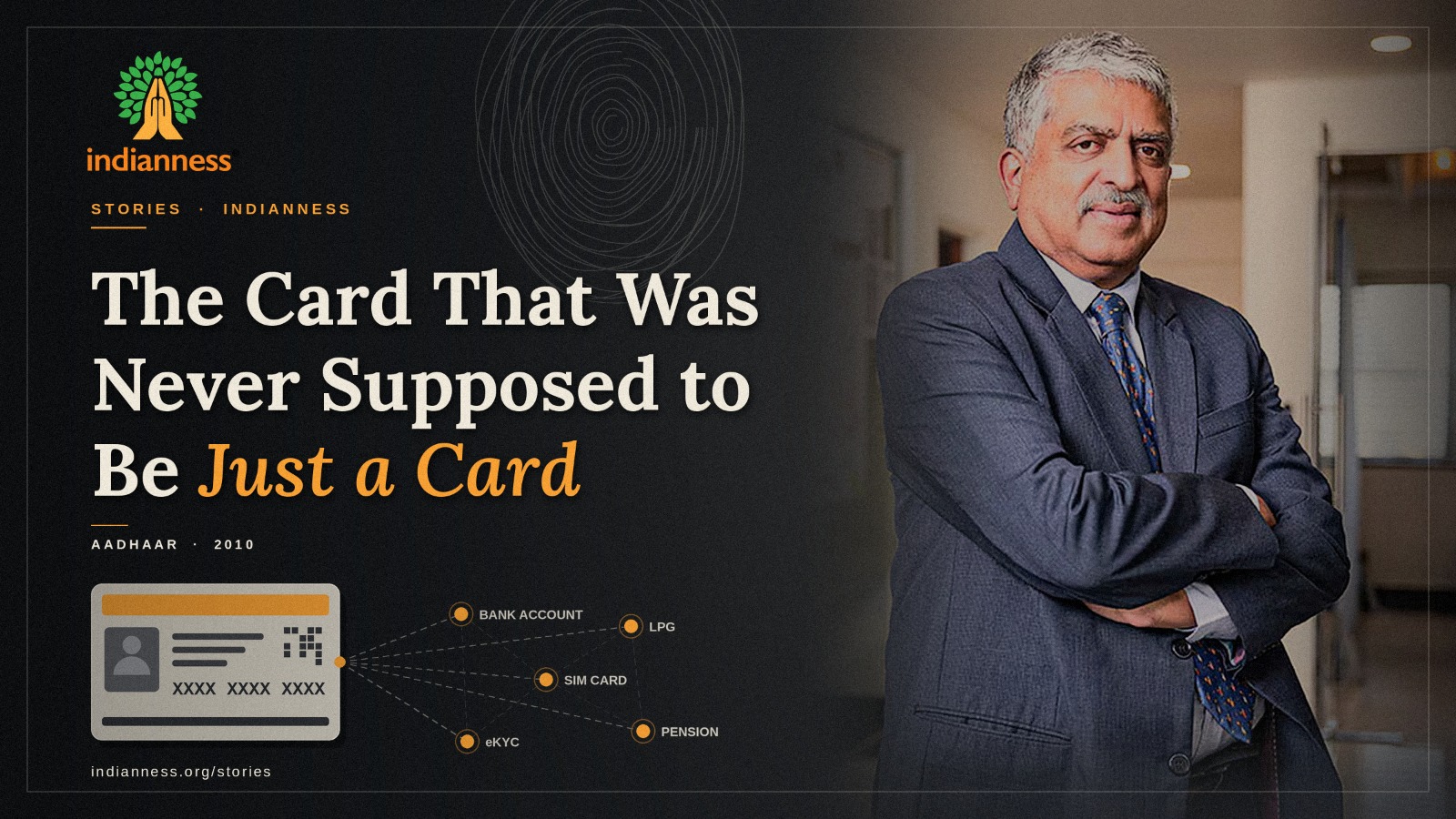
Imagine not officially existing. Not in a philosophical sense — in the specific, practical sense that no government database anywhere can confirm you are who you say you are, which means you can’t open a bank account, can’t easily prove eligibility for a subsidised ration of food, can’t get a mobile phone connection registered in your own name, and can’t reliably access government welfare programmes that are, on paper, meant for exactly people like you. For hundreds of millions of Indians before 2010 — many of them poor, rural, migrant, or simply undocumented by a fragmented and inconsistent patchwork of local identity records — this wasn’t a hypothetical. It was daily life. Nandan Nilekani’s central insight was that this invisibility wasn’t a minor administrative inconvenience. It was one of the largest, least-discussed barriers to economic participation in the entire country.
Nilekani had already built an extraordinary career before any of this. He co-founded Infosys, one of India’s most successful information technology companies, helping build it from a small startup into a global technology services giant over more than two decades. He could have simply continued in that world, comfortably wealthy and professionally accomplished. Instead, in 2009, he left the private sector to take on a government role that, on paper, sounds almost bureaucratically dull: chairman of the newly created Unique Identification Authority of India. What that role actually involved was something far more ambitious — building, essentially from scratch, a biometric identity system intended to eventually cover well over a billion people, the largest such undertaking ever attempted anywhere in the world.
One Billion People, and No Way to Prove Any of Them Existed
The specific technical challenge Nilekani inherited was staggering in scale. India, at the time, had no single, reliable, national system for verifying identity. People often held multiple different, inconsistent identity documents issued by different local and state authorities, or held no verifiable identity document at all — a situation especially common among the rural poor, migrant workers moving between states for work, and women who, in many households, had never independently been registered for anything in their own name. This absence of verifiable identity wasn’t a neutral gap. It actively blocked people from opening bank accounts, meant government subsidies frequently leaked to fraudulent or duplicate beneficiaries rather than reaching the people they were intended for, and left millions of genuinely eligible people unable to prove they qualified for programmes designed specifically to help them.
Nilekani’s proposed solution was Aadhaar — a twelve-digit unique identity number, linked to an individual’s fingerprints and iris scans, designed to give literally every resident of India a single, verifiable, portable digital identity that worked the same way whether you lived in a major city or a village with no paved road. The technical scale of this undertaking is difficult to overstate: building a biometric database and authentication system robust enough to reliably serve well over a billion people, across every kind of network condition and local infrastructure imaginable, had genuinely never been attempted before, anywhere, at anything close to this size.
Why a Number Mattered More Than Any Document Ever Could
What set Nilekani’s approach apart from earlier, failed attempts at national identity systems — in India and in other countries — was his insistence on Aadhaar functioning as an open, foundational layer of civic infrastructure rather than a single-purpose identity card. Aadhaar wasn’t designed to replace passports or driving licences. It was designed to be a verifiable digital identity that any government service, any bank, any private company could build on top of, through a set of open technical standards known as India Stack. That’s a subtle but genuinely important distinction: rather than building one more closed government system, Nilekani was trying to build the digital equivalent of a public utility — something as fundamental and broadly usable as a road or an electrical grid, that thousands of different applications could plug into.
This foundational-infrastructure approach turned out to be transformative in ways that went well beyond simple identity verification. Aadhaar, once it reached significant coverage, enabled the government to link welfare payments and subsidies directly to individual bank accounts, cutting out layers of intermediaries who had previously been able to siphon off funds meant for the poor. It made opening a basic bank account dramatically faster and simpler for people who had never had one before — in many cases, for the first time in their lives, giving them a formal, secure place to hold money rather than depending entirely on cash. It underpinned a wave of digital payment innovation in India, including systems that allowed even small vendors and rural workers to send and receive money instantly using little more than a mobile phone and a fingerprint or an Aadhaar-linked account.
What a System This Big Can Also Be Used to Do
Aadhaar has also been the subject of serious, sustained, and legitimate controversy — precisely the kind of controversy that any biometric identity system covering over a billion people probably should generate. Privacy advocates and civil liberties groups raised urgent concerns about surveillance risks, data security, and the potential for exclusion when biometric authentication failed for elderly people, manual labourers with worn fingerprints, or those in areas with unreliable internet connectivity — the same vulnerable populations the system was ostensibly built to help. India’s Supreme Court ultimately ruled on the constitutional limits of how Aadhaar could be mandated and used, restricting its application in several important respects. These debates remain genuinely unresolved in many ways, and they matter — they’re not a footnote to Aadhaar’s story, but a central and ongoing part of it, playing out in courtrooms and public debate as much as in server rooms and policy documents.
An Infrastructure Decision Most People Will Never Even Notice
What makes Nilekani’s work with Aadhaar worth understanding well beyond India’s borders is the underlying question it forces into the open: what does it actually take, at a technical and institutional level, to give an entire population a functioning digital identity, and who bears the risk when a system built to include people can also, under different political conditions, be used to exclude or surveil them? Countries around the world are wrestling with versions of this same question as they build their own digital identity and payment infrastructure, and Aadhaar — for all its genuine successes and its equally genuine, still-unresolved problems — remains the largest, most closely studied real-world case study anyone has to learn from.
Most Indians who now use their Aadhaar number to open a bank account, receive a subsidy, or verify their identity for a mobile SIM card never think about the person who first argued this kind of foundational digital infrastructure was even worth building. That’s arguably the clearest sign the underlying idea worked: it became invisible in exactly the way genuinely good infrastructure usually does.
Sources: Unique Identification Authority of India institutional records; Supreme Court of India rulings on Aadhaar (2018 and subsequent judgments); contemporaneous accounts of Nandan Nilekani’s role in Aadhaar’s design and rollout.