
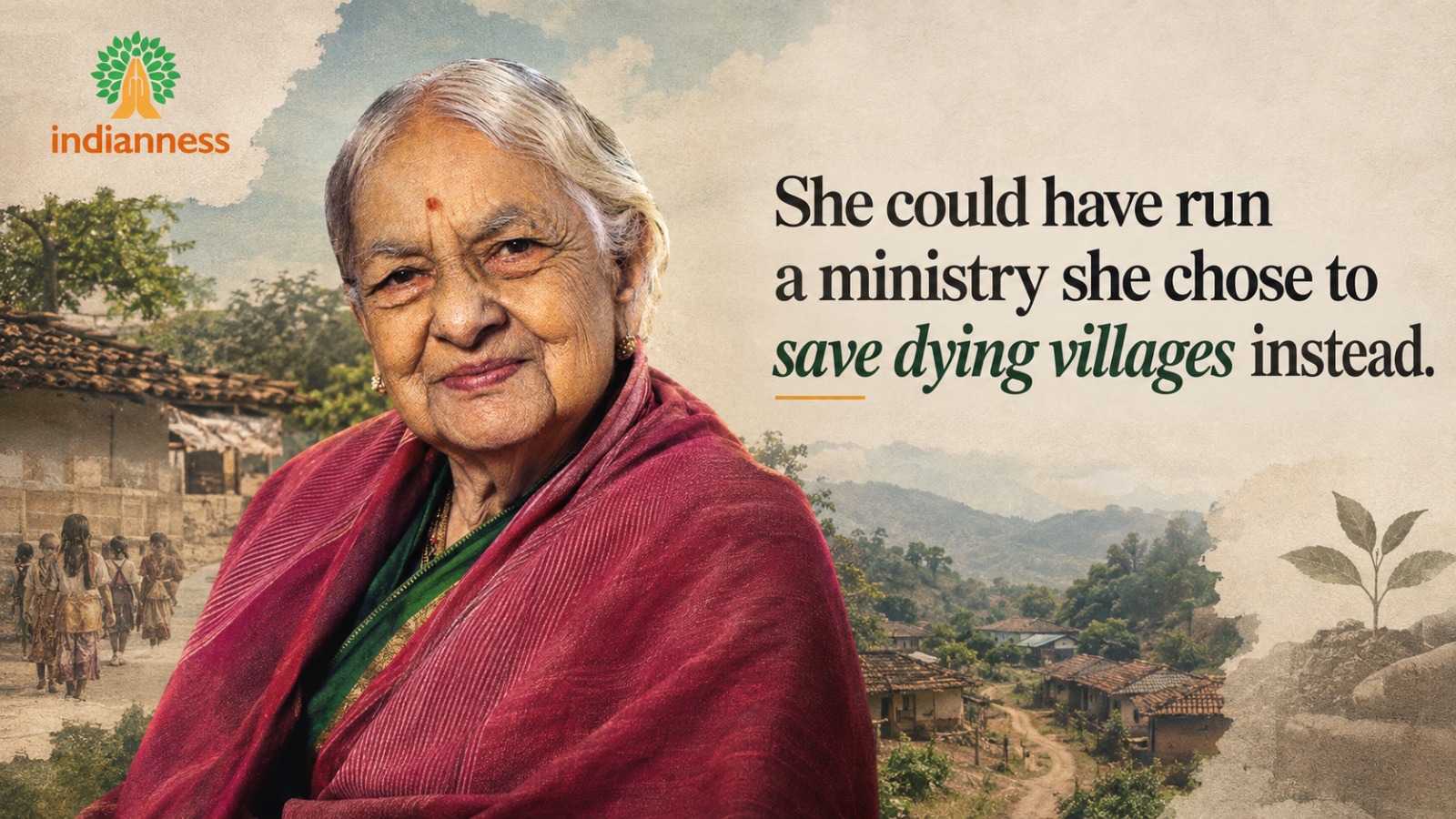
By the time she turned her attention to India’s craft traditions, Kamaladevi Chattopadhyay had already survived enough to fill several ordinary lifetimes. She had been widowed as a child, under social customs that offered young widows in colonial India almost nothing in the way of dignity or a future. She had defied those same customs by remarrying — an act of quiet, deliberate rebellion — to the poet and playwright Harindranath Chattopadhyay. She had walked into a colonial jail as a political prisoner during India’s independence movement, and had pushed, at every turn, for women to have a genuine voice in a freedom struggle that too often treated them as supporting characters. By the time India actually became independent in 1947, she had spent two decades as an activist, a writer, and an organiser, with the kind of political standing that could easily have carried her into a long, comfortable career in formal government.
She chose handicrafts instead. It’s worth pausing on how strange that choice must have looked to people around her at the time — a celebrated freedom fighter, with every door open to her, deciding to spend the coming decades travelling to remote villages in search of dying textile techniques and forgotten pottery methods. It wasn’t a retreat from public life. It was, if anything, a harder and lonelier kind of public service than the one she’d already proven she could do.
A Failing Government Shop Was Hiding a Much Bigger Loss
The specific problem placed in her hands looked, on its surface, almost mundane: a small government-run retail operation, the Central Cottage Industries Emporium, set up in the chaotic years after independence and Partition to help resettle displaced refugee artisans and sell what they made, was consistently losing money. It read like an accounting problem. It wasn’t.
Beneath that failing balance sheet sat something far larger and far more urgent: centuries-old craft traditions across India — intricate hand-painted textiles, region-specific handloom weaves, pottery techniques passed down through particular families in particular towns — were disappearing. Industrial manufacturing was making mass-produced goods cheaper and easier to find. The artisans who carried this knowledge, often the last few practitioners of a technique that had once supported entire communities, had no reliable market and no steady income, which meant no way to convince the next generation that learning the craft was worth the years it took to master. When Prime Minister Jawaharlal Nehru asked Chattopadhyay to take over the struggling emporium, he was, in effect, asking her to solve a retail problem. What she actually took on was closer to an act of cultural rescue, carried out against a ticking clock that no one else seemed to be paying close enough attention to.
Racing to Find the Last Person Who Still Remembered How
Chattopadhyay didn’t try to run this rescue from behind a desk in the capital. She travelled, often to remote and difficult-to-reach villages, specifically to find artisans practising crafts that were on the very edge of vanishing entirely — sometimes techniques with only a handful of surviving practitioners left, sometimes just one elderly craftsperson who happened to be the last living link to knowledge that had otherwise already been lost. Picture what that search must have actually involved: unreliable roads, no guarantee that the person she was looking for was even still alive or still practising, months of patient searching for a thread of knowledge that could disappear entirely the moment its last keeper did. Among the traditions she is credited with directly reviving through exactly this kind of painstaking search are Kalamkari, an intricate hand-painted and resist-dyed textile art originating in temple towns in southern India; Pochampally weaving, a distinctive tie-dye style of handloom textile; and Jaipur’s tradition of blue pottery, alongside several other regional craft forms that might otherwise exist today only as museum pieces, or not at all.
What set her approach apart was her refusal to treat these crafts as sentimental relics to be preserved behind glass. She argued, consistently and often against prevailing opinion, that traditional crafts were a genuinely viable source of income for millions of rural artisans — provided they had proper institutional support, cooperative organisation, and access to markets far beyond their immediate region. She wasn’t trying to freeze these traditions in amber. She was trying to give them a living, breathing economy to survive inside.
Building Something Strong Enough to Outlive Her
Chattopadhyay’s more lasting achievement, in the end, wasn’t any single craft she rescued — it was the institutional scaffolding she built so that the rescue work could continue long after she was no longer the one doing the travelling. She helped establish the All India Handicrafts Board in 1952, which she chaired, giving craft policy a permanent, formal home within the national government rather than leaving it dependent on the enthusiasm of any one individual. She was central to founding the Crafts Council of India, and helped shape a wider network of cooperative societies, marketing bodies, and design centres that connected individual artisans — working alone, often in isolated villages, with no way to reach buyers on their own — to markets, exhibitions, and eventually export opportunities they could never have accessed by themselves.
Her ambitions didn’t stop at crafts. In 1944, she founded what became the National School of Drama, and she played a significant role in reviving Indian classical and folk performing arts more broadly. She seemed to understand crafts, theatre, and dance as facets of the same underlying project: keeping a country’s traditional cultural knowledge economically alive, rather than allowing it to survive only as a fading memory in museum placards and academic footnotes.
What It Costs to Choose the Slow Fight Over the Easy One
There’s a particular kind of courage in Chattopadhyay’s choice that’s easy to miss if you only look at the institutions she left behind. She had the political capital, after independence, to pursue a formal government career with visible, immediate rewards — ministerial office, public recognition on a national political stage. She largely chose not to. She chose, instead, decades of slower, more decentralised, far less visible work: village visits, cooperative paperwork, the patient cultivation of trust with artisans who had every reason to be suspicious of yet another well-meaning outsider showing up with promises.
The handicraft and handloom sector she helped rebuild remains, today, one of the largest sources of rural non-farm employment in India — a living, functioning economy, employing millions, built out of traditions that were genuinely on the verge of disappearing when she first went looking for them. It’s not the kind of legacy that gets a statue in a capital city square. It’s something quieter and, in its way, more remarkable: countless individual family workshops, still weaving, still painting, still throwing pottery today, that exist at all because one woman decided a dying skill in a remote village was worth the long, uncertain journey to go and find.
Sources: All India Handicrafts Board and Central Cottage Industries Emporium institutional records; contemporary biographical accounts of Kamaladevi Chattopadhyay’s role in India’s independence movement and craft revival.