
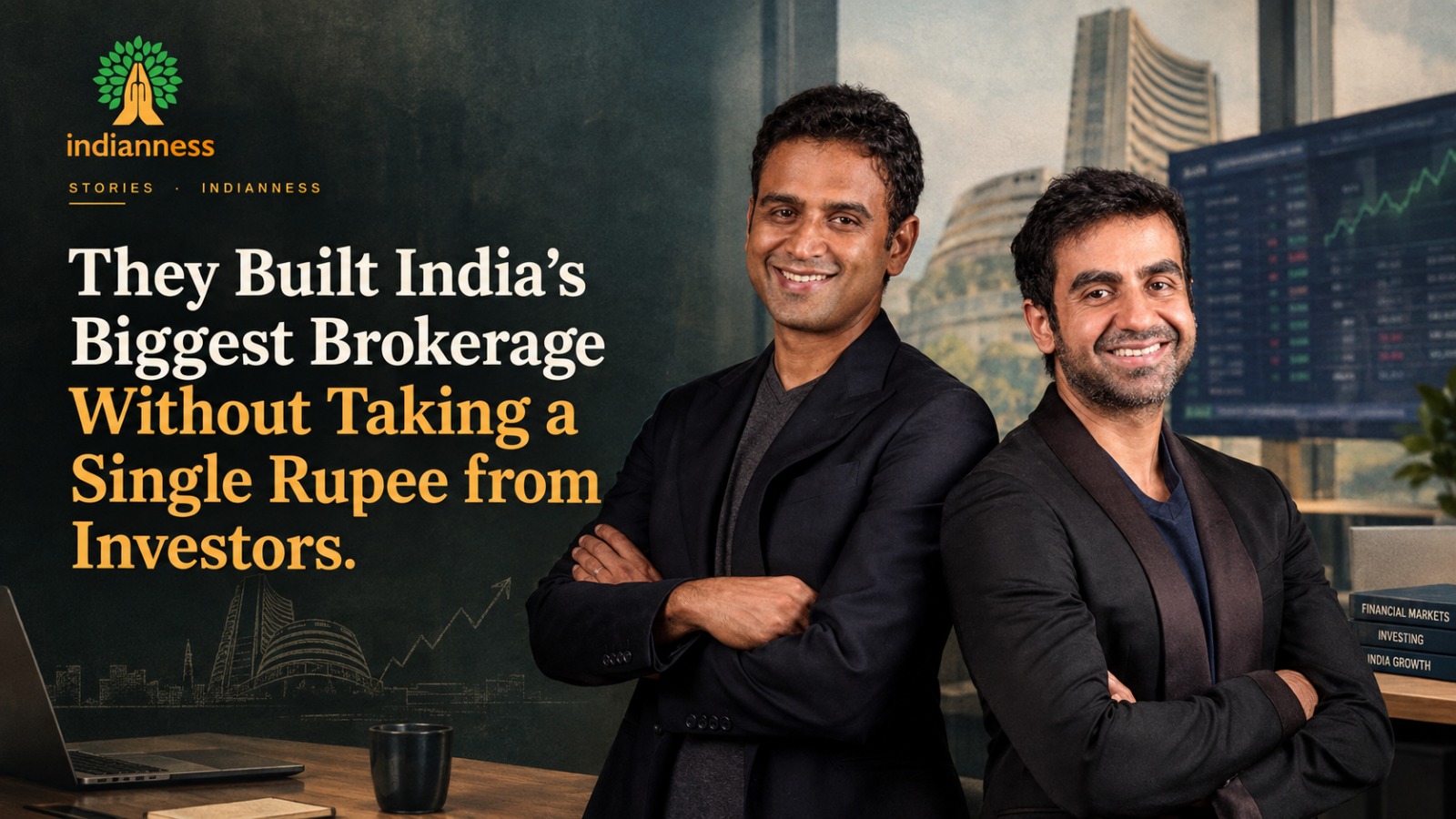
There’s a specific, well-worn script that most successful technology startups are expected to follow: raise venture capital early, use that money to grow as fast as possible, chase user numbers over profitability, and eventually either sell the company or take it public in a dramatic valuation event that makes headlines. Nithin Kamath and his brother Nikhil built Zerodha, now India’s largest stock brokerage by trading volume, by rejecting nearly every part of that script — bootstrapping the company entirely from their own savings and revenue, refusing outside investment even as the offers became larger and more persistent, and building what became a multi-billion-dollar business without ever holding a single funding round.
Nithin Kamath’s own path to founding Zerodha wasn’t a straight line from an elite engineering degree to startup success. He had traded stocks himself as a young man, largely self-taught, and had experienced directly the specific frustrations that Indian retail investors faced at the time: high brokerage fees that ate substantially into any potential trading profits, especially for smaller investors without large amounts of capital to trade with, and a general lack of transparency in how brokers actually charged for their services. He wasn’t approaching the problem as an outside consultant imagining what traders might want. He was a trader himself, irritated by a system that seemed deliberately built to extract as much fee revenue as possible from people who could least afford to lose it.
A Pricing Model Built Around His Own Frustration
Zerodha’s foundational innovation, launched in 2010, was a flat-fee brokerage model that charged traders a small fixed fee per trade rather than the percentage-based commissions most Indian brokers charged at the time. For a small retail trader, this distinction is not a minor technical detail — under a percentage-based commission structure, brokerage fees can consume a significant share of any profit on a trade, especially for people trading in smaller amounts, which effectively locks smaller investors out of active participation in the market unless they’re trading in volumes large enough to make the percentage fees worthwhile. A flat, low fee per trade changes that calculation completely, making active trading genuinely viable for a much larger population of retail investors who previously would have been priced out simply for not having enough capital to trade in bulk.
This pricing model, combined with an intentionally simple, low-cost, largely self-service digital trading platform — rather than the traditional model of assigning personal brokers and offering extensive advisory services that most Indian brokerages relied on and charged heavily for — allowed Zerodha to operate profitably while charging dramatically lower fees than its established competitors. It’s worth noting how counterintuitive that combination sounds: a business succeeding specifically by charging its customers less, in an industry where nearly every competitor was built around charging more. That only works if the underlying cost structure is genuinely leaner, and building that leaner cost structure requires exactly the kind of disciplined, no-frills operational focus that outside investor capital, ironically, often actively discourages, because investors frequently push portfolio companies toward rapid, expensive growth rather than patient efficiency.
Choosing Patience While Everyone Else Chased Speed
The decision not to raise venture capital, sustained consistently over more than a decade as the company grew into a genuinely massive brokerage, is arguably the more unusual and more instructive part of Zerodha’s story than the pricing model itself. Bootstrapped companies grow more slowly, by definition, than companies that inject large amounts of external capital to accelerate growth artificially — there’s no way around that basic trade-off. But bootstrapping also means a company answers to its own customers and its own long-term judgment about what the business needs, rather than to investors focused on hitting the kind of rapid growth trajectory that justifies the valuation attached to their investment, often on a timeline set by the investors’ own fund cycles rather than the actual, organic needs of the underlying business.
The Kamath brothers have spoken publicly and repeatedly about the discipline this approach forced onto Zerodha from day one: because there was no outside capital cushioning the company against poor decisions, every feature, every hire, and every expansion had to actually make sound business sense on its own terms, funded by revenue the company had genuinely already earned rather than capital raised against an imagined future. That’s a fundamentally different set of incentives than most venture-backed startups operate under, where the pressure to show rapid user growth, even at a real financial loss, for years, in order to justify subsequent funding rounds, can push companies toward business models that only work as long as investor capital keeps arriving to cover the gap.
What You Can Afford to Care About When No One’s Watching the Clock
This independence gave Zerodha something genuinely rare among large, fast-growing technology companies: complete freedom to prioritise customer interests even when doing so reduced the company’s own short-term revenue. Zerodha built and gave away, for free, a range of financial education resources and market analysis tools that a company more tightly focused on maximising short-term shareholder returns might well have chosen to charge for instead. It could afford to make decisions on a genuinely longer time horizon than the typical two-to-five-year cycle that venture capital funding tends to impose on the companies it backs, because there were no outside investors expecting a specific return by a specific deadline, pushing for decisions calibrated to that timeline rather than to the company’s actual long-term health.
A Different Answer to What a Company Actually Owes Its Investors
Zerodha’s rise — from a small startup to India’s largest stock brokerage by trading volume, entirely without outside funding — offers a genuinely useful counterexample to a piece of conventional startup wisdom that has become so deeply embedded in global technology culture that it’s rarely even questioned anymore: the assumption that meaningful, rapid growth requires outside venture capital as a virtually unavoidable precondition. The Kamath brothers built one of India’s most valuable financial technology companies by betting, and repeatedly proving, that patient, self-funded growth — even if it meant growing more slowly in the early years than better-funded competitors — could ultimately produce something more durable, more genuinely aligned with what customers actually needed, and less vulnerable to the specific kind of pressure that outside capital, however well-intentioned, almost always eventually applies.
Sources: Zerodha institutional accounts and public statements; contemporaneous interviews with Nithin Kamath on Zerodha’s founding, pricing model, and bootstrapped growth strategy.