
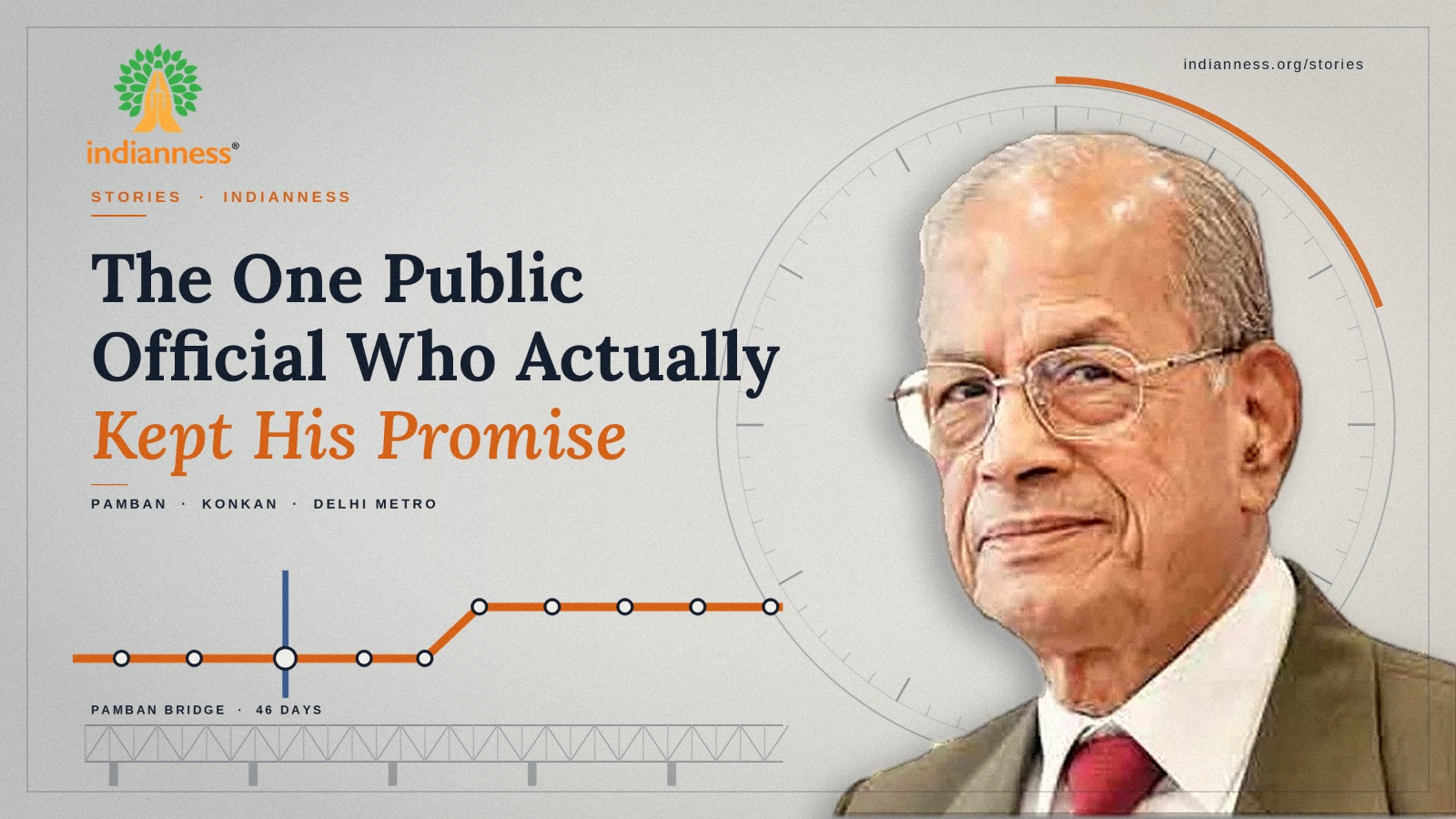
There is a very specific, very universal feeling that comes with waiting for a public project to finish. A bridge that was supposed to open two years ago. A rail line perpetually “six months away.” A city government’s promise that quietly becomes a punchline. Almost everyone, in almost every country, has learned to expect delay from big public infrastructure — to build the disappointment into their expectations before the project even breaks ground. E. Sreedharan built an entire career on refusing to let that cynicism be justified, and in doing so, gave millions of people in Delhi something rarer than a metro system: proof that a public promise could actually be kept.
Sreedharan was already in his late sixties — an age at which most engineers of his generation were long retired, tending gardens and reminiscing about earlier work — when he was appointed in 1995 to lead the construction of the Delhi Metro. The Indian capital, home to well over ten million people, had no metro rail system at all. Its roads were exactly what you’d imagine for a city that size without one: choked, slow, exhausting. Everyone knew a metro was needed. Almost no one, going by past experience with large infrastructure projects in India, expected it to arrive on time, or perhaps even to arrive at all in any recognisable form.
A Career Spent Being the Exception Everyone Assumed Was Impossible
Sreedharan hadn’t stumbled into this reputation by accident. Decades earlier, in 1963, a cyclone tore through the causeway connecting mainland southern India to the island town of Rameswaram, destroying a critical railway bridge. He was given roughly six months to rebuild it — an absurdly tight window for that kind of structural work — and he finished ahead of it. Years later, he took charge of building the Konkan Railway, a line cut through some of the most difficult coastal terrain in the country: steep hillsides, dozens of tunnels, bridges over unstable ground, all in a region prone to landslides and monsoon flooding. It is still considered one of the most technically demanding railway projects ever undertaken in India, and he saw it through.
By the time Delhi came calling, Sreedharan had arrived at something closer to a personal doctrine than a management technique: a deadline given to the public was not a suggestion or a hopeful estimate to be adjusted later without consequence. It was a promise, and promises made to millions of ordinary people who had no power to hold a government accountable in any other way deserved to be treated with the same seriousness as a contract with a paying client.
What Actually Changed the Moment He Walked In
It’s tempting to imagine that what Sreedharan brought to the Delhi Metro was some singular engineering trick, but the truth is less glamorous and, in its way, more instructive: he changed how the organisation behaved. He insisted that timelines be set realistically before construction started, rather than optimistically to please political sponsors eager for a groundbreaking ceremony. He pushed decision-making authority down to the engineers actually standing at construction sites, rather than routing every choice through layers of bureaucratic sign-off that could turn a two-day fix into a two-month delay. He became known — famously, almost mythically among people who worked under him — for showing up at construction sites unannounced, at odd hours, to check on quality with his own eyes rather than trusting a report written for him.
None of this sounds dramatic on paper. In practice, it was the difference between a project that crawled and one that moved. The first phase of the Delhi Metro was completed in 2006 — three full years ahead of its original schedule. Later phases mostly held to similarly tight, honestly-set timelines. Anyone who has lived through the drawn-out completion of a public transit project anywhere in the world can feel the weight of that sentence. Three years early is not a rounding error. It is thousands of extra days of a city moving more freely than it otherwise would have.
What Getting Three Years of Your Life Back Actually Feels Like
It’s easy to talk about a metro system in terms of ridership statistics and kilometres of track. It’s worth pausing on what it actually changes in someone’s day. A commute that used to eat two, sometimes three hours of a working parent’s time in traffic-choked buses becomes something that can be measured in minutes. A student living on the outskirts of the city gains real, physical access to universities and job opportunities that used to be functionally out of reach because of how long and unreliable the journey there was. An elderly person who once avoided crossing the city entirely because the trip was too exhausting gets some of that mobility back.
The Delhi Metro reshaped how one of the most congested capital cities on the planet actually moves through its own streets, and it became something other Indian cities studied closely and tried to replicate — Bengaluru, Kochi, Hyderabad, and others all built metro systems in the years that followed, several of them explicitly inviting Sreedharan to advise.
They Called Him “Metro Man.” That Undersold Him Completely.
Sreedharan became known across India by a nickname — the “Metro Man” — that, if anything, undersold what he actually represented. He wasn’t just someone who could build a metro. He was living proof that a government-run project could be executed with the discipline of the best private-sector operations while still remaining publicly accountable, a combination many people assume is a contradiction in terms. He was outspoken, often bluntly so, about the problems that plague large infrastructure projects everywhere — poor initial planning that guarantees later cost overruns, corruption that quietly inflates contracts, and the political incentive to announce ambitious projects before anyone has properly scoped what they will actually take to build.
He also spent much of his later public life campaigning for stronger safety standards across India’s vast conventional railway network — a system that carries more passengers on an average day than almost any other in the world, and where a single lapse in maintenance or signalling can cost dozens or hundreds of lives. It was, in a sense, the same argument he’d made about metro deadlines, applied to something with even higher stakes: that the people relying on public infrastructure deserved better than what “normal” had come to mean.
Still Showing Up, Still Checking Sites, Well Into His Eighties
What makes Sreedharan’s story resonate well beyond India is not really the metro itself — many cities have built metro systems, some of them faster or more expensive than Delhi’s. It’s the sheer duration and consistency of what he came to represent. He was still being consulted on metro and rail projects into his late eighties, called in specifically because commissioning authorities wanted the discipline associated with his name, not because anyone doubted a younger engineer could do the technical work.
In a world where “infrastructure” and “delay” have become almost synonymous in ordinary conversation — where announcing a project and finishing it on time can feel like two entirely separate events — Sreedharan’s career stands as a quiet, stubborn rebuttal. Project after project, he made the same argument without ever quite saying it out loud: the problem was never really the concrete or the steel. It was almost always whether anyone in charge actually meant what they promised.
Sources: Delhi Metro Rail Corporation institutional history; Konkan Railway Corporation records; contemporary reporting on the Delhi Metro’s phased completion timelines.