
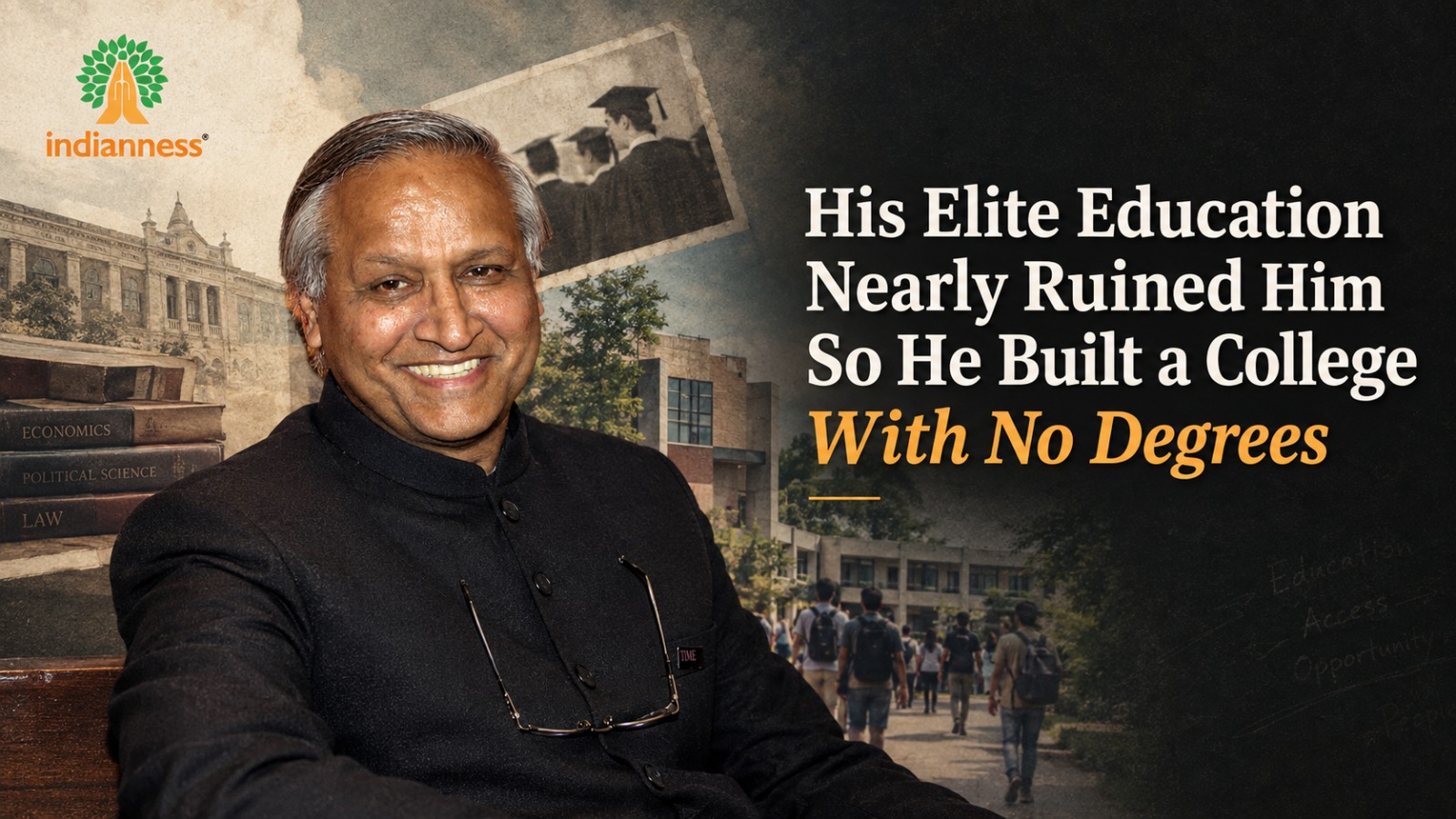
Sanjit “Bunker” Roy had precisely the kind of elite education that, in almost any country, points a young person toward a comfortable, prestigious professional career: he studied at some of India’s most exclusive schools and graduated from St. Stephen’s College in Delhi University, one of the country’s most selective and reputationally powerful institutions. He has since described that elite educational path, with a directness that’s genuinely rare among people who benefited so thoroughly from it, as something that very nearly ruined him — because it trained him, thoroughly and effectively, to see formal academic credentials as the only legitimate measure of a person’s competence and worth, a framework that, once he actually began working in rural India, he found didn’t remotely hold up against what he was seeing on the ground with his own eyes.
Roy’s formative turn toward rural development work reportedly began after he spent time in rural Bihar in the aftermath of a devastating famine, witnessing directly the skill, resourcefulness, and practical knowledge that rural, largely illiterate villagers already possessed and consistently drew on to survive and solve real, immediate problems — knowledge and capability that his own elite, credential-focused urban education had never once acknowledged as valuable, or even as a legitimate form of knowledge at all. That direct experience shaped the founding philosophy of what he would go on to build: an institution premised on the radical idea that the rural poor already held enormous, systematically underestimated reserves of practical skill and intelligence, and that what they most fundamentally lacked wasn’t ability, but institutional opportunity and basic access to relevant technical training.
A College That Refuses to Give Out a Single Degree
In 1972, Roy founded what became known as Barefoot College in the village of Tilonia, in the Indian state of Rajasthan — an institution built on a genuinely unconventional and, even now, still somewhat radical educational premise: formal literacy and paper credentials are treated as secondary to practical, hands-on skill, and the institution deliberately, consistently refuses to grant any formal academic degrees at all, no matter how advanced or valuable the actual skills a student ultimately masters there. Trainers at Barefoot College are, by explicit design, drawn overwhelmingly from the same rural, often semi-literate or fully illiterate communities the college serves, rather than being credentialed outside experts imported specifically to instruct local populations — a structural choice reflecting Roy’s core underlying conviction that people from these communities are entirely capable of teaching each other effectively, once they’re given real institutional support, resources, and structured opportunity to do so.
The college’s physical campus itself, an 80,000-square-foot facility built in 1982 using labour and traditional building knowledge contributed by roughly a hundred thousand local villagers, runs entirely on solar power and was constructed using traditional, locally sourced building materials and construction knowledge passed down informally across generations — a building that is, in a very direct and literal sense, a physical embodiment of the institution’s underlying educational philosophy: real capability doesn’t require imported expertise, imported materials, or imported institutional models to actually accomplish something genuinely significant.
Turning Illiterate Grandmothers Into Working Solar Engineers
Barefoot College’s most widely known and, in a very real sense, most quietly radical programme trains women — many of them illiterate grandmothers, recruited specifically from remote, often desperately poor villages without any reliable access to electricity, sometimes travelling from other countries entirely — to become fully functioning solar engineers, capable of installing, maintaining, and repairing solar lighting and power systems in their own home villages. Roy has spoken directly and repeatedly about why the programme specifically and deliberately targets older women rather than younger men, who might, on paper, seem like the more conventional choice for this kind of technical training: younger men trained in a marketable technical skill, he has observed, are considerably more likely to leave their home village altogether in search of higher-paying urban employment once they’ve acquired the new skill, whereas older women, more deeply and durably rooted in their own communities by family and social ties, are far more likely to stay and actually put the training to sustained, long-term use exactly where it’s needed most.
The pedagogical method itself is genuinely remarkable, precisely because it deliberately works entirely without relying on shared spoken language or formal literacy at all. Women trainees from dramatically different countries and completely different native languages — participants have come from across Africa, from the Himalayan region, and from numerous other parts of the developing world — learn to identify individual electronic components by their specific shape, colour, and physical function, to follow carefully mimed, purely visual instruction, and to execute genuinely complex, technically precise electrical and mechanical tasks entirely by direct visual example and hands-on repeated practice, without a single word of shared language passing between teacher and student at any point in the training process.
Insisting Communities Must Own What Gets Built for Them
A central and non-negotiable feature of the Barefoot College model is that trained women are expected to return to their own home villages and install and maintain solar systems specifically for their own communities, who are then required to collectively determine and directly pay a modest, locally agreed monthly maintenance fee — typically calculated to be roughly comparable to whatever amount households were already spending on kerosene for lighting before the switch to solar power. This deliberate design choice matters enormously and reflects a genuinely important, hard-won lesson from decades of well-intentioned but ultimately unsustainable rural development projects worldwide: infrastructure that is simply given to a community for free, with no local financial stake, local sense of ownership, or built-in local capacity for ongoing maintenance and repair, all too frequently falls into disrepair and permanent disuse within a few years once the original outside funding or outside institutional attention inevitably moves on to some other project or priority. Barefoot College’s model insists, by explicit design, that communities themselves must genuinely own, financially sustain, and locally maintain whatever gets installed — precisely because that ongoing ownership is what actually makes the resulting benefit durable over the long term, rather than a temporary improvement that quietly disappears the moment outside attention shifts elsewhere.
Exported to Ninety Countries, Without Ever Losing Its Village Roots
Over more than five decades of continuous operation, Barefoot College has trained several thousand women as solar engineers from dozens of countries across the developing world, and has expanded its core training model well beyond solar power alone to include teacher training, midwifery, water infrastructure development, and numerous other practical rural skills — all still grounded, consistently, in the same original founding principle: that genuine capability is already present in rural communities everywhere, and that institutions exist, or at least genuinely should exist, primarily to help unlock and structure that existing, often deeply underestimated capability, rather than to import supposedly superior external expertise and simply impose it wholesale from outside.
Roy received India’s Padma Shri award in recognition of this sustained body of work, and Barefoot College’s specific training model has since been studied and directly replicated by development organisations working across more than ninety countries — a level of genuinely global influence that traces back, in the end, to one relatively small, deliberately unglamorous rural training centre in Rajasthan, built specifically around the idea that a person’s actual ability to genuinely learn and to meaningfully contribute has never really had very much to do with whether they happen to hold a formal paper certificate proving it.
Sources: Barefoot College institutional history and public accounts of its training programmes; contemporaneous interviews with Bunker Roy on the founding philosophy and impact of Barefoot College; World Intellectual Property Organization profile of the Barefoot College solar engineer training model.