
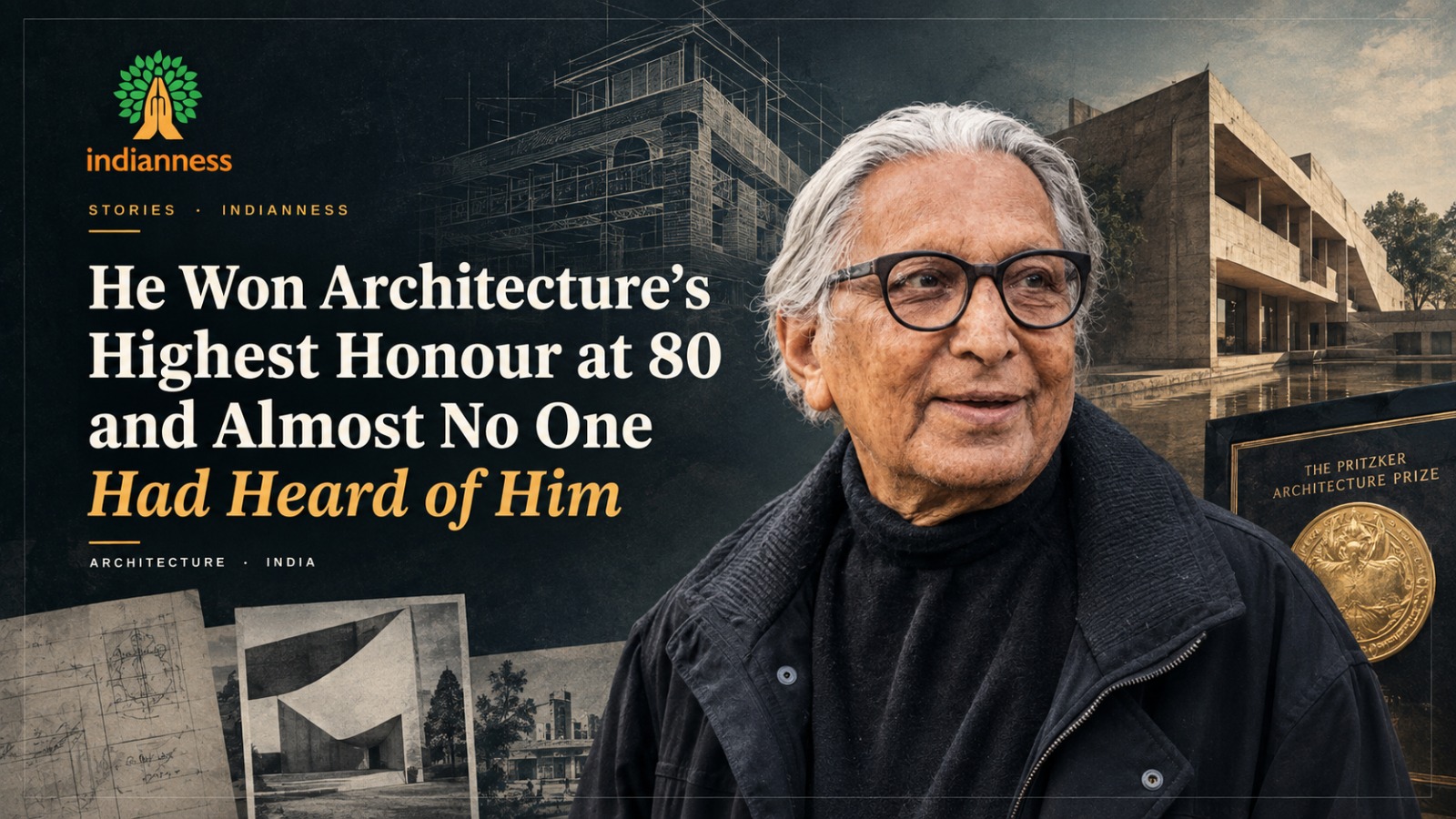
In 2018, Balkrishna Doshi became the first Indian architect ever to win the Pritzker Architecture Prize — widely regarded as the highest honour in the entire field of architecture, roughly equivalent in prestige to a Nobel Prize for the profession. He was, by that point, eighty years old, and had been quietly designing some of the most thoughtful, human-centred buildings in modern India for well over six decades. That such a significant, sustained body of work could remain largely unknown outside architectural specialist circles until his early eighties says something genuinely revealing — not about the quality of Doshi’s work, which was never in question among people who actually studied it, but about how differently the architecture world often distributes recognition compared to how it distributes genuine influence and impact.
Doshi’s formative professional experience came through an apprenticeship that most architects can only imagine: he worked directly under Le Corbusier, the towering, internationally influential Swiss-French modernist architect, on Le Corbusier’s major projects in India during the 1950s, including the design of Chandigarh, the ambitious planned capital city built for the newly divided Indian state of Punjab after independence. That apprenticeship placed Doshi at the very centre of one of the most significant architectural undertakings of the entire twentieth century, learning directly from one of the field’s most towering and influential figures.
He Took the Lessons and Quietly Threw Out What Didn’t Fit
What makes Doshi’s subsequent career genuinely notable, rather than simply a footnote to a more famous mentor’s legacy, is what he chose to do with that formative experience. Le Corbusier’s architectural style, however brilliant and influential internationally, had been developed substantially around European climate, materials, and cultural assumptions, then transplanted into an Indian context in Chandigarh with only partial adaptation to genuinely different conditions. Doshi absorbed the underlying rigour and discipline of his mentor’s approach to architectural form and space, but consciously, deliberately moved away from directly imitating the specific stylistic vocabulary Le Corbusier had brought from Europe — instead developing his own architectural language, one grounded far more specifically and sensitively in Indian climate, Indian materials, and Indian cultural and social patterns.
This is a genuinely difficult thing for a young architect to do: to have trained under one of the most influential figures in the entire history of the discipline, and to then have the independence of judgment and the confidence to consciously depart from that figure’s stylistic approach rather than simply becoming a skilled imitator, however talented, of a more famous teacher’s established vocabulary. Doshi managed it, and the resulting body of work reflects a genuinely distinctive architectural voice rather than a derivative one.
Buildings Designed to Feel Like an Extension of Daily Life
Doshi’s most celebrated projects consistently reflect an underlying, deeply held conviction that buildings — especially institutional buildings like schools, universities, and cultural centres — should feel like natural extensions of everyday Indian life and social patterns, rather than imposing an unfamiliar, foreign spatial language onto the people who actually have to use them daily. His design for the Indian Institute of Management in Bangalore, one of his most acclaimed works, incorporates courtyards, covered walkways, and carefully calibrated transitions between indoor and outdoor space that deliberately echo the layout and social rhythm of a traditional Indian town, rather than following the more enclosed, singular-building logic that a conventional Western university campus design would typically produce.
He also designed Aranya Low Cost Housing in Indore, a large-scale affordable housing project explicitly built around the principle that low-income housing could and should incorporate genuine architectural thoughtfulness, flexibility, and even a degree of beauty — rather than being reduced to the purely utilitarian, visually anonymous housing blocks that most large-scale low-income housing projects, in India and internationally, have historically defaulted to. The Aranya project deliberately allowed for incremental growth and modification by the residents themselves over time, treating the initial design as a flexible framework that families could adapt and expand as their own needs and resources changed, rather than a fixed, unchangeable final product imposed uniformly on everyone regardless of their circumstances.
A School Built to Keep Passing This Way of Seeing Forward
Beyond his individual building projects, Doshi founded his own architectural practice, Vastushilpa, and played a foundational role in establishing the School of Architecture in Ahmedabad, later renamed CEPT University, which became one of India’s most influential architectural education institutions. Through this teaching role, sustained across decades, Doshi’s specific approach to climate-responsive, culturally grounded architectural design was passed on directly to generations of Indian architects who studied under him — meaning his influence on Indian architecture runs considerably deeper and wider than his relatively small number of internationally famous individual buildings alone would suggest. A great many practising Indian architects working today were trained, at least in part, by someone who was themselves directly trained by Doshi, or trained within an institution he had personally helped shape.
What It Costs to Choose Substance Over Self-Promotion
Doshi’s relatively late international recognition — arriving only in his eighties, after more than six decades of consistently serious architectural work — reflects a genuine and recognisable pattern in how the international architecture world has often historically distributed recognition, disproportionately favouring architects working in major Western media and design markets, or those who actively cultivated a distinctive, easily marketable personal visual brand across their portfolio of projects. Doshi’s work, by contrast, was quieter, more varied in visual style from project to project because it responded so specifically and carefully to each particular site and programme, and produced substantially outside the major Western architectural media and publication ecosystem that most heavily shapes international professional reputation.
His belated Pritzker Prize recognition in 2018 prompted a genuine and overdue wave of renewed international attention to his full body of work — attention that, by his own account in interviews given around the time of the award, he received with characteristic humility, treating the recognition as belonging as much to the six decades of Indian students, colleagues, and communities he had worked alongside as to himself individually.
A Body of Work That Never Needed a Prize to Matter
Doshi’s story is, in the end, a genuinely useful and clarifying reminder that architectural significance and international architectural fame don’t always arrive on the same timeline, and sometimes don’t arrive together at all. He had already spent decades shaping how several generations of Indian architects thought about designing for their own climate and their own culture, long before an international jury formally recognised that contribution with the field’s most prestigious prize. The work itself — the buildings, the students, the institutions he helped establish — had already been doing exactly that important work for a very long time, whether or not the wider world outside architectural specialist circles happened to be paying attention yet.
Sources: Pritzker Architecture Prize citation for Balkrishna Doshi (2018); CEPT University institutional history; contemporaneous profiles of Doshi’s apprenticeship under Le Corbusier and his major built works.