
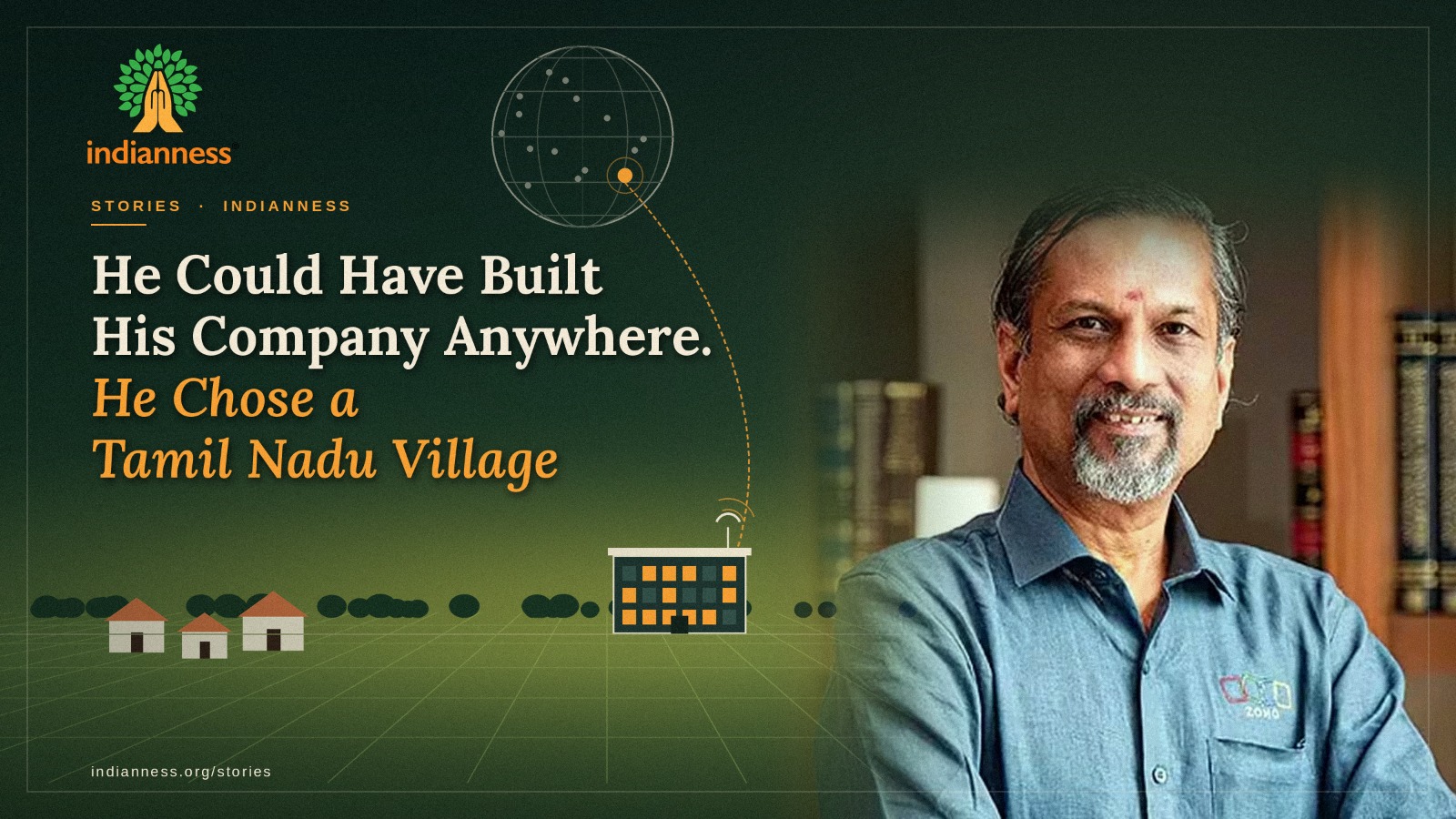
Every piece of conventional business wisdom said Sridhar Vembu should have kept his company’s operations in a major city, close to the talent, the investors, and the infrastructure that technology companies are supposed to need to compete globally. He built one of India’s most successful software companies instead by deliberately moving a substantial part of its operations to Tenkasi, a small town in rural Tamil Nadu, and hiring a meaningful share of his workforce from local students who had never been near a computer science degree, let alone a global technology company. It’s the kind of decision that sounds, on paper, like a marketing gesture. It wasn’t. It was a genuine, load-bearing bet about where talent actually comes from — and about what a technology company owes the places that make its success possible.
Vembu himself had every credential that would normally point toward a very different life. Born into a modest family in Tamil Nadu, he studied electrical engineering at the Indian Institute of Technology Madras, one of India’s most prestigious and selective institutions, before earning a PhD at Princeton University in the United States. That’s about as conventional an elite technical pedigree as exists anywhere in the world. He went on to work in Silicon Valley before co-founding what would eventually become Zoho, a company that builds a wide range of business software — customer relationship management tools, email, spreadsheets, accounting software, and dozens of other products used by millions of businesses worldwide.
Refusing to Build the Company Everyone Expected Him To
Zoho’s early growth followed a path that would have been entirely familiar to anyone who has watched the technology industry over the past few decades — a startup building useful software, competing against giants, looking for the capital and prestige that came with venture funding and a headquarters in a major tech hub. Vembu deliberately walked away from that playbook. Zoho famously never took venture capital funding, choosing instead to grow the company on its own revenue, a decision that gave it something venture-backed competitors often lack: the freedom to make long-term decisions without outside investors pushing for the kind of rapid, often unsustainable growth that venture funding typically demands.
That independence is precisely what allowed Vembu to make his most unconventional decision: moving substantial parts of Zoho’s operations away from major cities and into rural Tamil Nadu, specifically to Tenkasi and nearby towns. This wasn’t a symbolic gesture or a small corporate social responsibility programme run alongside the “real” business. Vembu built out genuine offices and development operations in these areas, and — perhaps more radically — created Zoho University, an in-house training programme that recruits promising students directly out of local schools, often without requiring a traditional college degree at all, and trains them to become working software engineers and developers within the company itself.
His Bet: Talent Is Everywhere. Opportunity Almost Never Is.
The underlying argument behind this decision is worth taking seriously on its own terms: Vembu has argued, consistently and often quite pointedly in public interviews, that raw technical talent and intelligence are distributed roughly evenly across a population, regardless of geography, family wealth, or access to elite educational credentials — but that opportunity to develop and use that talent is distributed extremely unevenly, concentrated overwhelmingly in major cities and among families who can afford expensive private education and university degrees. A brilliant student born in a rural town with no strong local school system and no family connections to the technology industry, in this framing, isn’t actually less capable than an equally brilliant student born in Bangalore or Bombay to a well-off, well-connected family. They’ve simply never been given anything close to the same chance to prove it.
Zoho University exists specifically to test that hypothesis in practice, not just assert it as a talking point, and by most independent accounts it has worked: students recruited directly out of rural schools in and around Tenkasi have gone on to become genuinely skilled software engineers, building real products used by millions of Zoho customers around the world, without ever having taken the traditional, expensive, credential-heavy educational path that the global technology industry generally treats as a prerequisite for that kind of work.
He Could Finally Afford to Leave. He Stayed Anyway.
There is something worth noticing in what Vembu chose not to do once Zoho became genuinely large and financially successful. Most founders, having built a company capable of competing with much bigger and better-funded rivals, would have moved everything to a major metropolitan hub the moment it became financially convenient to do so — following the talent, the investors, the industry conferences, and the general gravitational pull that draws successful technology companies toward a handful of major global cities. Vembu instead doubled down on rural Tamil Nadu, continuing to invest in expanding operations and training programmes there even as the company grew large enough that a move to a major city would have been the far more conventional, unremarkable choice.
This reflects something close to a genuine philosophical position about what a company’s growth should actually be for, beyond generating profit for its founders and investors. If a technology company’s success can, deliberately and by design, mean that a student from a small town who would otherwise have had essentially no access to a career in software engineering gets to build one anyway, without needing to leave home, take on debt for an expensive degree, or navigate an unfamiliar city with no support network — that’s a form of impact that a purely profit-maximising, city-centric growth strategy would never have produced, and that most successful technology companies never even attempt to pursue.
A Different Answer to a Question Every Growing Company Asks
Every company that grows large enough eventually has to decide, implicitly or explicitly, where its success actually belongs — whether it flows mainly toward founders, investors, and a small pool of already-privileged employees in major cities, or whether some meaningful share of it can be deliberately redirected toward people and places that would otherwise never have had a realistic path into that kind of opportunity at all. Vembu’s answer, built directly into where Zoho chose to locate its people and how it chose to train them, offers a genuinely different model — one being watched closely by founders and policymakers in other countries grappling with the same basic and increasingly urgent question: does economic opportunity in a technology-driven economy have to keep concentrating in the same handful of already-wealthy cities, or can it be deliberately built to reach further than that, if a company with real resources and real conviction actually decides to try?
Sources: Zoho Corporation institutional accounts and public statements; contemporaneous interviews with Sridhar Vembu on Zoho’s rural operations and hiring model; reporting on Zoho University’s training programme in Tenkasi, Tamil Nadu.