
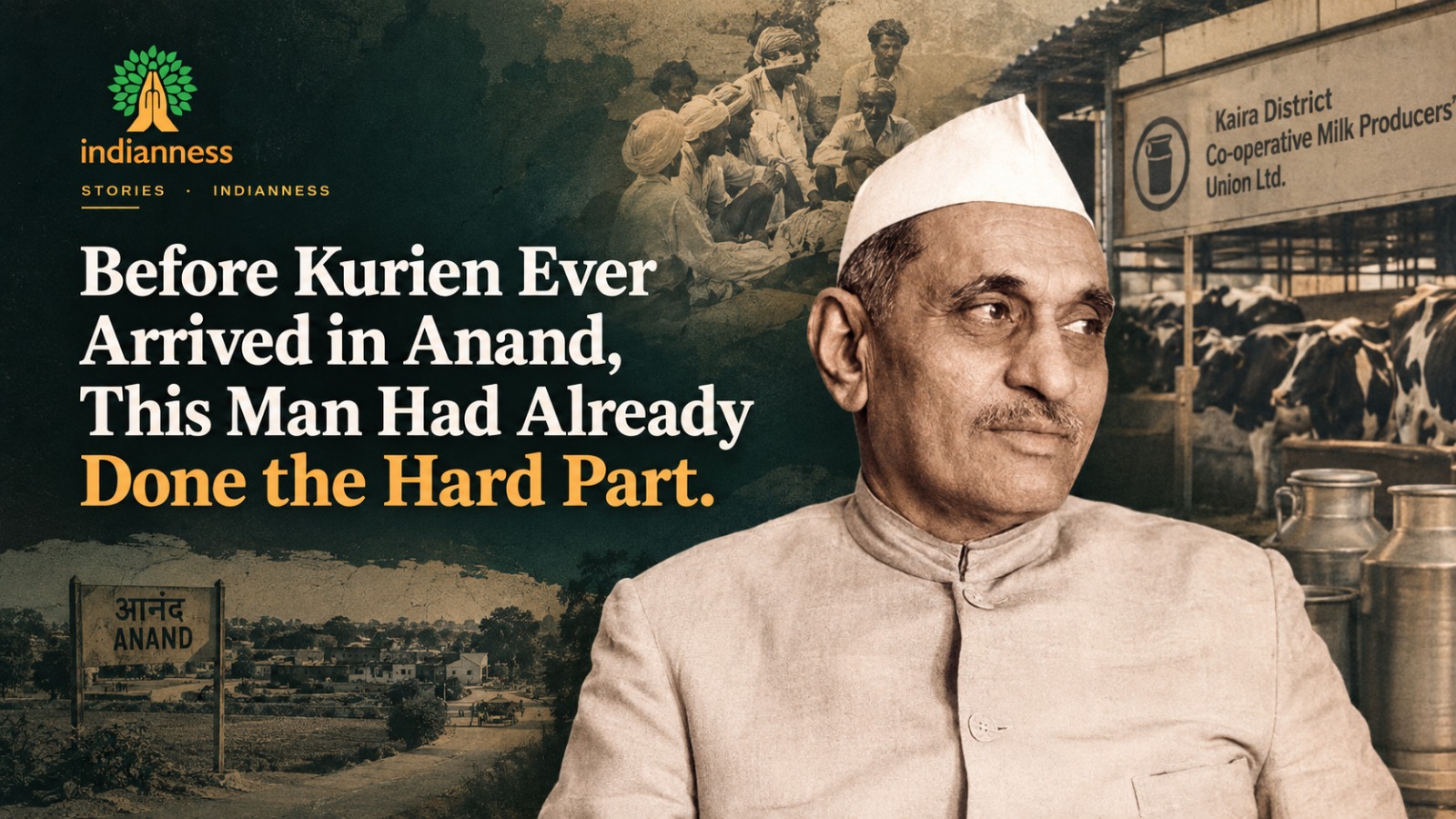
Every well-known success story eventually gets simplified down to a single name, and the story of Amul, India’s iconic dairy cooperative, has largely been simplified down to Verghese Kurien — the engineer whose technical breakthroughs and decades of institution-building genuinely earned him a central place in that history. But Amul did not begin with Kurien at all. It began three years before he ever arrived in Anand, with a farmer-organiser named Tribhuvandas Patel, who had already spent months going door to door, farmer to farmer, arguing that ordinary dairy producers could actually build and own something powerful enough to defeat a monopoly that had controlled their livelihoods for years. Without Patel’s groundwork, there would have been no cooperative for Kurien to eventually join, let alone lead.
Patel was born in 1903 in Anand, Gujarat, into a farming family, and became a follower of Mahatma Gandhi and Sardar Vallabhbhai Patel during India’s independence movement, participating in civil disobedience campaigns that led to his repeated imprisonment — jailed in 1930, 1935, and again in 1942, for participating in exactly the kind of nonviolent, organised resistance to unjust authority that would later define his approach to the dairy monopoly he took on. This detail matters more than it might first appear: Patel’s later organising work with dairy farmers wasn’t a departure from his earlier political activism. It was a direct continuation of it, applying the same organisational instincts and the same underlying conviction — that ordinary people, organised collectively, could successfully resist an unjust concentration of power — from the political sphere into the economic one.
Going Door to Door to Convince Farmers They Had Power They Didn’t Know They Had
By the late 1940s, dairy farmers around Anand faced a specific and deeply entrenched injustice. Polson, a private dairy company, held an effective monopoly on collecting and processing milk from the region for sale in Bombay, and used that monopoly position to dictate prices to farmers who had no alternative buyer to turn to. Farmers had no negotiating power whatsoever — they took whatever price Polson’s agents offered, on whatever schedule Polson’s agents decided to show up, because refusing simply meant their milk, a perishable product that couldn’t be stored or held back to wait for a better offer, would go to waste entirely.
Patel’s response, under the guidance of Sardar Vallabhbhai Patel and with encouragement from Morarji Desai, was to organise these farmers into a cooperative — the Kaira District Cooperative Milk Producers’ Union, formally established on 14 December 1946. This required something that’s easy to understate in hindsight but was genuinely difficult in practice: convincing individual farmers, many of them barely scraping by and understandably risk-averse about anything that might disrupt what little income and stability they already had, that collective organisation and open defiance of an established monopoly was actually worth the very real risk involved. According to accounts of his organising work, Patel went from village to village personally, convincing even the most hesitant and sceptical farmers that their milk held genuine value beyond what Polson’s agents were willing to pay them for it — patient, unglamorous, door-to-door persuasion, repeated across dozens of villages, that had to happen before any cooperative structure could exist at all.
It Started With Two Villages and 247 Litres of Milk
The cooperative Patel founded began modestly, almost precariously so: just two village dairy societies and a total of 247 litres of milk on its first day of operation — a genuinely tiny foundation for something that would eventually grow into one of the largest dairy cooperative networks in the world. Patel served as the union’s chairman, and it was in this role, in 1949, that he made the decision that would eventually transform the cooperative’s trajectory: he hired a young, reluctant engineer named Verghese Kurien, initially simply to help maintain and repair machinery at the cooperative’s processing plant.
What Patel actually provided Kurien, beyond the job itself, was something more foundational than a technical problem to solve. He provided an already-organised, already-committed base of farmer-members who had already taken the considerable risk of defying an entrenched monopoly, already understood the cooperative principle they were participating in, and were already prepared to support the kind of technical and institutional expansion that Kurien would go on to lead over the following decades. Kurien’s engineering breakthroughs and his eventual leadership of India’s national dairy development efforts genuinely mattered and deserve full recognition — but they were built directly on top of an organisational and political foundation that Patel had already spent years constructing, at real personal risk, before Kurien ever set foot in Anand.
A Partnership That History Chose to Remember Unevenly
Patel and Kurien worked together for decades, and by most contemporary accounts of their collaboration, their relationship combined real mutual respect with the kind of underlying tension that often exists between an organisation’s founding political leader and the professional manager who later builds out its technical and administrative capacity. Patel remained chairman of the union, providing what one Ramon Magsaysay Award citation describes as its essential organising genius, while Kurien, as general manager, provided the technical direction and administrative expertise that allowed the cooperative to actually function and scale at the level Patel’s original organising had made possible.
Patel went on to help establish several other major institutions that grew out of the Anand cooperative model, including the Gujarat Cooperative Milk Marketing Federation and the Institute of Rural Management Anand, continuing to apply the same underlying cooperative philosophy to new institutional forms well beyond the original dairy union. He is now formally recognised in India as the “father of the cooperative movement” — a title that has gained renewed public attention in recent years, including through the establishment of a university named in his honour in Anand, precisely because his specific contribution had, for decades, been substantially overshadowed by Kurien’s later and more internationally visible fame.
Why Founders Sometimes Disappear Inside What They Built
Patel’s relative obscurity, compared to Kurien’s global recognition, is a genuinely familiar pattern in the history of successful institutions: the person who does the difficult, unglamorous, high-risk work of organising and founding something new is often eventually overshadowed by whoever later scales it into something larger, more visible, and more easily credited with the institution’s eventual success. Patel took the considerable personal and financial risk of standing up to an entrenched monopoly, with no guarantee whatsoever that the cooperative he was building would actually survive its first difficult years, let alone grow into anything resembling what Amul eventually became. Kurien built something remarkable on the foundation Patel had already laid. But it was Patel’s foundation — his door-to-door persuasion, his willingness to organise and confront concentrated economic power directly, and his patient work turning individually powerless farmers into a genuinely powerful collective — without which there would have been no cooperative for Kurien to ever transform in the first place.
Sources: Ramon Magsaysay Award Foundation citation for Tribhuvandas Patel; Amul institutional history; contemporaneous and retrospective accounts of the founding of the Kaira District Cooperative Milk Producers’ Union.