
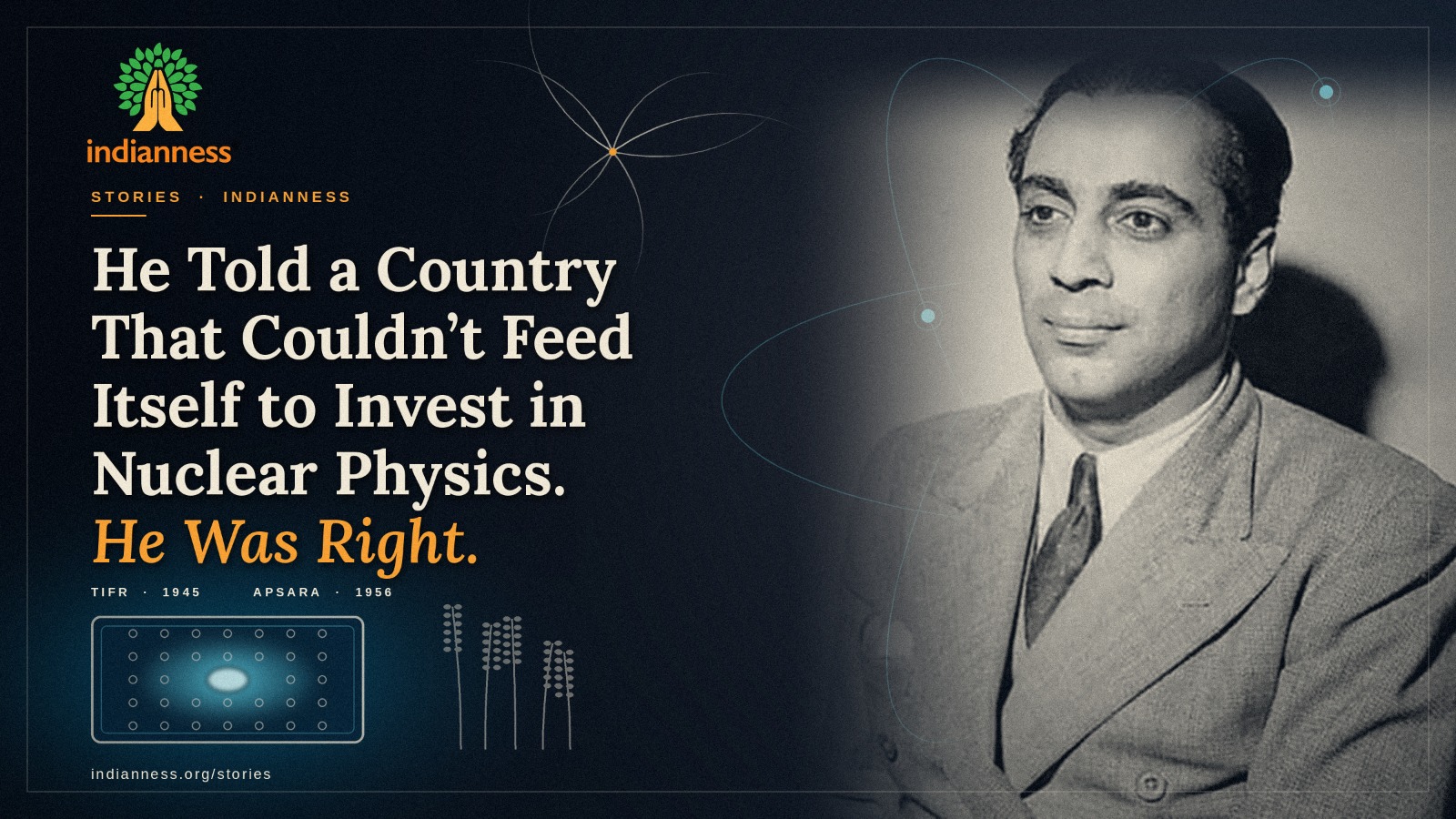
Try, for a moment, to imagine the argument Homi Bhabha actually had to win. It’s the late 1940s. India has just become independent after nearly two centuries of colonial rule. The country has almost no industrial base to speak of, chronic and often severe food shortages, a population overwhelmingly engaged in subsistence agriculture, and a government trying to figure out how to simply feed and clothe its people in the near term. And into this picture walks a physicist proposing that the country should invest, immediately and seriously, in nuclear science — one of the most capital-intensive, resource-hungry, specialist fields of research in the world, pursued at the time almost exclusively by a handful of wealthy industrial powers. It must have sounded, to many people in that room, close to absurd.
Bhabha won that argument. And the fact that India today runs its own civilian nuclear power programme largely on domestically developed technology, rather than remaining permanently dependent on other countries for it, traces directly back to his ability to make that case — and to be believed.
A Man Who Could Have Simply Stayed Away — and Didn’t
Homi Jehangir Bhabha came from a wealthy, cosmopolitan Parsi family in Mumbai, and trained as a physicist at Cambridge University during a genuinely extraordinary period in the field — working, at various points, alongside people who would go on to define twentieth-century physics. He had, by any reasonable measure, a comfortable and prestigious research career available to him in Europe, in institutions with funding, equipment, and colleagues that India, at the time, simply could not offer. He came back anyway.
This detail matters more than it might first appear. Bhabha wasn’t someone stranded in India by circumstance, forced to make the best of limited options. He was choosing, deliberately, to redirect a career that could have gone anywhere toward building something in a country that had almost nothing yet to build it with. And then, having made that choice, he spent his scientific capital not primarily on his own research output — the kind of thing that wins personal acclaim — but on founding institutions from nothing, the far less glamorous and far more thankless work of laying foundations other people would eventually stand on.
Convincing a Government That Couldn’t Feed Its People to Fund Physics
In 1945, two years before India’s independence, Bhabha founded the Tata Institute of Fundamental Research in Mumbai, funded initially with support from the Tata family’s industrial trusts. Committing to fundamental physics and nuclear science in a country with barely any industrial base, chronic shortages of trained scientists, and — after 1947 — an economy focused overwhelmingly on the basic tasks of survival, was a genuinely audacious bet.
Bhabha’s argument, made directly to India’s first Prime Minister Jawaharlal Nehru, refused to treat scientific ambition and poverty as mutually exclusive. Nuclear science, he insisted, shouldn’t be a luxury reserved for wealthy nations to pursue only after they’d solved every other problem first. He believed atomic energy represented a genuine, long-term path to energy security for a country with limited domestic fossil fuel reserves — and, more pointedly, that if India didn’t start building the scientific and engineering foundation early, it would end up permanently dependent on other countries for a technology that was rapidly becoming central to global power and prestige. Waiting, in his framing, wasn’t a neutral choice. It was a decision to remain dependent, indefinitely, on someone else’s terms.
Nehru was persuaded — which is itself worth pausing on, given everything else competing for the new government’s attention in those years. In 1948, Bhabha was appointed to lead India’s newly formed Atomic Energy Commission, and in 1954 he became the founding director of what would become the Bhabha Atomic Research Centre near Mumbai — an institution that remains, decades later, the central hub of India’s nuclear research programme.
Refusing to Just Borrow Someone Else’s Technology
What distinguished Bhabha’s approach from the far easier path of just importing foreign nuclear technology was his insistence that India build its own technical capability at every stage of the process — reactor design, fuel processing, and eventually the full nuclear fuel cycle — rather than remaining permanently dependent on technology transfers from more advanced nuclear powers. This is a slower, harder, more expensive road in the short term. It’s also the only road that leads somewhere other than permanent dependence.
He proposed a long-term, three-stage plan for India’s nuclear power programme, deliberately designed around the country’s own specific mineral resources — built around thorium, which India possesses in unusually large natural reserves, rather than uranium, which it largely does not. It’s a plan built for the country India actually was, rather than the country a more conventional nuclear strategy might have assumed. Remarkably, that three-stage framework, refined and adjusted over the decades since, still broadly shapes how India’s civilian nuclear power sector is structured today — a single scientist’s strategic thinking outliving him by well over half a century and continuing to guide national policy long after almost everyone who remembers him personally has also passed on.
He Wasn’t Just Building Labs. He Was Building People.
Bhabha’s influence reached well beyond nuclear physics specifically. He was instrumental in shaping India’s broader scientific research infrastructure in the years after independence, and is widely credited as one of the key figures who convinced a young, cash-strapped government that basic scientific research deserved serious state investment even while urgent poverty demanded attention everywhere else. Perhaps his quietest but most consequential legacy is the generation of Indian scientists and engineers he personally mentored and recruited — people who went on to lead major national research institutions themselves, effectively building the human pipeline that later Indian scientific and technological achievements, including the country’s space programme, would draw on for decades.
He died suddenly in a plane crash in 1966, at the age of 56, while still actively leading the institutions he had founded. It’s a stark, unfinished kind of ending — a life’s work interrupted mid-sentence, with so much of what he had set in motion still years, even decades, from being realised. He never saw India detonate its first nuclear device, never saw the full three-stage plan begin to take shape in operating reactors. What he built didn’t stop when he did, though. The institutions kept running. The scientists he’d trained kept training others.
A Bet That’s Still Paying Out, Decades After He Placed It
Bhabha’s central wager — that scientific self-reliance in a strategically critical field was worth the enormous upfront cost, even for a desperately poor country, because dependency compounds over decades in ways that early investment doesn’t — has become a familiar argument in policy debates about technology sovereignty far beyond nuclear energy, echoed today in conversations about semiconductors, satellite launch capability, and critical minerals in countries around the world. Bhabha made that argument, and staked his career on it, in the 1940s, for a country that most of the wider world at the time simply didn’t expect to be capable of running an advanced scientific research programme at all. He turned out to be right — and the fact that it now seems obvious in hindsight is, in its own way, the clearest measure of how correct he actually was.
Sources: Bhabha Atomic Research Centre institutional history; Department of Atomic Energy, Government of India, historical records; Tata Institute of Fundamental Research founding archives.